Loading...
Eric of Pomerania vs Henry II of England
Henry II of England leads by 23.6 pts · 2 figures compared
…
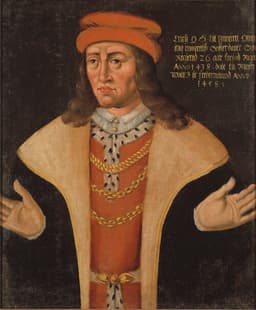
Eric of Pomerania
Emperor · Medieval
43.2Total

Henry II of England
Emperor · Medieval
66.8Total
Basic Information
Born
1381
1133
Died
1459
1189
Era
Medieval
Medieval
Nationality
Denmark
England
Occupation
Emperor
Emperor
Civilization
Western
Western
Score Comparison
Military (10%)
50.0
70.0
Political (20%)
35.1
72.0
Influence (20%)
49.4
72.0
Legacy (20%)
39.2
55.0
Leadership (15%)
48.4
80.0
Strategy (15%)
35.7
52.5
TOTAL
43.2
66.8
Eric of Pomerania — Complete Timeline
1397 AD
Crowned King of the Kalmar UnionPolitical Action◆ Major
Eric of Pomerania was crowned King of Denmark, Norway, and Sweden at the Kalmar Union meeting in 1397, under the regency of Margaret I. His coronation formalized the union of the three Scandinavian kingdoms, though Margaret retained real power until her death.
CoronationKalmar UnionScandinavia
Impact: regionalconstructive
1412 AD
Became sole ruler after Margaret I's deathPolitical Action◆ Major
After Margaret I's death, Eric of Pomerania became the sole ruler of the Kalmar Union. He attempted to centralize power and assert royal authority, but his policies often clashed with the nobility, leading to growing tensions within the union.
SuccessionKalmar UnionRule
Impact: regional
1426 AD
Fought the Dano-Hanseatic WarWar◆ Major
Eric of Pomerania engaged in a war with the Hanseatic League, a powerful trading confederation. The conflict, which lasted until 1435, resulted in Danish defeats and economic disruption, weakening the Kalmar Union's control over Baltic trade.
WarHanseatic LeagueTrade Conflict
Impact: regionaldestructive
1429 AD
Imposed the Sound DuesReform◆ Major
Eric of Pomerania introduced the Sound Dues, a toll on all ships passing through the
TaxTradeBaltic
Impact: regional
1439 AD
Deposed by the Danish and Swedish nobilityPolitical Action◆ Major
Eric of Pomerania was deposed as king of Denmark and Sweden by the nobility, who were dissatisfied with his rule and his handling of the union. He was forced into exile on the island of Gotland, and the Kalmar Union effectively collapsed.
DepositionKalmar UnionExile
Impact: regionaldestructive
Henry II of England — Complete Timeline
1164 AD
Conflict with Thomas BecketPolitical Action◆ Major
Henry II clashed with Thomas Becket, the Archbishop of Canterbury, over the rights of the church versus the crown. The conflict culminated in Becket's murder in Canterbury Cathedral in 1170. Henry was widely blamed for the murder, leading to a crisis of legitimacy.
ConflictBecketChurch and State
Impact: regionaltragic
1166 AD
Establishment of English Common LawReform◆ Major
Henry II issued the Assize of Clarendon, which established a system of royal justice and standardized legal procedures across England. This reform laid the foundation for English common law, replacing local customs with a unified legal system. It strengthened royal authority and reduced the power of feudal courts.
LawCommon LawReform
Impact: globalconstructive
1169 AD
Signing of the Treaty of MontmirailPolitical Action
Henry II signed the Treaty of Montmirail with King Louis VII of France. The treaty temporarily ended hostilities between England and France. It also arranged the marriage of Henry's son Richard to Louis's daughter, but the peace was short-lived.
TreatyFrancePeace
Impact: regionalconstructive
1171 AD
Conquest of IrelandWar◆ Major
Henry II led an expedition to Ireland, asserting English control over the island. He received the submission of many Irish kings and established English rule. This conquest began centuries of English involvement in Ireland, leading to long-term conflict.
ConquestIrelandEnglish Rule
Impact: regional
1173 AD
Revolt of Henry's SonsPolitical Action◆ Major
Henry II's sons, Henry the Young King, Richard, and Geoffrey, rebelled against him with support from King Louis VII of France. The revolt lasted over a year and was eventually suppressed. It highlighted the tensions within the Plantagenet family and weakened Henry's authority.
RevoltFamily ConflictPlantagenet
Impact: regionaldestructive
Expert Analysis
Origins
Eric of Pomerania (c. 1381–1459) was born into the Pomeranian noble family, the son of Duke Wartislaw VII. He was chosen as heir by his great-aunt Margaret I of Denmark, who had united the Scandinavian kingdoms. Eric was raised in the Danish court and educated as a future ruler of the Kalmar Union, a personal union of Denmark, Norway, and Sweden. His early life was shaped by Margaret's regency, which provided stability but limited his independent decision-making.
Henry II of England (1133–1189) was born in Le Mans, France, the son of Geoffrey Plantagenet, Count of Anjou, and Empress Matilda, daughter of Henry I of England. He inherited vast territories in France (Anjou, Normandy, Aquitaine through marriage) and was educated in the chivalric and administrative traditions of the Angevin Empire. His upbringing exposed him to both English and French political cultures, giving him a broader perspective on governance.
Rise to Power
Eric of Pomerania was crowned King of Denmark, Norway, and Sweden in 1397 at the Kalmar Union meeting, but real power remained with Margaret I until her death in 1412. Upon becoming sole ruler, Eric attempted to centralize authority and assert royal control over the union's disparate realms. His rise was thus a gradual transition from regency to independent rule, marked by his introduction of the Sound Dues in 1429, a tax on all ships passing through the Øresund strait, which became a major revenue source but alienated the Hanseatic League.
Henry II's rise was more dramatic. He became Duke of Normandy in 1150 and Count of Anjou in 1151, then married Eleanor of Aquitaine in 1152, gaining control of Aquitaine. In 1153, he invaded England and forced King Stephen to name him heir; he ascended the throne in 1154. His rise was fueled by military force, strategic marriages, and inheritance, establishing the vast Angevin Empire stretching from Scotland to the Pyrenees.
Leadership & Governance
Eric of Pomerania ruled the Kalmar Union with a focus on centralization and fiscal expansion. He imposed the Sound Dues, which provided steady income but sparked conflict with the Hanseatic League, leading to the Dano-Hanseatic War (1426–1435). His governance style was authoritarian; he ignored noble councils and alienated the Swedish and Danish nobility by favoring German advisors. His political score of 35.1 reflects his inability to build consensus. In contrast, Henry II transformed English governance through legal reforms. He issued the Assize of Clarendon (1166), establishing royal justices and standardized procedures, laying the foundation for English common law. He also strengthened the Exchequer and asserted royal authority over the church, though his conflict with Thomas Becket (murdered in 1170) tarnished his rule. Henry's leadership score of 80.0 underscores his effectiveness, while Eric's 48.4 indicates mediocrity.
Triumph & Tragedy
Eric's greatest success was the Sound Dues, which financially sustained the Danish crown for centuries. However, his failure to manage the Kalmar Union led to its fragmentation. He was deposed in Denmark and Sweden in 1439 after noble revolts, and his attempt to centralize power collapsed. His military score of 50.0 reflects indecisive campaigns against the Hanseatic League. Henry II's triumphs include the establishment of common law, the conquest of Ireland (1171–1172), and the expansion of the Angevin Empire. Yet his tragedy was the revolt of his sons (1173–1174, 1183, 1189), fueled by his poor family relations and the murder of Becket, which damaged his reputation. Henry's military score of 70.0 is higher due to his successful campaigns, but his strategy score of 52.5 shows occasional miscalculations.
Character & Destiny
Eric was stubborn and fiscally focused, but lacked diplomatic finesse. His dependence on the Sound Dues and his clash with the Hanseatic League reveal a preference for short-term revenue over long-term alliances. His deposition shows that his character—rigid and unyielding—alienated key supporters. Henry II was energetic, intelligent, and legally minded, but also hot-tempered and manipulative. His conflict with Becket arose from his desire to control the church, and his sons' revolt stemmed from his refusal to share power. Henry's character drove his legal achievements but also his personal tragedies. Historical assessments rank Henry among England's greatest medieval kings, while Eric is seen as a failed unionist.
Legacy
Eric's legacy is the Sound Dues, which remained in place until 1857, and the precedent of Scandinavian unionism, though the Kalmar Union dissolved after his deposition. His influence score of 49.4 is modest. Henry II's legacy is far greater: English common law, the legal framework that influences many nations today. His reforms centralized royal justice and limited feudal power. His influence score of 72.0 reflects this enduring impact. Henry also established the Plantagenet dynasty's dominance, though his sons' revolts foreshadowed future instability.
Conclusion
Henry II of England had a significantly greater impact than Eric of Pomerania. His military (70.0 vs. 50.0), political (72.0 vs. 35.1), and leadership (80.0 vs. 48.4) scores all indicate superior effectiveness. Henry's legal reforms shaped Western jurisprudence, while Eric's union failed and his main legacy was a toll. Henry's total score of 66.8 dwarfs Eric's 43.2. While Eric faced structural challenges in uniting three kingdoms, Henry's achievements in governance and law were more transformative. The data supports Henry II as the more consequential ruler.
Rankings
🥇
Henry II of EnglandLeader
Mil: 70.0Pol: 72.0Inf: 72.0
66.8
🥈
Eric of Pomerania
Mil: 50.0Pol: 35.1Inf: 49.4
43.2
+23.6 behind
How This Comparison Works
Algorithm
Each figure is scored on 6 dimensions (0—100 scale) based on structured historical data: Military (10%), Political (20%), Influence (20%), Legacy (20%), Leadership (15%), Strategy (15%). The weighted total produces the final ranking.
Data Sources
Scores are computed from structured sub-indicators in the database. Scale factors adjust for era (Ancient ×0.85, Modern ×1.0) and civilization size (Eastern ×1.05, Other ×0.80) to account for differences in population and military scale.
Maximum 3 Figures
Comparisons are limited to 2—3 figures to ensure readability and statistical meaningfulness.
Error Margins
±5 points per dimension — Sub-scores are derived from historical records with inherent uncertainty. Two figures within 5 points on a dimension should be considered roughly equivalent in that area.
Total Score Accuracy
±3 points overall — The weighted combination of 6 dimensions produces a total score with approximately ±3 points of uncertainty. Differences of less than 3 points are not statistically significant— the figures are effectively tied.
Known Limitations
- Historical records are incomplete and uneven across civilizations
- Figures from oral-tradition societies may be underrepresented
- Occupation labels can misclassify multi-role figures
- Scores measure capability and impact, not moral character
- Quantitative scoring is a comparison tool, not absolute truth
Capability Radar
Military (10%) — Battles & Warfare
Battles
20
55
Win Rate
25
60
Expansion
15
60
Political (20%) — Governance & Reform
Reform
30
85
Diplomacy
35
70
Economy
25
70
Influence (20%) — Cultural & Global Reach
Cultural
20
65
Global
15
60
Legacy (20%) — Historical Impact
Historical
25
75
Longevity
20
70
Leadership (15%) — Power & Stability
Tenure
40
75
Stability
20
60
Strategy (15%) — Tactics & Innovation
Strategy
20
65
Tactics
15
50
Reform
10
40
Similar Comparisons
Comments & Discussion
No comments yet. Be the first to share your thoughts!