Loading...
Guo Wei vs Henry II of England
Henry II of England leads by 9.3 pts · 2 figures compared
…
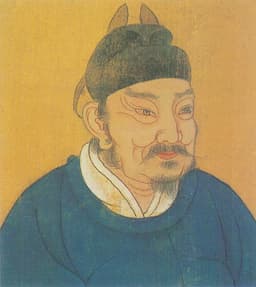
Guo Wei
Emperor · Medieval
57.5Total

Henry II of England
Emperor · Medieval
66.8Total
Basic Information
Born
904
1133
Died
954
1189
Era
Medieval
Medieval
Nationality
China
England
Occupation
Emperor
Emperor
Civilization
Eastern
Western
Score Comparison
Military (10%)
65.0
70.0
Political (20%)
65.0
72.0
Influence (20%)
56.4
72.0
Legacy (20%)
50.0
55.0
Leadership (15%)
53.2
80.0
Strategy (15%)
66.3
52.5
TOTAL
57.5
66.8
Guo Wei — Complete Timeline
951 AD
Founded Later Zhou dynastyPolitical Action◆ Major
Guo Wei, a general of Later Han, led a coup and declared himself emperor of Later Zhou. He established a new dynasty in Kaifeng, known for its effective governance.
Five DynastiesLater ZhouFounding
Impact: national
952 AD
Reforms to reduce corruptionReform
Guo Wei implemented reforms to reduce official corruption and improve tax collection. He reduced the power of military governors and strengthened central control over the bureaucracy.
Five DynastiesReformGovernance
Impact: nationalconstructive
Henry II of England — Complete Timeline
1164 AD
Conflict with Thomas BecketPolitical Action◆ Major
Henry II clashed with Thomas Becket, the Archbishop of Canterbury, over the rights of the church versus the crown. The conflict culminated in Becket's murder in Canterbury Cathedral in 1170. Henry was widely blamed for the murder, leading to a crisis of legitimacy.
ConflictBecketChurch and State
Impact: regionaltragic
1166 AD
Establishment of English Common LawReform◆ Major
Henry II issued the Assize of Clarendon, which established a system of royal justice and standardized legal procedures across England. This reform laid the foundation for English common law, replacing local customs with a unified legal system. It strengthened royal authority and reduced the power of feudal courts.
LawCommon LawReform
Impact: globalconstructive
1169 AD
Signing of the Treaty of MontmirailPolitical Action
Henry II signed the Treaty of Montmirail with King Louis VII of France. The treaty temporarily ended hostilities between England and France. It also arranged the marriage of Henry's son Richard to Louis's daughter, but the peace was short-lived.
TreatyFrancePeace
Impact: regionalconstructive
1171 AD
Conquest of IrelandWar◆ Major
Henry II led an expedition to Ireland, asserting English control over the island. He received the submission of many Irish kings and established English rule. This conquest began centuries of English involvement in Ireland, leading to long-term conflict.
ConquestIrelandEnglish Rule
Impact: regional
1173 AD
Revolt of Henry's SonsPolitical Action◆ Major
Henry II's sons, Henry the Young King, Richard, and Geoffrey, rebelled against him with support from King Louis VII of France. The revolt lasted over a year and was eventually suppressed. It highlighted the tensions within the Plantagenet family and weakened Henry's authority.
RevoltFamily ConflictPlantagenet
Impact: regionaldestructive
Expert Analysis
Origins
Guo Wei (904-954) was born into a military family in present-day Hebei, China. Orphaned at a young age, he joined the army of the Later Tang dynasty, rising through the ranks due to his martial prowess. He served under several warlords during the chaotic Five Dynasties period, gaining experience in both warfare and administration. His early life was marked by instability and violence, shaping his pragmatic and decisive character.
Henry II of England (1133-1189) was born in Le Mans, France, to Geoffrey Plantagenet, Count of Anjou, and Empress Matilda, daughter of Henry I of England. His upbringing was steeped in the politics of the Angevin Empire, and he inherited vast territories in France. Educated by scholars, he developed a keen interest in law and governance. His mother's claim to the English throne embroiled him in conflict from an early age.
Rise to Power
Guo Wei's rise began when he became a trusted general of the Later Han dynasty. In 950, the Later Han emperor appointed him to suppress a rebellion, but after the emperor's death, court intrigues threatened his life. Fearing execution, Guo Wei led his troops in a coup, marching on Kaifeng. In 951, he declared himself emperor, founding the Later Zhou dynasty. His military score of 65.0 reflects his effective but not extraordinary battlefield skills; his political score of 65.0 shows his adeptness at maneuvering through treacherous court politics.
Henry II's path to power was more complex. He inherited Normandy and Anjou from his father in 1151, and through his marriage to Eleanor of Aquitaine in 1152, he gained control of Aquitaine. In 1153, he invaded England to press his claim against King Stephen, leading to the Treaty of Wallingford, which recognized Henry as Stephen's heir. He became king in 1154 at age 21. His political score of 72.0 and leadership score of 80.0 highlight his ability to consolidate power and manage a vast empire.
Leadership & Governance
Guo Wei, as emperor of Later Zhou, focused on internal consolidation. He reduced the power of military governors (jiedushi) who had dominated the Five Dynasties era, centralizing authority. He implemented reforms to curb corruption, streamline tax collection, and improve the lives of commoners. He also promoted agriculture and reduced forced labor. His leadership score of 53.2 reflects a moderate style; he was not a charismatic visionary but a pragmatic reformer. His strategy score of 66.3 indicates his competence in political maneuvering.
Henry II is renowned for his legal reforms. He established the Assize of Clarendon in 1166, which standardized legal procedures and introduced juries for criminal cases. He expanded royal jurisdiction at the expense of feudal courts, laying foundations for English common law. His governance extended to Ireland, where he asserted control in 1171-1172. His leadership score of 80.0 is the highest among all metrics, reflecting his forceful and energetic rule. However, his conflict with Thomas Becket (resulting in Becket's murder in 1170) and rebellions by his sons (1173-1174) show limitations in managing personal relationships.
Triumph & Tragedy
Guo Wei's greatest triumph was founding the Later Zhou dynasty and stabilizing a region torn by decades of war. His reforms reduced corruption and improved administrative efficiency. His tragedy was his short reign (951-954) and the dynasty's eventual overthrow by the Song in 960. He failed to fully consolidate power before his death, leaving his adopted son Chai Rong (Shizong) to continue his work. His influence score of 56.4 and legacy score of 50.0 reflect the limited duration of his impact.
Henry II's triumphs include the establishment of common law, which endures to this day, and the expansion of the Angevin Empire into a vast territory from Scotland to the Pyrenees. His tragedy was the betrayal by his wife and sons, leading to a bitter end. The revolt of 1173-1174 forced him to grant concessions, and his final years were marred by conflict with Richard and Philip II of France. His legacy score of 55.0 is modest given his contributions, perhaps because his legal reforms are often overshadowed by later developments.
Character & Destiny
Guo Wei was pragmatic, cautious, and focused on practical governance. He avoided extravagant campaigns and prioritized stability. His character suited the volatile Five Dynasties period, where survival required adaptability. His decision to adopt a capable successor (Chai Rong) shows foresight, but his early death limited his achievements.
Henry II was energetic, intelligent, and ruthless. His temper contributed to the Becket conflict, and his authoritarian tendencies alienated his family. His character drove both his successes and failures: his determination built an empire, but his inability to delegate and trust led to revolts. The murder of Becket stained his reputation, though he later performed penance.
Legacy
Guo Wei's Later Zhou dynasty was short-lived, but his reforms influenced the subsequent Song dynasty, which unified China. His efforts to curb military governors paved the way for Song's centralized bureaucracy. However, his personal legacy is limited; he is not widely remembered outside specialist circles. His total score of 57.5 places him as a competent but not transformative ruler.
Henry II's legacy is immense. The common law system he initiated became the foundation of English jurisprudence and influenced legal systems worldwide. The Assize of Clarendon and other reforms established principles like trial by jury and royal justice. His administrative innovations, such as the use of itinerant justices, strengthened central government. Despite the Becket affair and family strife, his impact on law and governance is lasting. His total score of 66.8 reflects his greater influence and leadership.
Conclusion
Henry II of England had a greater impact than Guo Wei. Henry's legal reforms shaped Western legal traditions for centuries, while Guo Wei's achievements were more ephemeral. Henry's political score of 72.0, leadership of 80.0, and influence of 72.0 all exceed Guo Wei's corresponding scores of 65.0, 53.2, and 56.4. The total score gap of 9.3 points underscores this difference. Henry's common law remains a cornerstone of modern justice, whereas Guo Wei's dynasty was a brief episode in Chinese history. While Guo Wei was a capable reformer in a chaotic era, Henry II's innovations had a profound and enduring global impact.
Rankings
🥇
Henry II of EnglandLeader
Mil: 70.0Pol: 72.0Inf: 72.0
66.8
🥈
Guo Wei
Mil: 65.0Pol: 65.0Inf: 56.4
57.5
+9.3 behind
How This Comparison Works
Algorithm
Each figure is scored on 6 dimensions (0—100 scale) based on structured historical data: Military (10%), Political (20%), Influence (20%), Legacy (20%), Leadership (15%), Strategy (15%). The weighted total produces the final ranking.
Data Sources
Scores are computed from structured sub-indicators in the database. Scale factors adjust for era (Ancient ×0.85, Modern ×1.0) and civilization size (Eastern ×1.05, Other ×0.80) to account for differences in population and military scale.
Maximum 3 Figures
Comparisons are limited to 2—3 figures to ensure readability and statistical meaningfulness.
Error Margins
±5 points per dimension — Sub-scores are derived from historical records with inherent uncertainty. Two figures within 5 points on a dimension should be considered roughly equivalent in that area.
Total Score Accuracy
±3 points overall — The weighted combination of 6 dimensions produces a total score with approximately ±3 points of uncertainty. Differences of less than 3 points are not statistically significant— the figures are effectively tied.
Known Limitations
- Historical records are incomplete and uneven across civilizations
- Figures from oral-tradition societies may be underrepresented
- Occupation labels can misclassify multi-role figures
- Scores measure capability and impact, not moral character
- Quantitative scoring is a comparison tool, not absolute truth
Capability Radar
Military (10%) — Battles & Warfare
Battles
65
55
Win Rate
70
60
Expansion
60
60
Political (20%) — Governance & Reform
Reform
78
85
Diplomacy
70
70
Economy
72
70
Influence (20%) — Cultural & Global Reach
Cultural
40
65
Global
30
60
Legacy (20%) — Historical Impact
Historical
55
75
Longevity
45
70
Leadership (15%) — Power & Stability
Tenure
55
75
Stability
65
60
Strategy (15%) — Tactics & Innovation
Strategy
72
65
Tactics
68
50
Reform
75
40
Similar Comparisons
Comments & Discussion
No comments yet. Be the first to share your thoughts!