Loading...
Erich von Manstein vs Raja Man Singh
Raja Man Singh leads by 1.6 pts · 2 figures compared
…
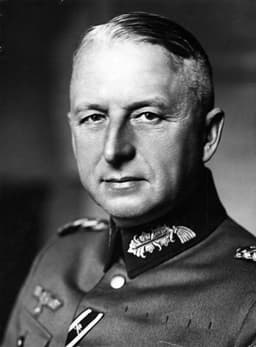
Erich von Manstein
General · Modern
56.2Total

Raja Man Singh
General · Modern
57.8Total
Basic Information
Born
1887
1550
Died
1973
1614
Era
Modern
Modern
Nationality
Germany
India
Occupation
General
General
Civilization
Western
Indian
Score Comparison
Military (10%)
72.0
78.8
Political (20%)
35.1
55.0
Influence (20%)
65.0
58.0
Legacy (20%)
55.0
48.3
Leadership (15%)
43.8
62.0
Strategy (15%)
72.0
58.0
TOTAL
56.2
57.8
Erich von Manstein — Complete Timeline
1942 AD
Battle of SevastopolWar◆ Major
Manstein commanded the 11th Army in the assault on the Soviet fortress of Sevastopol in Crimea. After a prolonged siege, German forces captured the city in July 1942. For this victory, Manstein was promoted to field marshal.
World War IIEastern FrontSiege
Impact: regionaldestructive
1943 AD
Battle of KurskWar◆ Major
Manstein commanded Army Group South during the Battle of Kursk, the largest tank battle in history. His forces achieved tactical successes at Prokhorovka but failed to break through Soviet defenses. The German offensive was halted, marking a strategic defeat on the Eastern Front.
World War IIEastern FrontTank Battle
Impact: globaldestructive
1944 AD
Planning of the Ardennes OffensiveWar◆ Major
Manstein did not plan the Ardennes Offensive; that was Hitler's plan. Manstein was the primary planner of the 1940 Ardennes offensive through Belgium and France. His plan, known as the Manstein Plan, involved a surprise armored thrust through the Ardennes forest, leading to the rapid defeat of France.
World War IIBattle of FranceMilitary Strategy
Impact: global
Dismissal by HitlerPolitical Action◆ Major
After repeated disagreements with Hitler over military strategy, Manstein was dismissed from command of Army Group South in March 1944. He was replaced by Walter Model and never held another active command during the war.
World War IICommand ChangeHitler
Impact: national
1949 AD
Trial and ImprisonmentPolitical Action◆ Major
Manstein was tried by a British military court in Hamburg for war crimes, including the use of scorched earth tactics and mistreatment of prisoners. He was convicted on several counts and sentenced to 18 years imprisonment, but was released in 1953 due to health reasons.
War Crimes TrialPost-WarJustice
Impact: nationaltragic
Raja Man Singh — Complete Timeline
1576 AD
Battle of HaldighatiWar◆ Major
Raja Man Singh commanded the Mughal army that defeated Rana Pratap's forces at Haldighati. This victory strengthened Mughal control over Mewar and demonstrated Man Singh's military capability.
Mughal-Rajput WarsBattleCommand
Impact: regional
1590 AD
Military Campaign in OrissaWar
Raja Man Singh led a Mughal campaign into Orissa, defeating the local Afghan rulers and bringing the region under Mughal suzerainty. This expanded the empire's eastern frontier.
Military CampaignOrissaExpansion
Impact: regional
1592 AD
Construction of Amber FortCultural◆ Major
Raja Man Singh oversaw the expansion and renovation of the Amber Fort near Jaipur. The fort became a major architectural landmark, blending Rajput and Mughal styles.
ArchitectureFortCultural Heritage
Impact: regionalconstructive
1595 AD
Governor of BengalPolitical Action◆ Major
Raja Man Singh was appointed governor of Bengal by Emperor Akbar. He administered the province, suppressed rebellions, and expanded Mughal influence in the region.
GovernorshipBengalAdministration
Impact: regionalconstructive
Expert Analysis
Origins
Erich von Manstein was born in 1887 in Berlin into a Prussian military family. His birth name was Erich von Lewinski, but he was adopted by his uncle. He attended the Prussian Cadet Corps and was commissioned as a lieutenant in 1906. His upbringing was steeped in military tradition, and he served in World War I, gaining staff experience.
Raja Man Singh was born in 1550 in Amber, India, into the Kachwaha Rajput clan. He was the son of Raja Bhagwant Das, a trusted Mughal ally. Man Singh received a princely education in warfare, administration, and culture. He was a nephew of Akbar's wife, which facilitated his entry into the Mughal court.
Rise to Power
Manstein rose through the German army in the interwar period. He was a key planner of the 1940 invasion of France, proposing the Ardennes offensive through Belgium, which led to a swift victory. His success earned him command of the 11th Army in 1941. He captured Sevastopol in July 1942 after a prolonged siege, which led to his promotion to field marshal. He later commanded Army Group South in 1943.
Raja Man Singh rose to prominence as a general under Emperor Akbar. He was appointed commander of 7,000 troops, one of the highest ranks in the Mughal army. He led the Mughal forces at the Battle of Haldighati in 1576, defeating Rana Pratap. This victory solidified his position. He was later appointed governor of Bengal in 1595, where he expanded Mughal influence.
Leadership & Governance
Manstein's leadership was characterized by operational brilliance but political naivety. He excelled in mobile warfare and defensive battles, as seen at Kharkov in 1943. However, he clashed with Hitler over strategy, leading to his dismissal in 1944. His governance was limited to military command; he had no significant administrative role.
Raja Man Singh was a skilled administrator and general. As governor of Bengal, he suppressed rebellions, collected taxes, and maintained stability. He also oversaw the expansion of Amber Fort, blending Rajput and Mughal architecture. His leadership was based on loyalty to Akbar and pragmatic alliances.
Triumph & Tragedy
Manstein's greatest triumph was the planning of the 1940 Ardennes offensive, which led to the fall of France. He also achieved a tactical victory at the Third Battle of Kharkov in 1943. His tragedies include the failure at Kursk in 1943, where his forces were halted despite initial gains. He was dismissed by Hitler in 1944 and later convicted of war crimes for scorched-earth tactics, serving four years in prison.
Raja Man Singh's greatest triumph was his victory at Haldighati, which secured Mughal control over Mewar. He also successfully administered Bengal and expanded Mughal territory into Orissa. His tragedy was the conflict with Rana Pratap, which despite victory, did not fully pacify Mewar. He also faced challenges in Bengal with local rebellions. He died in 1614, having remained loyal to Akbar and Jahangir.
Character & Destiny
Manstein was a strategic thinker but politically inflexible. His refusal to align with Hitler's instincts led to his dismissal. He was seen as a professional soldier, but his involvement in war crimes tarnished his reputation. His character shaped his fate: he achieved operational success but lacked the political acumen to survive in the Nazi regime.
Raja Man Singh was a loyal and pragmatic Rajput. He adapted to Mughal rule, which allowed him to rise high. His character was marked by military competence and administrative skill. His destiny was tied to Akbar's success; he remained a trusted general and governor.
Legacy
Manstein's legacy is complex. He is remembered as a brilliant military tactician, but his association with Nazism and war crimes limits his influence. His memoirs, "Lost Victories," shaped post-war perceptions. In military history, he scored 72.0 in strategy, but his political score is low at 35.1.
Raja Man Singh's legacy is more positive. He is remembered as a capable general and administrator who strengthened Mughal rule. The Amber Fort stands as a testament to his patronage. His military score is 78.8, reflecting his battlefield successes. However, his influence is largely regional, limited to Indian history.
Conclusion
Raja Man Singh had a greater overall impact than Erich von Manstein, with a total score of 57.8 vs 56.2. While Manstein was a master tactician, his legacy is marred by war crimes and a failed regime. Man Singh's contributions to the Mughal Empire were more lasting, as he helped consolidate Akbar's rule and left architectural and administrative legacies. Man Singh's higher military score (78.8 vs 72.0) and leadership score (62.0 vs 43.8) reflect his effectiveness. Although Manstein's strategic impact in WWII was significant, Man Singh's broader influence on Indian history gives him the edge.
Rankings
🥇
Raja Man SinghLeader
Mil: 78.8Pol: 55.0Inf: 58.0
57.8
🥈
Erich von Manstein
Mil: 72.0Pol: 35.1Inf: 65.0
56.2
+1.6 behind
How This Comparison Works
Algorithm
Each figure is scored on 6 dimensions (0—100 scale) based on structured historical data: Military (10%), Political (20%), Influence (20%), Legacy (20%), Leadership (15%), Strategy (15%). The weighted total produces the final ranking.
Data Sources
Scores are computed from structured sub-indicators in the database. Scale factors adjust for era (Ancient ×0.85, Modern ×1.0) and civilization size (Eastern ×1.05, Other ×0.80) to account for differences in population and military scale.
Maximum 3 Figures
Comparisons are limited to 2—3 figures to ensure readability and statistical meaningfulness.
Error Margins
±5 points per dimension — Sub-scores are derived from historical records with inherent uncertainty. Two figures within 5 points on a dimension should be considered roughly equivalent in that area.
Total Score Accuracy
±3 points overall — The weighted combination of 6 dimensions produces a total score with approximately ±3 points of uncertainty. Differences of less than 3 points are not statistically significant— the figures are effectively tied.
Known Limitations
- Historical records are incomplete and uneven across civilizations
- Figures from oral-tradition societies may be underrepresented
- Occupation labels can misclassify multi-role figures
- Scores measure capability and impact, not moral character
- Quantitative scoring is a comparison tool, not absolute truth
Capability Radar
Military (10%) — Battles & Warfare
Battles
85
75
Win Rate
80
70
Expansion
75
78
Political (20%) — Governance & Reform
Reform
20
50
Diplomacy
25
80
Economy
15
55
Influence (20%) — Cultural & Global Reach
Cultural
55
45
Global
65
35
Legacy (20%) — Historical Impact
Historical
75
50
Longevity
60
40
Leadership (15%) — Power & Stability
Tenure
30
65
Stability
10
60
Strategy (15%) — Tactics & Innovation
Strategy
90
68
Tactics
95
72
Reform
70
55
Similar Comparisons
Comments & Discussion
No comments yet. Be the first to share your thoughts!