Loading...
Erich von Manstein vs Napoleon Bonaparte
Napoleon Bonaparte leads by 14.7 pts · 2 figures compared
…
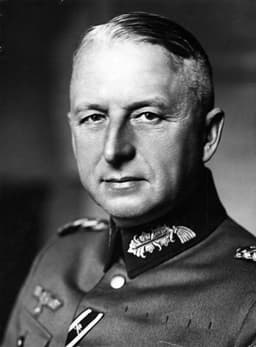
Erich von Manstein
General · Modern
56.2Total

Napoleon Bonaparte
General · Modern
70.9Total
Basic Information
Born
1887
1769
Died
1973
1821
Era
Modern
Modern
Nationality
Germany
France
Occupation
General
General
Civilization
Western
Western
Score Comparison
Military (10%)
72.0
94.0
Political (20%)
35.1
72.0
Influence (20%)
65.0
40.0
Legacy (20%)
55.0
80.0
Leadership (15%)
43.8
78.0
Strategy (15%)
72.0
90.0
TOTAL
56.2
70.9
Erich von Manstein — Complete Timeline
1942 AD
Battle of SevastopolWar◆ Major
Manstein commanded the 11th Army in the assault on the Soviet fortress of Sevastopol in Crimea. After a prolonged siege, German forces captured the city in July 1942. For this victory, Manstein was promoted to field marshal.
World War IIEastern FrontSiege
Impact: regionaldestructive
1943 AD
Battle of KurskWar◆ Major
Manstein commanded Army Group South during the Battle of Kursk, the largest tank battle in history. His forces achieved tactical successes at Prokhorovka but failed to break through Soviet defenses. The German offensive was halted, marking a strategic defeat on the Eastern Front.
World War IIEastern FrontTank Battle
Impact: globaldestructive
1944 AD
Planning of the Ardennes OffensiveWar◆ Major
Manstein did not plan the Ardennes Offensive; that was Hitler's plan. Manstein was the primary planner of the 1940 Ardennes offensive through Belgium and France. His plan, known as the Manstein Plan, involved a surprise armored thrust through the Ardennes forest, leading to the rapid defeat of France.
World War IIBattle of FranceMilitary Strategy
Impact: global
Dismissal by HitlerPolitical Action◆ Major
After repeated disagreements with Hitler over military strategy, Manstein was dismissed from command of Army Group South in March 1944. He was replaced by Walter Model and never held another active command during the war.
World War IICommand ChangeHitler
Impact: national
1949 AD
Trial and ImprisonmentPolitical Action◆ Major
Manstein was tried by a British military court in Hamburg for war crimes, including the use of scorched earth tactics and mistreatment of prisoners. He was convicted on several counts and sentenced to 18 years imprisonment, but was released in 1953 due to health reasons.
War Crimes TrialPost-WarJustice
Impact: nationaltragic
Napoleon Bonaparte — Complete Timeline
1799 AD
Coup of 18 BrumaireOther◆ Major
Napoleon Bonaparte, with support from his brother Lucien and key political figures, overthrew the Directory in a bloodless coup. He established the Consulate with himself as First Consul, effectively becoming the ruler of France. This event ended the French Revolution's most unstable period.
French RevolutionCoupRise to Power
Impact: regional
1804 AD
Promulgation of the Napoleonic CodeOther◆ Major
Napoleon enacted the Civil Code of the French, known as the Napoleonic Code, a comprehensive set of laws that replaced the fragmented feudal legal systems. The code established legal equality, protected property rights, and secularized law. It became the basis for legal systems in many European and world countries.
Legal ReformNapoleonic CodeCivil Law
Impact: globalconstructive
1805 AD
Battle of AusterlitzWar◆ Major
Napoleon's Grande Arm
Napoleonic WarsBattleDecisive Victory
Impact: global
1812 AD
Invasion of RussiaWar◆ Major
Napoleon led the Grande Arm
Napoleonic WarsInvasionDisaster
Impact: globaldestructive
1815 AD
Battle of WaterlooWar◆ Major
Napoleon's French army was defeated by the combined forces of the Duke of Wellington's Anglo-Allied army and Gebhard Leberecht von Bl
Napoleonic WarsBattleFinal Defeat
Impact: globaldestructive
Expert Analysis
erich-von-manstein-vs-napoleon-bonaparte
# The General's Mirror: Napoleon and Manstein
On a rain-soaked June morning in 1815, Napoleon Bonaparte stood on a muddy ridge near Waterloo, watching his Imperial Guard march into the maw of British cannon fire. One hundred and twenty-nine years later, another German commander, Erich von Manstein, would study a map of the Ardennes forest, plotting a very different kind of gamble. Both men were masters of war, yet their fates could not have diverged more sharply. Why did one forge an empire while the other served a doomed one? The answer lies not just in their talents, but in the eras that shaped them.
Origins
Napoleon was born in 1769 on the rugged island of Corsica, a year after it passed from Genoa to French control. His family was minor nobility, struggling and ambitious. He spoke Italian-accented French and was mocked at military school for his provincial origins. Yet the French Revolution, erupting when he was twenty, shattered the old order and opened paths unimaginable under a monarchy. A young artillery officer could rise by merit, not birth. Corsica’s fierce independence and the Revolution’s chaos forged in him a relentless will to impose order.
Erich von Manstein was born in 1887 into the Prussian military aristocracy. His birth name was Erich von Lewinski, but he was adopted by the von Manstein family, a lineage of generals. He was raised in a world where the army was the state, and the Kaiser was its god. The rigid hierarchies of Imperial Germany, the cult of obedience, and the trauma of World War I’s defeat shaped him. He was a product of a system that valued technical brilliance but discouraged political ambition. Where Napoleon saw the Revolution as a ladder, Manstein saw the army as a fortress.
Rise to Power
Napoleon’s ascent was meteoric. In 1793, at age twenty-four, he recaptured Toulon from British forces with a bold artillery plan. By 1795, he saved the revolutionary government from a royalist insurrection with a “whiff of grapeshot.” In 1796, he took command of the starving Army of Italy and within a year had defeated the Austrians, seizing northern Italy and forcing peace. Each victory was a political weapon. By 1799, he staged a coup and became First Consul. By 1804, he crowned himself Emperor.
Manstein’s rise was slower, more institutional. He served as a staff officer in World War I, earning respect for his intellect. Between wars, he wrote and taught, developing the concept of “maneuver warfare” that would become the Blitzkrieg. His breakthrough came in 1940, when he authored the plan for the Ardennes offensive—a daring, risky thrust through supposedly impassable forest that outflanked the French Maginot Line and crushed France in six weeks. Hitler, whom Manstein privately despised, rewarded him with command of a panzer corps. Yet Manstein never seized power; he remained a servant of a regime he found increasingly repellent.
Leadership & Governance
Napoleon was a political genius as much as a military one. He centralized the French state, created the Bank of France, and codified laws in the Napoleonic Code, which enshrined equality before the law and property rights while rolling back women’s rights. He built roads, canals, and a state education system. On the battlefield, he was charismatic and ruthless, leading from the front, inspiring soldiers with promises of glory and loot. His system of corps allowed him to outmarch and outfight coalitions. At Austerlitz in 1805, he crushed the combined armies of Russia and Austria, a masterpiece of deception and timing.
Manstein was a strategic technician, not a statesman. He commanded the 11th Army in the siege of Sevastopol in 1942, a grinding, methodical assault that reduced a fortress to rubble. At the Battle of Kursk in 1943, his Army Group South achieved tactical breakthroughs but could not win against Soviet reserves. He pleaded with Hitler for operational freedom, but the Führer refused. Manstein had no political vision; he fought to win battles, not to build a nation. He famously said, “The best weapon is the one that is never fired,” but he never questioned the war itself.
Triumph & Tragedy
Napoleon’s greatest triumph was the Empire of 1807–1812, when he controlled Europe from Spain to Poland. His tragedy was the invasion of Russia in 1812. He marched 600,000 men into the vastness; he lost them to cold, hunger, and Cossacks. He returned to Paris a shadow. Exiled to Elba, he escaped in 1815 and rallied France for a Hundred Days, but at Waterloo, his genius failed him. His army was destroyed, and he was sent to St. Helena, a remote island in the South Atlantic, where he died in 1821, possibly poisoned.
Manstein’s triumph was the 1940 campaign, which he planned but did not lead. His tragedy was his complicity in a criminal regime. He implemented scorched-earth tactics on the Eastern Front, leaving civilians to starve. After the war, he was tried in 1949 by a British military court for war crimes and sentenced to eighteen years, though he served only four. In his memoirs, he portrayed himself as a soldier doing his duty, a claim that historians have largely rejected.
Character & Destiny
Napoleon was driven by an insatiable ambition. “Impossible,” he said, “is a word to be found only in the dictionary of fools.” His ego, however, blinded him. He refused to share power, alienated allies, and invaded Russia without a winter strategy. His personality—brilliant, arrogant, restless—built an empire and then shattered it.
Manstein was cautious and calculating, a staff officer at heart. He respected competence over charisma. Yet his deference to authority, his Prussian obedience, made him an instrument of evil. He knew Hitler was a madman but followed orders. The difference: Napoleon shaped his era; Manstein was shaped by his.
Legacy
Napoleon’s legacy is immense. The Napoleonic Code influenced legal systems across Europe and the Americas. He redrew borders, ended feudalism, and inspired nationalism. He is remembered as a military genius and a tyrant, a man who made the modern world.
Manstein’s legacy is narrower. He is studied in military academies for his operational brilliance, but his reputation is stained by his service to Nazism. His memoirs have been discredited as self-serving. He is a cautionary tale: a brilliant general who forgot that war is not an end in itself.
Conclusion
Napoleon and Manstein stand at opposite ends of the same spectrum. One rose from obscurity to reshape a continent; the other rose within a system to serve its darkest hour. Both were masters of war, but only one understood that war is a tool of politics, not a substitute for it. Napoleon’s tragedy was his ambition; Manstein’s was his obedience. In the end, the general’s mirror shows not just two men, but two worlds—and the choices that define them.
Rankings
🥇
Napoleon BonaparteLeader
Mil: 94.0Pol: 72.0Inf: 40.0
70.9
🥈
Erich von Manstein
Mil: 72.0Pol: 35.1Inf: 65.0
56.2
+14.7 behind
How This Comparison Works
Algorithm
Each figure is scored on 6 dimensions (0—100 scale) based on structured historical data: Military (10%), Political (20%), Influence (20%), Legacy (20%), Leadership (15%), Strategy (15%). The weighted total produces the final ranking.
Data Sources
Scores are computed from structured sub-indicators in the database. Scale factors adjust for era (Ancient ×0.85, Modern ×1.0) and civilization size (Eastern ×1.05, Other ×0.80) to account for differences in population and military scale.
Maximum 3 Figures
Comparisons are limited to 2—3 figures to ensure readability and statistical meaningfulness.
Error Margins
±5 points per dimension — Sub-scores are derived from historical records with inherent uncertainty. Two figures within 5 points on a dimension should be considered roughly equivalent in that area.
Total Score Accuracy
±3 points overall — The weighted combination of 6 dimensions produces a total score with approximately ±3 points of uncertainty. Differences of less than 3 points are not statistically significant— the figures are effectively tied.
Known Limitations
- Historical records are incomplete and uneven across civilizations
- Figures from oral-tradition societies may be underrepresented
- Occupation labels can misclassify multi-role figures
- Scores measure capability and impact, not moral character
- Quantitative scoring is a comparison tool, not absolute truth
Capability Radar
Military (10%) — Battles & Warfare
Battles
85
95
Win Rate
80
90
Expansion
75
95
Political (20%) — Governance & Reform
Reform
20
95
Diplomacy
25
80
Economy
15
85
Influence (20%) — Cultural & Global Reach
Cultural
55
85
Global
65
90
Legacy (20%) — Historical Impact
Historical
75
95
Longevity
60
90
Leadership (15%) — Power & Stability
Tenure
30
85
Stability
10
70
Strategy (15%) — Tactics & Innovation
Strategy
90
95
Tactics
95
98
Reform
70
92
Similar Comparisons
Comments & Discussion
No comments yet. Be the first to share your thoughts!