Loading...
Esarhaddon vs Julius Caesar
Julius Caesar leads by 20.6 pts · 2 figures compared
…
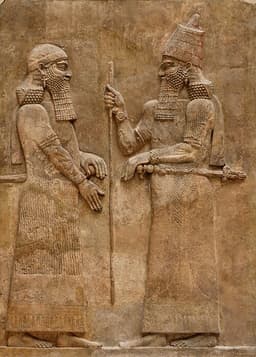
Esarhaddon
Emperor · Ancient
62.2Total

Julius Caesar
General · Ancient
82.8Total
Basic Information
Born
-681
-100
Died
-669
-44
Era
Ancient
Ancient
Nationality
Assyria
Roman Republic
Occupation
Emperor
General
Civilization
Middle Eastern
Western
Score Comparison
Military (10%)
72.0
88.0
Political (20%)
59.3
78.0
Influence (20%)
61.0
85.0
Legacy (20%)
56.0
82.0
Leadership (15%)
66.0
80.0
Strategy (15%)
70.0
85.0
TOTAL
62.2
82.8
Esarhaddon — Complete Timeline
680 BC
Rebuilding of BabylonReform◆ Major
Esarhaddon reversed his father Sennacherib's destruction of Babylon. He ordered the reconstruction of the city, its temples, and the Esagila. He returned the statue of Marduk and granted Babylon privileges, seeking to heal the religious rift caused by his father.
BabylonReconstructionReconciliation
Impact: regionalconstructive
679 BC
Campaign Against the CimmeriansWar
Esarhaddon defeated the Cimmerian invaders in the region of Hubushna (Anatolia). The Cimmerians had been threatening Assyrian vassals. This victory secured the northern frontier of the Assyrian Empire for a time.
CimmeriansAnatoliaDefense
Impact: regional
672 BC
Vassal Treaties of EsarhaddonPolitical Action◆ Major
Esarhaddon imposed loyalty oaths on his subjects, officials, and vassal states, requiring them to swear allegiance to his chosen heir Ashurbanipal. These treaties were inscribed on tablets and included curses for violation. They ensured a smooth succession.
TreatiesSuccessionAshurbanipal
Impact: regional
671 BC
Conquest of EgyptWar◆ Major
Esarhaddon led the Assyrian army across the Sinai desert and defeated the Kushite Pharaoh Taharqa. He captured Memphis and took the Egyptian royal family hostage. This was the first time an Assyrian king ruled Egypt, though control was brief.
EgyptConquestTaharqa
Impact: regional
Julius Caesar — Complete Timeline
58 BC
Gallic WarsWar◆ Major
Caesar, as proconsul of Gaul, launched a series of campaigns that conquered all of Gaul (modern France, Belgium, and parts of Switzerland). He fought numerous battles, including against the Helvetii, the Belgae, and the Gallic chieftain Vercingetorix. The wars brought immense wealth and a loyal army to Caesar.
Gallic WarsConquestRoman Expansion
Impact: regional
49 BC
Crossing the RubiconPolitical Action◆ Major
Caesar led Legio XIII across the Rubicon River into Italy, defying the Roman Senate's order to disband his army. This act triggered a civil war against Pompey and the Optimates, ultimately leading to Caesar's dictatorship and the end of the Roman Republic.
Roman Civil WarEnd of RepublicPower Struggle
Impact: global
48 BC
Battle of PharsalusWar◆ Major
Caesar's outnumbered army defeated the larger forces of Pompey the Great at Pharsalus in Greece. Caesar's tactical use of a reserve line to counter Pompey's cavalry charge proved decisive. Pompey fled to Egypt, where he was assassinated, leaving Caesar as the undisputed master of the Roman world.
Roman Civil WarBattleDecisive Victory
Impact: regional
44 BC
Appointment as Dictator for LifePolitical Action◆ Major
The Roman Senate appointed Caesar dictator perpetuo (dictator for life), granting him unprecedented personal power. This move concentrated military, legislative, and judicial authority in one person, effectively ending the Roman Republic's traditional system of checks and balances and alarming many senators.
DictatorshipEnd of RepublicPower Consolidation
Impact: regionaldestructive
Assassination on the Ides of MarchPolitical Action◆ Major
A group of Roman senators, led by Marcus Junius Brutus and Gaius Cassius Longinus, stabbed Caesar to death at a meeting of the Senate in the Theatre of Pompey. The assassination was intended to restore the Republic, but instead triggered another civil war that led to the rise of the Roman Empire.
AssassinationRoman PoliticsEnd of Republic
Impact: globaldestructive
Expert Analysis
esarhaddon-vs-julius-caesar
# The Crossing and the Conquest: Caesar and Esarhaddon
On a January morning in 49 BCE, Julius Caesar stood at the banks of the Rubicon, a small river that marked the boundary between his province and Rome itself. To cross with his army was treason, a declaration of civil war. To turn back was political oblivion. He hesitated, then uttered a phrase that would echo through millennia: "The die is cast." Across the centuries and the Mediterranean, another ruler faced a different kind of threshold. In 671 BCE, Esarhaddon, king of Assyria, led his army across the Sinai desert—a wasteland of sand and scorching heat that had defeated many before him. He was marching not to seize his own capital, but to conquer Egypt, the oldest kingdom on earth. Both men stood at the razor's edge of history, yet their paths diverged as dramatically as their fates.
Origins
Caesar was born into the patrician Julian clan, an ancient but politically marginal family in the late Roman Republic. His youth unfolded amid the violent collapse of republican norms—civil wars, street gangs, and the rise of military strongmen like Sulla and Marius. Caesar learned early that in Rome, survival meant ambition, and ambition meant debt, charm, and ruthlessness. He was a man of the city, of forums and intrigues, where words were weapons and alliances shifted like desert sands.
Esarhaddon, by contrast, was born into absolute power—the son of Sennacherib, the mighty king of Assyria who had sacked Babylon and turned it to rubble. But Esarhaddon's inheritance was not peaceful. His father was murdered by his own sons, Esarhaddon's brothers, in a palace coup. He himself had to fight his way to the throne, pursued by rivals and omens. The Assyrian Empire was a machine of war and bureaucracy, where kings were both high priests and generals, and where rebellion was a constant, bloody rhythm of life.
Rise to Power
Caesar’s rise was a masterclass in strategic patience. He climbed the republican ladder—quaestor, aedile, praetor—borrowing fortunes to stage lavish games and buy influence. His break came in 58 BCE, when he secured command of Gaul. Over eight years, he conquered a vast territory, built a loyal army, and wrote his own legend in the *Commentaries*. The Rubicon was not a rash act; it was the culmination of a calculated gamble. He knew that without military power, his political enemies would destroy him.
Esarhaddon’s rise was swifter and more brutal. After his father’s assassination, he crushed his brothers and their allies within two years. He then turned to the great wound of his dynasty: Babylon. In 680 BCE, in a stunning act of political theater, he ordered the reconstruction of the city that his father had destroyed. He restored its temples, returned its gods, and declared himself the chosen of Marduk. This was not mercy—it was statecraft. He understood that an empire built on terror alone could not endure.
Leadership & Governance
Caesar governed through personal magnetism and institutional reform. As dictator, he overhauled the calendar (giving us the Julian calendar), reformed debt laws, extended citizenship to provincials, and launched massive public works. His military genius was in speed and decisiveness—at Alesia, he besieged a Gallic army while simultaneously fending off a relief force, a feat of logistics and nerve. Yet his political wisdom faltered. He centralized power too openly, accepted divine honors, and treated the Senate as a rubber stamp. He governed like a conqueror, not a coalition-builder.
Esarhaddon ruled through a network of oaths and terror. In 672 BCE, he imposed the Vassal Treaties on his subjects, binding them under penalty of horrific curses to swear loyalty to his chosen heir, Ashurbanipal. He was a master of propaganda, inscribing his victories on clay and stone, but his governance was always precarious. His greatest military achievement—the conquest of Egypt in 671 BCE—was a lightning strike. He marched across the Sinai, defeated the Kushite Pharaoh Taharqa, and captured Memphis. But he did not stay. He installed local governors and returned to Nineveh, leaving a garrison that would soon be overwhelmed. He conquered, but he could not hold.
Triumph & Tragedy
Caesar’s triumph was the conquest of Gaul and his victory in the civil war. He stood as master of the Roman world, with the title "dictator for life." His tragedy came on the Ides of March, 44 BCE, when sixty senators stabbed him to death in the Theatre of Pompey. He had seen the conspiracy coming but walked into the Senate anyway, perhaps out of fatalism or arrogance. His last words, reportedly, were to his friend Brutus: "You too, my child?"
Esarhaddon’s triumph was Egypt—the first time an Assyrian king had ruled the Nile. He erected a victory stele at Sam'al, showing himself with the defeated Pharaoh's son in chains. But his tragedy was the fragility of that conquest. Within a few years, Taharqa returned, and Assyrian control crumbled. Esarhaddon died in 669 BCE, possibly on campaign, leaving his empire to his son Ashurbanipal. He never saw the full unraveling of his Egyptian dream.
Character & Destiny
Caesar was restless, brilliant, and insatiable. He wanted not just power but glory—the kind that poets sing and historians debate. His clemency toward former enemies was genuine but calculated; his ambition was boundless but never blind. He died because he could not stop pushing. The Republic could not contain him, and he could not reform it fast enough.
Esarhaddon was more cautious, more pious. He consulted oracles, rebuilt temples, and worried about his legacy. He was a consolidator, not a revolutionary. His destiny was to hold together an empire that stretched from the Persian Gulf to the Nile, but he understood that empires are built on fear and faith, not love. He succeeded in his time, but his conquests were ephemeral.
Legacy
Caesar’s legacy is immeasurable. His name became a title—Kaiser, Tsar. His reforms outlasted the Republic he destroyed. He shaped the course of Western civilization, for better and worse. He is remembered as the man who crossed the Rubicon, a phrase that still means to pass the point of no return.
Esarhaddon is remembered mainly by specialists. His conquest of Egypt is a footnote in Assyrian history, a brief moment when the two great powers of the ancient world collided. His rebuilding of Babylon was more lasting, a gesture of reconciliation that stabilized his dynasty. But his empire fell within decades of his death, swallowed by Babylonians and Medes.
Conclusion
Standing at the Rubicon, Caesar saw only one path forward—himself. Marching across the Sinai, Esarhaddon saw a world of gods and kings, where even the mightiest ruler is a servant of fate. One man forged a legend that would outlast his empire; the other built an empire that barely outlasted him. Both crossed their deserts, but only one crossed into eternity.
Rankings
🥇
Julius CaesarLeader
Mil: 88.0Pol: 78.0Inf: 85.0
82.8
🥈
Esarhaddon
Mil: 72.0Pol: 59.3Inf: 61.0
62.2
+20.6 behind
How This Comparison Works
Algorithm
Each figure is scored on 6 dimensions (0—100 scale) based on structured historical data: Military (10%), Political (20%), Influence (20%), Legacy (20%), Leadership (15%), Strategy (15%). The weighted total produces the final ranking.
Data Sources
Scores are computed from structured sub-indicators in the database. Scale factors adjust for era (Ancient ×0.85, Modern ×1.0) and civilization size (Eastern ×1.05, Other ×0.80) to account for differences in population and military scale.
Maximum 3 Figures
Comparisons are limited to 2—3 figures to ensure readability and statistical meaningfulness.
Error Margins
±5 points per dimension — Sub-scores are derived from historical records with inherent uncertainty. Two figures within 5 points on a dimension should be considered roughly equivalent in that area.
Total Score Accuracy
±3 points overall — The weighted combination of 6 dimensions produces a total score with approximately ±3 points of uncertainty. Differences of less than 3 points are not statistically significant— the figures are effectively tied.
Known Limitations
- Historical records are incomplete and uneven across civilizations
- Figures from oral-tradition societies may be underrepresented
- Occupation labels can misclassify multi-role figures
- Scores measure capability and impact, not moral character
- Quantitative scoring is a comparison tool, not absolute truth
Capability Radar
Military (10%) — Battles & Warfare
Battles
75
95
Win Rate
85
92
Expansion
80
97
Political (20%) — Governance & Reform
Reform
75
90
Diplomacy
80
85
Economy
70
82
Influence (20%) — Cultural & Global Reach
Cultural
60
88
Global
65
94
Legacy (20%) — Historical Impact
Historical
70
95
Longevity
60
96
Leadership (15%) — Power & Stability
Tenure
70
75
Stability
65
60
Strategy (15%) — Tactics & Innovation
Strategy
85
94
Tactics
80
96
Reform
70
88
Similar Comparisons
Comments & Discussion
THE_RUBICON_GAMBLER6/17/2026
Classics scholar here: Caesar's "the die is cast" was actually a mistranslation of Menander's Greek phrase "let the die be thrown," stripping it of its original passive, fatalistic flavor. Esarhaddon's Sinai crossing was far more impressive—he hauled siege equipment and water supplies across 200 miles of desert without a single mutiny. Caesar faced a shallow stream with loyal legions; Esarhaddon faced dehydration, sandstorms, and Nubian archers. One man gambled, the other conquered. Not the same
沙漠之鹰6/17/2026
军事历史爱好者来说句实话:埃萨尔哈东才是真狠人。他横跨西奈沙漠时,后勤线长达300公里,每天需运送超过50吨水,这在古代是顶级军事工程成就。凯撒渡过卢比孔河?那不过是个政治表演,河宽才十来米,附近还有桥可走。别拿演戏当史诗。
ASSYRIAN_FOOTNOTE6/17/2026
Revisionist critic here: we're ignoring that Esarhaddon's "conquest" of Egypt lasted barely a decade before his son lost it all to a Cushite rebellion. Meanwhile, Caesar's Rubicon crossing permanently destroyed the Roman Republic and set up an empire that lasted 500 years. Esarhaddon's campaign was a family road trip compared to Caesar's regime change. And yes, Esarhaddon annihilated Sidon, but Caesar annihilated the entire legal system of Rome. Scale matters.
数据打假员6/17/2026
别被埃萨尔哈东的“征服埃及”骗了。亚述铭文记载他击败了法老塔哈尔卡,但实际他只控制了尼罗河三角洲北部,底比斯以南根本纹丝不动。凯撒起码真接管了罗马,埃萨尔哈东更像打了个高分却输了比赛的球队。而且他女儿后来嫁给了一位西徐亚酋长,这件事在铭文里只提了一句——连战利品都不如。
THE_SINAI_SAGE6/17/2026
History buff perspective: What everyone misses is the psychological difference. Esarhaddon's inscriptions constantly invoke fear of his father Sennacherib's assassination—he was a son trying to prevent the same palace coups. Caesar was the opposite: he actively manufactured crisis to justify his power grab. One crossed boundaries out of paranoia, the other out of pure ambition. That changes how we interpret their "heroic" crossings. Esarhaddon's was defensive paranoia in epaulets; Caesar's was c