Loading...
This comparison has not been analyzed yet.
One-time AI generation (~1 minute). Scores and timeline are already available below.
Ezer Weizman vs George Marshall
George Marshall leads by 12.2 pts · 2 figures compared
…
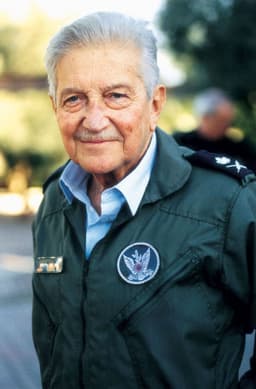
Ezer Weizman
General · Modern
57.8Total
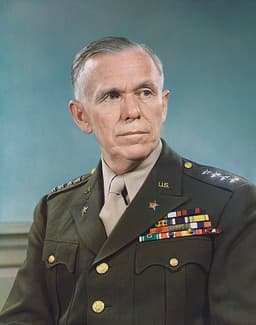
George Marshall
General · Modern
70.0Total
Basic Information
Born
1924
1880
Died
—
1959
Era
Modern
Modern
Nationality
Israel
United States
Occupation
General
General
Civilization
Middle Eastern
Western
Score Comparison
Military (10%)
40.0
47.5
Political (20%)
68.0
86.0
Influence (20%)
59.0
65.0
Legacy (20%)
50.0
70.0
Leadership (15%)
72.0
78.0
Strategy (15%)
55.0
69.1
TOTAL
57.8
70.0
Ezer Weizman — Complete Timeline
1958 AD
Appointed Commander of the Israeli Air ForceWar◆ Major
Ezer Weizman was appointed Commander of the Israeli Air Force in 1958. He modernized the force and oversaw the acquisition of French Mirage jets, which were crucial in the Six-Day War.
Air ForceMilitary modernization
Impact: nationalconstructive
1967 AD
Led the Israeli Air Force in the Six-Day WarWar
As Air Force commander, Weizman planned and executed the preemptive airstrikes that destroyed the Egyptian, Jordanian, and Syrian air forces on the ground. This operation secured Israeli air superiority and was decisive in the war.
Six-Day WarAirstrikes
Impact: global
1977 AD
Served as Minister of DefensePolitical Action◆ Major
Weizman served as Minister of Defense from 1977 to 1980 under Prime Minister Menachem Begin. He played a key role in the Camp David Accords and the peace treaty with Egypt.
Defense MinisterCamp David
Impact: globalconstructive
1993 AD
Elected Seventh President of IsraelPolitical Action◆ Major
Weizman was elected as the seventh President of Israel in March 1993. He served two terms until 2000, focusing on promoting peace and reconciliation, including supporting the Oslo Accords.
PresidencyPeace
Impact: nationalconstructive
2000 AD
Resigned as President Amid ScandalPolitical Action◆ Major
Weizman resigned as President in July 2000 after an investigation revealed he had accepted large cash gifts from a French businessman while in office. His resignation ended his political career.
ResignationScandal
Impact: nationaltragic
George Marshall — Complete Timeline
1939 AD
Appointed US Army Chief of StaffPolitical Action◆ Major
Marshall was appointed Chief of Staff of the United States Army, overseeing its expansion from a small peacetime force to the world's largest army. He was instrumental in preparing the US for World War II.
World War IIUS ArmyPreparation
Impact: globalconstructive
1947 AD
Developed the Marshall PlanPolitical Action
As Secretary of State, Marshall proposed the European Recovery Program, known as the Marshall Plan. The plan provided over $12 billion in economic aid to rebuild Western Europe, stabilizing economies and countering Soviet influence.
Cold WarEconomic AidEurope
Impact: globalconstructive
1953 AD
Received the Nobel Peace PrizeCultural◆ Major
Marshall was awarded the Nobel Peace Prize for his role in the Marshall Plan. He was the only professional soldier ever to receive the prize, recognizing his contribution to post-war reconstruction and peace.
Nobel PrizePeaceReconstruction
Impact: globalconstructive
This comparison has not been analyzed yet.
One-time AI generation (~1 minute). Scores and timeline are already available below.
Rankings
🥇
George MarshallLeader
Mil: 47.5Pol: 86.0Inf: 65.0
70.0
🥈
Ezer Weizman
Mil: 40.0Pol: 68.0Inf: 59.0
57.8
+12.2 behind
How This Comparison Works
Algorithm
Each figure is scored on 6 dimensions (0—100 scale) based on structured historical data: Military (10%), Political (20%), Influence (20%), Legacy (20%), Leadership (15%), Strategy (15%). The weighted total produces the final ranking.
Data Sources
Scores are computed from structured sub-indicators in the database. Scale factors adjust for era (Ancient ×0.85, Modern ×1.0) and civilization size (Eastern ×1.05, Other ×0.80) to account for differences in population and military scale.
Maximum 3 Figures
Comparisons are limited to 2—3 figures to ensure readability and statistical meaningfulness.
Error Margins
±5 points per dimension — Sub-scores are derived from historical records with inherent uncertainty. Two figures within 5 points on a dimension should be considered roughly equivalent in that area.
Total Score Accuracy
±3 points overall — The weighted combination of 6 dimensions produces a total score with approximately ±3 points of uncertainty. Differences of less than 3 points are not statistically significant— the figures are effectively tied.
Known Limitations
- Historical records are incomplete and uneven across civilizations
- Figures from oral-tradition societies may be underrepresented
- Occupation labels can misclassify multi-role figures
- Scores measure capability and impact, not moral character
- Quantitative scoring is a comparison tool, not absolute truth
Capability Radar
Military (10%) — Battles & Warfare
Battles
45
45
Win Rate
50
60
Expansion
30
40
Political (20%) — Governance & Reform
Reform
40
95
Diplomacy
60
90
Economy
35
95
Influence (20%) — Cultural & Global Reach
Cultural
40
60
Global
45
85
Legacy (20%) — Historical Impact
Historical
50
85
Longevity
40
75
Leadership (15%) — Power & Stability
Tenure
65
70
Stability
55
85
Strategy (15%) — Tactics & Innovation
Strategy
55
85
Tactics
60
55
Reform
70
90
Similar Comparisons
Comments & Discussion
No comments yet. Be the first to share your thoughts!