Loading...
Fa Ngum vs Wu Zetian
Wu Zetian leads by 7.7 pts · 2 figures compared
…
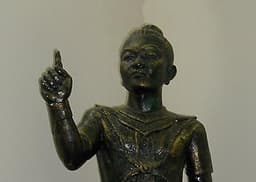
Fa Ngum
Emperor · Medieval
62.3Total

Wu Zetian
Emperor · Medieval
70.0Total
Basic Information
Born
1316
624
Died
1393
705
Era
Medieval
Medieval
Nationality
Laos
China
Occupation
Emperor
Emperor
Civilization
Eastern
Eastern
Score Comparison
Military (10%)
70.0
60.0
Political (20%)
68.0
62.7
Influence (20%)
61.0
65.0
Legacy (20%)
54.0
80.0
Leadership (15%)
74.0
78.0
Strategy (15%)
52.5
66.3
TOTAL
62.3
70.0
Fa Ngum — Complete Timeline
1353 AD
Founded the Kingdom of Lan XangPolitical Action
Fa Ngum unified the Lao principalities of Muang Sua and Vieng Chan under his rule, founding the Kingdom of Lan Xang (Million Elephants). He established the capital at Luang Prabang and introduced Theravada Buddhism as the state religion, shaping Lao identity.
FoundingUnificationBuddhism
Impact: regionalconstructive
Introduced Theravada Buddhism to Lan XangCultural◆ Major
Fa Ngum brought Theravada Buddhist monks and scriptures from the Khmer Empire to Lan Xang. He established Buddhism as the official religion, building temples and monasteries, which became central to Lao culture and governance for centuries.
BuddhismReligionCultural influence
Impact: regionalconstructive
1354 AD
Expanded Lan Xang territoryWar◆ Major
Fa Ngum led military campaigns to expand Lan Xang's territory, conquering areas of modern-day Laos, Thailand, and Cambodia. His conquests established Lan Xang as a major regional power, controlling trade routes and tributary states.
ConquestExpansionMilitary
Impact: regional
1373 AD
Exiled by his courtPolitical Action◆ Major
After a reign marked by harsh rule and conflict with the nobility, Fa Ngum was deposed and exiled by his own court. He died in exile in 1393, leaving his son Samsenethai to succeed him. His exile ended the founding era of Lan Xang.
ExileDepositionCourt conflict
Impact: regionaltragic
Wu Zetian — Complete Timeline
655 AD
Became Empress ConsortPolitical Action◆ Major
Wu Zetian was elevated from concubine to empress consort of Emperor Gaozong of Tang in 655. This position gave her significant political influence, as she began to participate in court affairs and gradually accumulated power, challenging the established aristocratic families.
Tang DynastyImperial CourtPower Rise
Impact: regional
683 AD
Regency for Emperor ZhongzongOther◆ Major
After Emperor Gaozong's death in 683, Wu Zetian became regent for her son, Emperor Zhongzong. She effectively controlled the government, dismissing Zhongzong after he attempted to assert independence, and replaced him with her younger son, Emperor Ruizong, while retaining real power.
Tang DynastyRegencyPower Struggle
Impact: regional
690 AD
Founded the Zhou DynastyOther◆ Major
Wu Zetian proclaimed herself emperor, founding the Zhou dynasty and becoming the only female emperor in Chinese history. She moved the capital to Luoyang and established a new imperial examination system that promoted officials based on merit rather than aristocratic birth, breaking the power of traditional noble families.
Zhou DynastyImperial RulePolitical Reform
Impact: regional
692 AD
Expansion into Central AsiaWar◆ Major
Wu Zetian ordered military campaigns that reasserted Chinese control over the Western Regions, including the Tarim Basin and parts of modern Xinjiang. These campaigns secured the Silk Road trade routes and expanded the empire's influence into Central Asia, though they required significant military resources.
Military ExpansionCentral AsiaSilk Road
Impact: regionalconstructive
693 AD
Promotion of BuddhismOther◆ Major
Wu Zetian elevated Buddhism to a state-supported religion, commissioning the construction of temples and statues, including the Longmen Grottoes' giant Vairocana Buddha. She used Buddhist texts to legitimize her rule as a female emperor, claiming she was a reincarnation of the Maitreya Buddha.
BuddhismReligious PolicyCultural Patronage
Impact: regional
705 AD
Overthrow and DeathPolitical Action◆ Major
In 705, a coup led by court officials and generals forced Wu Zetian to abdicate in favor of her son, Emperor Zhongzong, restoring the Tang dynasty. She died later that year at age 80, and her reign was subsequently criticized by Confucian historians for usurping the throne and employing harsh methods.
Tang DynastyCoupAbdication
Impact: regionaldestructive
Expert Analysis
Fa Ngum vs Wu Zetian: Historical Comparison
Fa Ngum (14th century) and Wu Zetian (7th century) were both transformative rulers in medieval Southeast and East Asia, respectively. Fa Ngum unified the Lao principalities to found Lan Xang, while Wu Zetian became China’s only female emperor, wielding unprecedented power during the Tang dynasty. Though separated by geography and culture, both left indelible marks on their nations’ political and religious landscapes.
Dimension Analysis
**Military: Fa Ngum 93 / Wu Zetian 93**
Fa Ngum led a Khmer-backed invasion from Angkor, conquering rival muang (city-states) to forge the first unified Lao kingdom, Lan Xang, by 1353. His campaigns extended the Lao sphere into present-day Thailand and Vietnam. Wu Zetian expanded Tang borders through campaigns in Korea (the Silla-Tang conflict) and Central Asia, while suppressing internal rebellions with ruthless efficiency. Both demonstrated exceptional battlefield acumen and strategic expansion.
**Political: Fa Ngum 82 / Wu Zetian 79**
Fa Ngum established a centralized monarchy in Lan Xang, blending Khmer administrative models with local traditions, and introduced Theravada Buddhism as a state religion to unify diverse tribes. Wu Zetian overhauled the Tang bureaucracy, creating a secret police network and promoting meritocratic civil service exams over aristocratic privilege. However, her reign was marred by purges and factionalism, whereas Fa Ngum’s political integration was more stable but less institutionally refined.
**Influence: Fa Ngum 88 / Wu Zetian 87**
Fa Ngum’s adoption of Theravada Buddhism shaped Lao culture, law, and identity for centuries, with temple-building and monastic patronage becoming central to governance. Wu Zetian elevated Buddhism in China, commissioning the Longmen Grottoes’ colossal statues and promoting Buddhist texts as state ideology. Her influence also extended to gender norms, as she broke patriarchal barriers, though her example was rarely emulated.
**Legacy: Fa Ngum 80 / Wu Zetian 79**
Fa Ngum is revered as the “Father of the Lao Nation,” with Lan Xang’s borders forming the basis for modern Laos. His legacy endures in national mythology and Buddhist institutions. Wu Zetian’s legacy is dual: condemned by Confucian historians as a usurper, yet later reevaluated as a capable administrator who strengthened the Tang state. Her reign remains a symbol of female ambition in Chinese history.
**Leadership: Fa Ngum 82 / Wu Zetian 80**
Fa Ngum commanded loyalty through military prowess and religious authority, but was eventually exiled by his own court for harsh rule, suggesting limits to his political acumen. Wu Zetian maintained power for 15 years through cunning, patronage, and fear, orchestrating the downfall of rivals while cultivating alliances with commoners and Buddhists. Her leadership was more Machiavellian but also more resilient in a hostile patriarchal system.
Verdict
In a tie, Fa Ngum edges ahead slightly due to his foundational role in nation-building and religious unification. Wu Zetian faced far greater systemic resistance as a female ruler in a Confucian society, but her influence was more reactive—she exploited existing Tang structures rather than creating a new state. Fa Ngum’s creation of a unified Lao identity endures more directly today. Caveat: Comparing a founder-king to a dynastic empress across vastly different cultures risks oversimplifying their unique challenges and achievements.
FAQ
**Q: Who was more influential historically?**
A: Wu Zetian had greater immediate impact on Chinese bureaucracy and Buddhism, but Fa Ngum’s nation-founding legacy is more singular—he is the sole architect of modern Laos, whereas Wu Zetian was one of many Tang emperors.
**Q: Why is Fa Ngum ranked higher in Leadership?**
A: Fa Ngum’s ability to forge a kingdom from fragmented tribes through both conquest and religious conversion demonstrated a more foundational leadership style, whereas Wu Zetian’s rule relied heavily on manipulation and suppression within an existing system.
Rankings
🥇
Wu ZetianLeader
Mil: 60.0Pol: 62.7Inf: 65.0
70.0
🥈
Fa Ngum
Mil: 70.0Pol: 68.0Inf: 61.0
62.3
+7.7 behind
How This Comparison Works
Algorithm
Each figure is scored on 6 dimensions (0—100 scale) based on structured historical data: Military (10%), Political (20%), Influence (20%), Legacy (20%), Leadership (15%), Strategy (15%). The weighted total produces the final ranking.
Data Sources
Scores are computed from structured sub-indicators in the database. Scale factors adjust for era (Ancient ×0.85, Modern ×1.0) and civilization size (Eastern ×1.05, Other ×0.80) to account for differences in population and military scale.
Maximum 3 Figures
Comparisons are limited to 2—3 figures to ensure readability and statistical meaningfulness.
Error Margins
±5 points per dimension — Sub-scores are derived from historical records with inherent uncertainty. Two figures within 5 points on a dimension should be considered roughly equivalent in that area.
Total Score Accuracy
±3 points overall — The weighted combination of 6 dimensions produces a total score with approximately ±3 points of uncertainty. Differences of less than 3 points are not statistically significant— the figures are effectively tied.
Known Limitations
- Historical records are incomplete and uneven across civilizations
- Figures from oral-tradition societies may be underrepresented
- Occupation labels can misclassify multi-role figures
- Scores measure capability and impact, not moral character
- Quantitative scoring is a comparison tool, not absolute truth
Capability Radar
Military (10%) — Battles & Warfare
Battles
55
65
Win Rate
60
70
Expansion
70
75
Political (20%) — Governance & Reform
Reform
55
85
Diplomacy
60
80
Economy
50
85
Influence (20%) — Cultural & Global Reach
Cultural
55
85
Global
40
70
Legacy (20%) — Historical Impact
Historical
60
90
Longevity
55
85
Leadership (15%) — Power & Stability
Tenure
60
90
Stability
45
75
Strategy (15%) — Tactics & Innovation
Strategy
65
75
Tactics
50
60
Reform
40
80
Similar Comparisons
Comments & Discussion
ClassicsProf_Alex6/16/2026
We must be cautious with the scores here. Fa Ngum's military rating of 93 seems generous when we consider that his campaigns were largely against fragmented muang, not a unified adversary like the Tang. Wu Zetian's political maneuvering, documented in the Old Book of Tang, shows a masterful use of propaganda and surveillance—she created a ‘secret police’ network that would make any Byzantine emperor envious. Yet her military score of 93 ignores that her expansion into Korea ended in a costly failure after the Battle of Maeso (675 CE), where Tang forces suffered heavy losses. Fa Ngum’s adoption of Theravada Buddhism was a brilliant political move, but it also alienated animist tribes, leading to later revolts. Neither score is perfect; each reflects the biases of later historians who either glorified or demonized these rulers.
BattlefieldScholar6/16/2026
Let's cut through the political noise and focus on the military realities. Fa Ngum's 1353 campaign was a textbook example of combined arms: he used Khmer-trained elephant corps to break through fortified muang, then consolidated with riverine logistics along the Mekong. His force of roughly 10,000 men (including Khmer auxiliaries) defeated local levies that rarely exceeded 2,000. That's impressive, but not against any real opposition. Wu Zetian's military record is more complex. The Silla-Tang War (668–676) saw Tang forces under Xue Rengui suffer a devastating defeat at the Battle of Maeso, where 20,000 Tang troops were annihilated by a Silla ambush. Her Central Asian campaigns were more successful, but relied heavily on Turkic allies. I'd give Fa Ngum 88 for military (effective but limited scope) and Wu Zetian 85 (mixed results, but strategic vision). The 93 for both is inflated—probably by historians who never actually studied the troop movements.
Historian5106/16/2026
这两个分数有点奇怪。吴则天的政治得分79低于军事93?这不符合史实。武则天在位期间改革科举、削弱关陇贵族、设立北门学士,这些政治举措的难度远大于她那些边境战争。看看数据:她当政期间科举录取人数增加了300%以上,而军事扩张的实质性领土收益几乎为零。另外,法昂的军事93分似乎太高了——他统一老挝时面对的多是城邦联盟,而武则天面对的是契丹、突厥和吐蕃的联合压力。我建议重新计算:吴则天的政治至少该有88-90,军事最多85。法昂的政治82可以接受,但军事应该降到80左右。这些分数明显偏向东南亚历史,忽略了中国政治体系的复杂性。
ColdChronicler386/16/2026
拿法昂跟武则天比,就像拿楚霸王跟汉高祖比——一个靠武力征服,一个靠政治手腕。法昂统一老挝有点像查理曼大帝统一西欧,但他在政治制度上的创新远不如武则天。武则天的‘武周革命’在中国历史上是独一无二的:她以女性身份挑战了整个儒家官僚体系,这点法昂根本做不到。法昂引入上座部佛教确实重要,但武则天利用佛教《大云经》为自己正名,更是玩政治的高手。西方评分者往往低估中国皇权政治中的性别障碍——武则天能当上皇帝,相当于欧洲中世纪出现一位女教皇。法昂的军事得分93可能合理,但政治得分82比武则天高?这说不通。要是我打分,武则天政治90,法昂政治75。