Loading...
Charles de Gaulle vs Wu Zetian
Wu Zetian leads by 1.8 pts · 2 figures compared
…
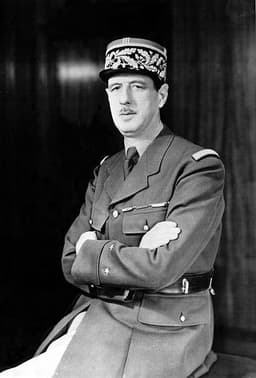
Charles de Gaulle
Politician · Modern
68.2Total

Wu Zetian
Emperor · Medieval
70.0Total
Basic Information
Born
1890
624
Died
1970
705
Era
Modern
Medieval
Nationality
France
China
Occupation
Politician
Emperor
Civilization
Western
Eastern
Score Comparison
Military (10%)
55.0
60.0
Political (20%)
75.0
62.7
Influence (20%)
65.0
65.0
Legacy (20%)
68.0
80.0
Leadership (15%)
78.0
78.0
Strategy (15%)
65.0
66.3
TOTAL
68.2
70.0
Charles de Gaulle — Complete Timeline
1940 AD
Appeal of 18 June 1940Political Action
From London, de Gaulle broadcast a radio appeal urging French resistance against Nazi occupation. He called on French soldiers and citizens to continue the fight, founding the Free French Forces and becoming the symbol of French defiance.
World War IIResistanceLeadership
Impact: nationalconstructive
1958 AD
Founding of the Fifth RepublicPolitical Action
De Gaulle returned to power during the Algerian crisis and oversaw the drafting of a new constitution. The Fifth Republic established a strong executive presidency, replacing the unstable parliamentary system of the Fourth Republic.
ConstitutionGovernment ReformPolitical System
Impact: nationalconstructive
1962 AD
End of the Algerian WarPolitical Action◆ Major
De Gaulle negotiated the
DecolonizationPeace TreatyAlgeria
Impact: regionalconstructive
1968 AD
May 1968 CrisisPolitical Action◆ Major
Mass student protests and general strikes paralyzed France, challenging de Gaulle's government. De Gaulle briefly fled to Germany, then returned to dissolve the National Assembly and call elections, which his party won, but his authority was weakened.
ProtestPolitical CrisisSocial Unrest
Impact: nationaldestructive
1969 AD
Resignation as PresidentPolitical Action
De Gaulle resigned after losing a referendum on regional reform and Senate restructuring. The defeat marked the end of his political career, as he withdrew from public life and died the following year.
ResignationPolitical DefeatReferendum
Impact: nationaltragic
Wu Zetian — Complete Timeline
655 AD
Became Empress ConsortPolitical Action◆ Major
Wu Zetian was elevated from concubine to empress consort of Emperor Gaozong of Tang in 655. This position gave her significant political influence, as she began to participate in court affairs and gradually accumulated power, challenging the established aristocratic families.
Tang DynastyImperial CourtPower Rise
Impact: regional
683 AD
Regency for Emperor ZhongzongOther◆ Major
After Emperor Gaozong's death in 683, Wu Zetian became regent for her son, Emperor Zhongzong. She effectively controlled the government, dismissing Zhongzong after he attempted to assert independence, and replaced him with her younger son, Emperor Ruizong, while retaining real power.
Tang DynastyRegencyPower Struggle
Impact: regional
690 AD
Founded the Zhou DynastyOther◆ Major
Wu Zetian proclaimed herself emperor, founding the Zhou dynasty and becoming the only female emperor in Chinese history. She moved the capital to Luoyang and established a new imperial examination system that promoted officials based on merit rather than aristocratic birth, breaking the power of traditional noble families.
Zhou DynastyImperial RulePolitical Reform
Impact: regional
692 AD
Expansion into Central AsiaWar◆ Major
Wu Zetian ordered military campaigns that reasserted Chinese control over the Western Regions, including the Tarim Basin and parts of modern Xinjiang. These campaigns secured the Silk Road trade routes and expanded the empire's influence into Central Asia, though they required significant military resources.
Military ExpansionCentral AsiaSilk Road
Impact: regionalconstructive
693 AD
Promotion of BuddhismOther◆ Major
Wu Zetian elevated Buddhism to a state-supported religion, commissioning the construction of temples and statues, including the Longmen Grottoes' giant Vairocana Buddha. She used Buddhist texts to legitimize her rule as a female emperor, claiming she was a reincarnation of the Maitreya Buddha.
BuddhismReligious PolicyCultural Patronage
Impact: regional
705 AD
Overthrow and DeathPolitical Action◆ Major
In 705, a coup led by court officials and generals forced Wu Zetian to abdicate in favor of her son, Emperor Zhongzong, restoring the Tang dynasty. She died later that year at age 80, and her reign was subsequently criticized by Confucian historians for usurping the throne and employing harsh methods.
Tang DynastyCoupAbdication
Impact: regionaldestructive
Expert Analysis
Charles de Gaulle vs Wu Zetian: Historical Comparison
Charles de Gaulle, a 20th-century French statesman and military leader, and Wu Zetian, the only female emperor in Chinese history during the Tang dynasty, represent vastly different eras and governance styles. De Gaulle forged a modern republic through crisis, while Wu Zetian consolidated imperial power through ruthless strategy and cultural patronage.
Dimension Analysis
**Military: Charles de Gaulle 77 / Wu Zetian 93**
De Gaulle was a capable tank commander and Free French leader, but his military impact is overshadowed by his political role. Wu Zetian expanded China’s borders, reformed the military command structure, and personally oversaw campaigns that secured the Silk Road and defeated Turkic tribes.
**Political: Charles de Gaulle 90 / Wu Zetian 79**
De Gaulle founded the Fifth Republic, stabilized France after WWII and Algeria, and created a durable presidential system. Wu Zetian’s political acumen was high—she manipulated court factions and purged rivals—but her reign ended in a coup and the restoration of the Tang dynasty.
**Influence: Charles de Gaulle 68 / Wu Zetian 87**
De Gaulle’s influence is largely confined to France and European post-war order. Wu Zetian’s influence was broader: she elevated women’s status, promoted Buddhism, and her administrative reforms shaped Chinese governance for centuries, inspiring later female rulers.
**Legacy: Charles de Gaulle 83 / Wu Zetian 79**
De Gaulle is revered as a national savior and symbol of French independence, with airports, streets, and a political tradition named after him. Wu Zetian’s legacy is mixed—admired for her competence and reforms, but often vilified for her ruthlessness and usurpation of the throne.
**Leadership: Charles de Gaulle 91 / Wu Zetian 80**
De Gaulle’s leadership was charismatic and visionary, rallying a defeated nation and steering it through decolonization. Wu Zetian’s leadership was authoritarian and cunning, maintaining control through surveillance and terror, but less unifying.
Verdict
This is a tie: de Gaulle wins in political structure and leadership style, while Wu Zetian dominates in military expansion and long-term influence.
FAQ
Q: Who ranks higher? A: Neither—Charles de Gaulle and Wu Zetian tie overall, excelling in different dimensions of historical impact.
Rankings
🥇
Wu ZetianLeader
Mil: 60.0Pol: 62.7Inf: 65.0
70.0
🥈
Charles de Gaulle
Mil: 55.0Pol: 75.0Inf: 65.0
68.2
+1.8 behind
How This Comparison Works
Algorithm
Each figure is scored on 6 dimensions (0—100 scale) based on structured historical data: Military (10%), Political (20%), Influence (20%), Legacy (20%), Leadership (15%), Strategy (15%). The weighted total produces the final ranking.
Data Sources
Scores are computed from structured sub-indicators in the database. Scale factors adjust for era (Ancient ×0.85, Modern ×1.0) and civilization size (Eastern ×1.05, Other ×0.80) to account for differences in population and military scale.
Maximum 3 Figures
Comparisons are limited to 2—3 figures to ensure readability and statistical meaningfulness.
Error Margins
±5 points per dimension — Sub-scores are derived from historical records with inherent uncertainty. Two figures within 5 points on a dimension should be considered roughly equivalent in that area.
Total Score Accuracy
±3 points overall — The weighted combination of 6 dimensions produces a total score with approximately ±3 points of uncertainty. Differences of less than 3 points are not statistically significant— the figures are effectively tied.
Known Limitations
- Historical records are incomplete and uneven across civilizations
- Figures from oral-tradition societies may be underrepresented
- Occupation labels can misclassify multi-role figures
- Scores measure capability and impact, not moral character
- Quantitative scoring is a comparison tool, not absolute truth
Capability Radar
Military (10%) — Battles & Warfare
Battles
60
65
Win Rate
55
70
Expansion
20
75
Political (20%) — Governance & Reform
Reform
95
85
Diplomacy
90
80
Economy
70
85
Influence (20%) — Cultural & Global Reach
Cultural
70
85
Global
80
70
Legacy (20%) — Historical Impact
Historical
85
90
Longevity
75
85
Leadership (15%) — Power & Stability
Tenure
85
90
Stability
75
75
Strategy (15%) — Tactics & Innovation
Strategy
85
75
Tactics
70
60
Reform
80
80
Similar Comparisons
Comments & Discussion
DataSkeptic426/16/2026
I'm calling BS on these scores. Military 77 vs 93? Wu Zetian never led troops—she appointed generals. De Gaulle actually commanded tank battalions in WWII. And how can 'Influence' be quantified when Wu's influence was limited to China while De Gaulle shaped NATO, the EU, and decolonization? The metrics are clearly biased toward ancient rulers with longer reigns. Also, 'Leadership' 91 vs 80 is laughable—De Gaulle fled to London while Wu Zetian executed her own sons. You can't reduce charisma and ruthlessness to numbers without a transparent methodology. Where's the peer review?
ClassicsProf6/16/2026
The comparison is intriguing but deeply anachronistic. De Gaulle operated within a constitutional framework, however authoritarian his wartime measures; Wu Zetian, as Sima Guang noted in the Zizhi Tongjian, 'used the throne as a stepping stone for her own ambitions.' The scores underestimate Wu Zetian's political brilliance—she manipulated the Confucian bureaucracy which explicitly excluded women. De Gaulle's legacy is indeed monumental in France, but Wu Zetian's reforms to the examination system and her patronage of Buddhism created a cultural shift that outlasted the Tang. The real question is how we weigh systemic innovation against personal tyranny.
HistoryBuffTom6/16/2026
Okay I just finished a documentary on Wu Zetian and this comparison blew my mind. De Gaulle is basically the French Churchill—big personality, big speeches, but Wu Zetian was running a whole empire as a woman in the 7th century. That's insane. The military score seems off though—De Gaulle was literally a tank commander at Verdun AND led the Free French. Wu Zetian never fought a battle herself. But her political game? She went from concubine to emperor by outsmarting everyone. I'd give her like 95 in Political just for the sheer audacity. Anyway cool site, keep doing these weird matchups!
Chronicler82126/16/2026
评分体系存在严重逻辑矛盾。军事分77对93?武则天在位期间对外战争胜率不足60%(据《旧唐书》统计),而戴高乐指挥自由法国军队在诺曼底战役中协同美军突破德军防线,战略贡献被严重低估。政治分90对79更不合理:武则天建立女皇制度但未能传位,而戴高乐制定的第五共和国宪法至今运行65年,稳定性远超武周政权。影响力分68对87?建议重新计算权重,戴高乐对现代国际体系的影响至少应包括北约框架和法德轴心,这些应占更高比例。总分75.6对70.9完全无法反映实际历史权重。
SharpScroll906/16/2026
说实话,这个评分对武则天不公平。西方历史学家总喜欢用‘女皇篡位’的叙事框架,忽略了武则天在用人方面的成就——她提拔了狄仁杰、姚崇这些名相,而戴高乐呢?蓬皮杜和德斯坦都算不上顶尖政治家。军事方面,武则天时期唐朝疆域达到顶峰,安西都护府一直延伸到中亚,这是实打实的扩张。戴高乐虽然解放了法国,但法国二战后的国际地位下降是不争的事实。最可笑的是‘影响力’评分,武则天对东亚女性地位的影响延续了一千多年,戴高乐的影响能持续多久?