Loading...
This comparison has not been analyzed yet.
One-time AI generation (~1 minute). Scores and timeline are already available below.
Fatos Nano vs Shaukat Aziz
Shaukat Aziz leads by 4.5 pts · 2 figures compared
…

Fatos Nano
Politician · Modern
46.2Total
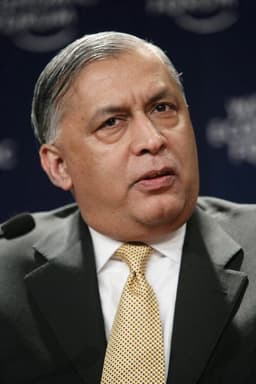
Shaukat Aziz
Politician · Modern
50.7Total
Basic Information
Born
1952
1949
Died
—
—
Era
Modern
Modern
Nationality
Albania
Pakistan
Occupation
Politician
Politician
Civilization
Western
Indian
Score Comparison
Military (10%)
50.0
35.8
Political (20%)
39.4
62.7
Influence (20%)
47.9
50.2
Legacy (20%)
39.2
38.3
Leadership (15%)
62.2
64.0
Strategy (15%)
41.4
60.0
TOTAL
46.2
50.7
Fatos Nano — Complete Timeline
1991 AD
Elected Prime Minister of AlbaniaPolitical Action◆ Major
Nano became the first post-communist Prime Minister of Albania, leading the country through its transition from communism. His government faced economic collapse and social unrest.
TransitionGovernmentAlbania
Impact: nationalconstructive
1997 AD
Resigned amid the 1997 civil unrestPolitical Action◆ Major
Nano resigned as Prime Minister after the collapse of pyramid schemes led to widespread protests and anarchy. His resignation paved the way for early elections and a period of instability.
CrisisResignationPyramid Schemes
Impact: nationaldestructive
2002 AD
Returned as Prime MinisterPolitical Action◆ Major
Nano returned as Prime Minister after his Socialist Party won the elections. He focused on Euro-Atlantic integration and economic reforms, but faced criticism for corruption.
GovernmentReformsAlbania
Impact: nationalconstructive
2005 AD
Resigned after losing party leadershipPolitical Action◆ Major
Nano resigned as Prime Minister after his party lost the 2005 elections. He later lost the leadership of the Socialist Party to Edi Rama, ending his political dominance.
ResignationParty PoliticsAlbania
Impact: nationaldestructive
Shaukat Aziz — Complete Timeline
1999 AD
Economic Reforms as Finance MinisterReform◆ Major
As Finance Minister under President Pervez Musharraf from 1999 to 2004, Shaukat Aziz implemented economic reforms including privatization of state-owned enterprises, banking sector reforms, and tax restructuring. These policies contributed to GDP growth averaging 7% annually.
Economic ReformPrivatizationMusharraf
Impact: nationalconstructive
2004 AD
Appointed Prime Minister of PakistanPolitical Action◆ Major
Shaukat Aziz was appointed as the 17th Prime Minister of Pakistan on August 28, 2004, after serving as Finance Minister. He was a former Citibank executive and his appointment marked a technocratic shift in Pakistani politics.
Prime MinisterTechnocratPakistan
Impact: national
2007 AD
Completion of Five-Year TermPolitical Action◆ Major
Shaukat Aziz completed his five-year term as Prime Minister on November 15, 2007, becoming the first Pakistani Prime Minister to serve a full term since 1977. His tenure saw continued economic growth but also rising political instability.
Term CompletionPolitical StabilityPakistan
Impact: national
This comparison has not been analyzed yet.
One-time AI generation (~1 minute). Scores and timeline are already available below.
Rankings
🥇
Shaukat AzizLeader
Mil: 35.8Pol: 62.7Inf: 50.2
50.7
🥈
Fatos Nano
Mil: 50.0Pol: 39.4Inf: 47.9
46.2
+4.5 behind
How This Comparison Works
Algorithm
Each figure is scored on 6 dimensions (0—100 scale) based on structured historical data: Military (10%), Political (20%), Influence (20%), Legacy (20%), Leadership (15%), Strategy (15%). The weighted total produces the final ranking.
Data Sources
Scores are computed from structured sub-indicators in the database. Scale factors adjust for era (Ancient ×0.85, Modern ×1.0) and civilization size (Eastern ×1.05, Other ×0.80) to account for differences in population and military scale.
Maximum 3 Figures
Comparisons are limited to 2—3 figures to ensure readability and statistical meaningfulness.
Error Margins
±5 points per dimension — Sub-scores are derived from historical records with inherent uncertainty. Two figures within 5 points on a dimension should be considered roughly equivalent in that area.
Total Score Accuracy
±3 points overall — The weighted combination of 6 dimensions produces a total score with approximately ±3 points of uncertainty. Differences of less than 3 points are not statistically significant— the figures are effectively tied.
Known Limitations
- Historical records are incomplete and uneven across civilizations
- Figures from oral-tradition societies may be underrepresented
- Occupation labels can misclassify multi-role figures
- Scores measure capability and impact, not moral character
- Quantitative scoring is a comparison tool, not absolute truth
Capability Radar
Military (10%) — Battles & Warfare
Battles
27
45
Win Rate
29
45
Expansion
33
52
Political (20%) — Governance & Reform
Reform
30
55
Diplomacy
35
50
Economy
25
65
Influence (20%) — Cultural & Global Reach
Cultural
15
10
Global
10
30
Legacy (20%) — Historical Impact
Historical
20
20
Longevity
15
10
Leadership (15%) — Power & Stability
Tenure
40
40
Stability
20
35
Strategy (15%) — Tactics & Innovation
Strategy
36
54
Tactics
40
55
Reform
43
57
Similar Comparisons
Comments & Discussion
No comments yet. Be the first to share your thoughts!