Loading...
This comparison has not been analyzed yet.
One-time AI generation (~1 minute). Scores and timeline are already available below.
Fedor von Bock vs Miguel Miramon
Fedor von Bock leads by 2.5 pts · 2 figures compared
…
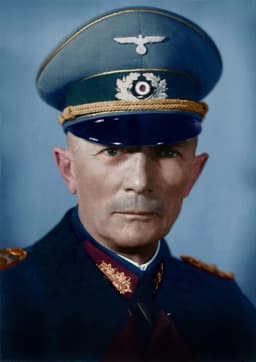
Fedor von Bock
General · Modern
50.2Total
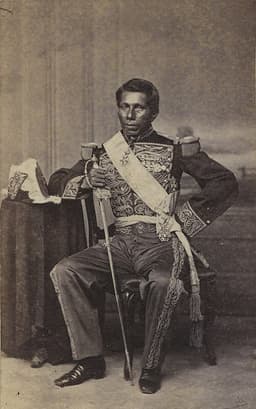
Miguel Miramon
General · Modern
47.7Total
Basic Information
Born
1880
1831
Died
1945
1867
Era
Modern
Modern
Nationality
Germany
Mexico
Occupation
General
General
Civilization
Western
Western
Score Comparison
Military (10%)
80.0
30.0
Political (20%)
27.9
39.4
Influence (20%)
58.0
51.8
Legacy (20%)
50.0
44.2
Leadership (15%)
40.4
58.8
Strategy (15%)
50.0
60.0
TOTAL
50.2
47.7
Fedor von Bock — Complete Timeline
1939 AD
Commanded Army Group North in Invasion of PolandWar◆ Major
Von Bock commanded Army Group North during the invasion of Poland. His forces advanced from Pomerania and East Prussia, encircling Polish forces. The campaign ended with the surrender of Warsaw and the partition of Poland between Germany and the Soviet Union.
World War IIInvasion of PolandArmy Group North
Impact: regionaldestructive
1941 AD
Led Army Group Center in Operation BarbarossaWar
Von Bock commanded Army Group Center, the main German force in the invasion of the Soviet Union. His forces captured Minsk, Smolensk, and advanced to the outskirts of Moscow. The campaign stalled in winter, failing to capture Moscow.
World War IIOperation BarbarossaEastern Front
Impact: globaldestructive
Battle of Moscow - German DefeatWar
Von Bock's Army Group Center launched Operation Typhoon to capture Moscow. Soviet counterattacks and harsh winter conditions halted the German advance. The failure to take Moscow marked the first major German defeat on the Eastern Front.
World War IIBattle of MoscowDefeat
Impact: globaltragic
1942 AD
Relieved of Command and RetiredPolitical Action
After the failure at Moscow, von Bock was relieved of command by Hitler. He was briefly recalled in 1942 to command Army Group South but was again dismissed after disagreements with Hitler over strategy. He retired to his estate and was killed in an air raid in 1945.
World War IIDismissalEastern Front
Impact: national
Miguel Miramon — Complete Timeline
1859 AD
Became President of MexicoPolitical Action◆ Major
Miramón became president of Mexico at age 28, the youngest in Mexican history. He led the conservative government during the War of the Reform, opposing the liberal forces of Benito Juárez.
PresidencyWar of the ReformConservative
Impact: national
1860 AD
Battle of CalpulalpanWar◆ Major
Miramón's conservative army was decisively defeated by liberal forces under Jesús González Ortega at the Battle of Calpulalpan. This defeat ended the War of the Reform and forced Miramón into exile.
War of the ReformBattleDefeat
Impact: nationaltragic
1863 AD
Returned to Mexico with French SupportWar
Miramón returned to Mexico during the French intervention, serving as a general for the imperial forces of Emperor Maximilian. He commanded troops in several battles against the republican forces.
French InterventionImperial ArmyMaximilian
Impact: national
1867 AD
Executed with MaximilianPolitical Action◆ Major
Miramón was captured by republican forces at the Siege of Querétaro. He was tried and executed by firing squad alongside Emperor Maximilian and General Tomás Mejía on the Cerro de las Campanas.
ExecutionQuerétaroMaximilian
Impact: nationaltragic
This comparison has not been analyzed yet.
One-time AI generation (~1 minute). Scores and timeline are already available below.
Rankings
🥇
Fedor von BockLeader
Mil: 80.0Pol: 27.9Inf: 58.0
50.2
🥈
Miguel Miramon
Mil: 30.0Pol: 39.4Inf: 51.8
47.7
+2.5 behind
How This Comparison Works
Algorithm
Each figure is scored on 6 dimensions (0—100 scale) based on structured historical data: Military (10%), Political (20%), Influence (20%), Legacy (20%), Leadership (15%), Strategy (15%). The weighted total produces the final ranking.
Data Sources
Scores are computed from structured sub-indicators in the database. Scale factors adjust for era (Ancient ×0.85, Modern ×1.0) and civilization size (Eastern ×1.05, Other ×0.80) to account for differences in population and military scale.
Maximum 3 Figures
Comparisons are limited to 2—3 figures to ensure readability and statistical meaningfulness.
Error Margins
±5 points per dimension — Sub-scores are derived from historical records with inherent uncertainty. Two figures within 5 points on a dimension should be considered roughly equivalent in that area.
Total Score Accuracy
±3 points overall — The weighted combination of 6 dimensions produces a total score with approximately ±3 points of uncertainty. Differences of less than 3 points are not statistically significant— the figures are effectively tied.
Known Limitations
- Historical records are incomplete and uneven across civilizations
- Figures from oral-tradition societies may be underrepresented
- Occupation labels can misclassify multi-role figures
- Scores measure capability and impact, not moral character
- Quantitative scoring is a comparison tool, not absolute truth
Capability Radar
Military (10%) — Battles & Warfare
Battles
75
55
Win Rate
70
45
Expansion
75
20
Political (20%) — Governance & Reform
Reform
10
25
Diplomacy
15
30
Economy
10
20
Influence (20%) — Cultural & Global Reach
Cultural
30
25
Global
50
15
Legacy (20%) — Historical Impact
Historical
55
35
Longevity
40
20
Leadership (15%) — Power & Stability
Tenure
20
40
Stability
15
15
Strategy (15%) — Tactics & Innovation
Strategy
70
40
Tactics
65
50
Reform
30
30
Similar Comparisons
Comments & Discussion
No comments yet. Be the first to share your thoughts!