Loading...
Fedor von Bock vs Napoleon Bonaparte
Napoleon Bonaparte leads by 20.7 pts · 2 figures compared
…
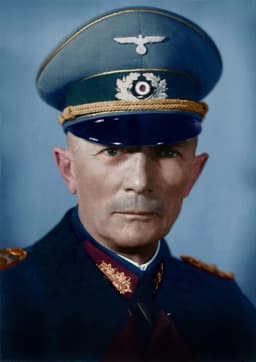
Fedor von Bock
General · Modern
50.2Total

Napoleon Bonaparte
General · Modern
70.9Total
Basic Information
Born
1880
1769
Died
1945
1821
Era
Modern
Modern
Nationality
Germany
France
Occupation
General
General
Civilization
Western
Western
Score Comparison
Military (10%)
80.0
94.0
Political (20%)
27.9
72.0
Influence (20%)
58.0
40.0
Legacy (20%)
50.0
80.0
Leadership (15%)
40.4
78.0
Strategy (15%)
50.0
90.0
TOTAL
50.2
70.9
Fedor von Bock — Complete Timeline
1939 AD
Commanded Army Group North in Invasion of PolandWar◆ Major
Von Bock commanded Army Group North during the invasion of Poland. His forces advanced from Pomerania and East Prussia, encircling Polish forces. The campaign ended with the surrender of Warsaw and the partition of Poland between Germany and the Soviet Union.
World War IIInvasion of PolandArmy Group North
Impact: regionaldestructive
1941 AD
Led Army Group Center in Operation BarbarossaWar
Von Bock commanded Army Group Center, the main German force in the invasion of the Soviet Union. His forces captured Minsk, Smolensk, and advanced to the outskirts of Moscow. The campaign stalled in winter, failing to capture Moscow.
World War IIOperation BarbarossaEastern Front
Impact: globaldestructive
Battle of Moscow - German DefeatWar
Von Bock's Army Group Center launched Operation Typhoon to capture Moscow. Soviet counterattacks and harsh winter conditions halted the German advance. The failure to take Moscow marked the first major German defeat on the Eastern Front.
World War IIBattle of MoscowDefeat
Impact: globaltragic
1942 AD
Relieved of Command and RetiredPolitical Action
After the failure at Moscow, von Bock was relieved of command by Hitler. He was briefly recalled in 1942 to command Army Group South but was again dismissed after disagreements with Hitler over strategy. He retired to his estate and was killed in an air raid in 1945.
World War IIDismissalEastern Front
Impact: national
Napoleon Bonaparte — Complete Timeline
1799 AD
Coup of 18 BrumaireOther◆ Major
Napoleon Bonaparte, with support from his brother Lucien and key political figures, overthrew the Directory in a bloodless coup. He established the Consulate with himself as First Consul, effectively becoming the ruler of France. This event ended the French Revolution's most unstable period.
French RevolutionCoupRise to Power
Impact: regional
1804 AD
Promulgation of the Napoleonic CodeOther◆ Major
Napoleon enacted the Civil Code of the French, known as the Napoleonic Code, a comprehensive set of laws that replaced the fragmented feudal legal systems. The code established legal equality, protected property rights, and secularized law. It became the basis for legal systems in many European and world countries.
Legal ReformNapoleonic CodeCivil Law
Impact: globalconstructive
1805 AD
Battle of AusterlitzWar◆ Major
Napoleon's Grande Arm
Napoleonic WarsBattleDecisive Victory
Impact: global
1812 AD
Invasion of RussiaWar◆ Major
Napoleon led the Grande Arm
Napoleonic WarsInvasionDisaster
Impact: globaldestructive
1815 AD
Battle of WaterlooWar◆ Major
Napoleon's French army was defeated by the combined forces of the Duke of Wellington's Anglo-Allied army and Gebhard Leberecht von Bl
Napoleonic WarsBattleFinal Defeat
Impact: globaldestructive
Expert Analysis
fedor-von-bock-vs-napoleon-bonaparte
# The General and the Emperor
On a frozen December morning in 1941, Field Marshal Fedor von Bock stood in the snow outside Moscow, watching his magnificent Army Group Center grind to a halt. Tanks that had rolled triumphantly across a thousand miles now sat silent, their engines seized by cold that reached forty degrees below zero. Just 120 years earlier, another general had stood in Moscow—but as a conqueror. Napoleon Bonaparte had entered the city in September 1812, expecting the Tsar's surrender. Instead, he found a burning city and the beginning of his end. Two commanders, two invasions of Russia, separated by a century but bound by the same terrible lesson: even the greatest military minds cannot defeat geography, climate, and a nation that refuses to die.
Origins
Napoleon was born in 1769 on Corsica, an island that had only recently become French. His family was minor nobility, poor enough that young Napoleone Buonaparte spoke Italian-accented French and was mocked by his classmates at military school. This outsider status forged in him an unrelenting ambition—he would prove himself not just equal to the French aristocracy, but superior to them all. The French Revolution, which erupted when he was twenty, shattered the old order and created a world where talent mattered more than birth.
Fedor von Bock was born in 1880 into precisely the world Napoleon had destroyed. His family were Prussian aristocrats with centuries of military tradition. Where Napoleon had to claw his way up, von Bock was born into the officer corps. He was raised on stories of Prussian glory and German unification, schooled in the rigid hierarchies of the Imperial Army. The world he knew was stable, ordered, and already fading—the Great War would destroy it when he was thirty-four.
Rise to Power
Napoleon's ascent was meteoric and improbable. In 1793, at age twenty-four, he drove British forces from the port of Toulon with a brilliant artillery barrage. By 1796 he commanded the Army of Italy, where he defeated larger Austrian armies through speed and daring. In 1799, at thirty, he seized power in a coup. By 1804 he crowned himself Emperor. Each step was a gamble, and each gamble paid off.
Von Bock's rise was methodical. He served as a staff officer in World War I, earning the Pour le Mérite—the Blue Max. During the interwar years, he rose steadily through the ranks of the Reichswehr. When Hitler came to power in 1933, von Bock was already a senior commander. He did not seize power; he accepted it. In 1939, at fifty-nine, he commanded Army Group North in the invasion of Poland. His forces advanced from Pomerania and East Prussia, crushing Polish resistance in weeks. He was competent, professional, and utterly loyal to the state—whichever state that happened to be.
Leadership & Governance
Napoleon ruled as much through law as through war. His Napoleonic Code, established in 1804, standardized French law, abolished feudal privileges, and spread revolutionary ideals across Europe. He appointed officials based on merit, built schools, and reformed taxation. Yet he also centralized power absolutely, suppressed dissent, and placed his brothers on thrones from Spain to Naples. His genius was administrative; his flaw was that he could never stop conquering.
Von Bock never governed. He was a soldier in the purest sense—he commanded armies, not nations. His leadership style was cold, demanding, and professional. He drove his men hard but shared their hardships. During Operation Barbarossa in 1941, his Army Group Center captured Minsk and Smolensk, encircling hundreds of thousands of Soviet soldiers. But he had no political vision beyond victory. When Hitler ordered his armies to divert south to Ukraine rather than drive straight on Moscow, von Bock protested—but obeyed. He was a technician of war, not a shaper of history.
Triumph & Tragedy
Napoleon's greatest moment came in 1805 at Austerlitz, where he destroyed a larger Austro-Russian army with a feigned retreat and devastating flank attack. His worst came in 1812, when he marched 600,000 men into Russia and returned with fewer than 100,000. The disaster broke his aura of invincibility. By 1814, Paris was occupied. He was exiled to Elba, escaped, ruled for a Hundred Days, and was finally defeated at Waterloo in 1815.
Von Bock's triumph was Operation Barbarossa's first months—the greatest military campaign in history until it failed. His tragedy was Moscow. In November 1941, his forward units reached the outskirts of the Soviet capital. Then the winter hit, Soviet reinforcements arrived, and his exhausted army was thrown back. Hitler relieved him of command in December. He was briefly recalled in 1942 to command Army Group South, but was again dismissed after disagreements. He died in 1945, killed by a British fighter-bomber while his car fled the collapsing Reich.
Character & Destiny
Napoleon burned with ambition so immense it reshaped continents. "I am not a man, but a thing," he once said—meaning he was an instrument of destiny. He believed in his own star, and for a decade, the stars obeyed. But his arrogance grew with his power. He divorced Josephine for a Habsburg princess, crowned himself emperor, and treated other nations as chess pieces. When he lost, he lost everything—but he never stopped believing he was right.
Von Bock was a man without a star. He served the Kaiser, then the Weimar Republic, then Hitler—each with the same professional detachment. He was not a Nazi; he was a Prussian officer who believed in duty, not ideology. But duty to what? When Hitler's orders became suicidal, von Bock complained but complied. He lacked Napoleon's vision, but also his megalomania. He was a magnificent instrument—but instruments do not choose their masters.
Legacy
Napoleon's legacy is written in law codes, national borders, and the very concept of modern warfare. He is remembered as a genius and a tyrant, a liberator and a conqueror. His influence score of 82.0 reflects how he reshaped Europe permanently. The Napoleonic Code governs France and inspired legal systems worldwide. He is a figure of endless fascination—the little Corsican who nearly ruled the world.
Von Bock's legacy is narrower. His military score of 81.3 marks him as a superb commander, but his political score of 63.9 reveals his limitation: he was a man of his time, not above it. He is remembered primarily by military historians, a footnote in the greater tragedy of Nazi Germany. He did not create a code, found a dynasty, or change the world. He was a general who served a terrible cause with terrible competence.
Conclusion
What separates these two men is not talent—both were brilliant commanders. What separates them is ambition and its direction. Napoleon wanted to remake the world in his image; von Bock only wanted to win the next battle. Napoleon failed spectacularly because he aimed too high; von Bock failed quietly because he aimed too low. One became a legend; the other became a lesson. And perhaps the deepest lesson is this: history remembers not those who served power, but those who seized it—for better and for worse.
Rankings
🥇
Napoleon BonaparteLeader
Mil: 94.0Pol: 72.0Inf: 40.0
70.9
🥈
Fedor von Bock
Mil: 80.0Pol: 27.9Inf: 58.0
50.2
+20.7 behind
How This Comparison Works
Algorithm
Each figure is scored on 6 dimensions (0—100 scale) based on structured historical data: Military (10%), Political (20%), Influence (20%), Legacy (20%), Leadership (15%), Strategy (15%). The weighted total produces the final ranking.
Data Sources
Scores are computed from structured sub-indicators in the database. Scale factors adjust for era (Ancient ×0.85, Modern ×1.0) and civilization size (Eastern ×1.05, Other ×0.80) to account for differences in population and military scale.
Maximum 3 Figures
Comparisons are limited to 2—3 figures to ensure readability and statistical meaningfulness.
Error Margins
±5 points per dimension — Sub-scores are derived from historical records with inherent uncertainty. Two figures within 5 points on a dimension should be considered roughly equivalent in that area.
Total Score Accuracy
±3 points overall — The weighted combination of 6 dimensions produces a total score with approximately ±3 points of uncertainty. Differences of less than 3 points are not statistically significant— the figures are effectively tied.
Known Limitations
- Historical records are incomplete and uneven across civilizations
- Figures from oral-tradition societies may be underrepresented
- Occupation labels can misclassify multi-role figures
- Scores measure capability and impact, not moral character
- Quantitative scoring is a comparison tool, not absolute truth
Capability Radar
Military (10%) — Battles & Warfare
Battles
75
95
Win Rate
70
90
Expansion
75
95
Political (20%) — Governance & Reform
Reform
10
95
Diplomacy
15
80
Economy
10
85
Influence (20%) — Cultural & Global Reach
Cultural
30
85
Global
50
90
Legacy (20%) — Historical Impact
Historical
55
95
Longevity
40
90
Leadership (15%) — Power & Stability
Tenure
20
85
Stability
15
70
Strategy (15%) — Tactics & Innovation
Strategy
70
95
Tactics
65
98
Reform
30
92
Similar Comparisons
Comments & Discussion
TheFrozenMarshal6/17/2026
Calling this a comparison is generous. Von Bock was a capable operational commander, but Napoleon was a force that reshaped continents. The scale is entirely different—Napoleon commanded the Grande Armée of 600,000 men; von Bock had maybe 1.4 million under his broader command over the whole Eastern Front, but the strategic vision wasn’t his. Napoleon’s invasion crumbled from logistics and politics; von Bock’s stalled because Hitler meddled at every turn. One made history; the other just followed
北国冤魂6/17/2026
拿破仑至少进了莫斯科,博克连城边都没碰到就冻住了。1812年的法军是败于焦土政策和俄军精髓的撤退——库图佐夫早算好了冬天。1941年德军呢?博克的中央集团军群明明在斯摩棱斯克就该停,非要去撞莫斯科的防线,结果朱可夫反攻差点把德军整个右翼打穿。拿破仑败于战略过度自信,博克败于愚蠢的战术冒进。两个都是冰雕,但一个是被冻死,另一个是自己跳进冰窟窿。