Loading...
This comparison has not been analyzed yet.
One-time AI generation (~1 minute). Scores and timeline are already available below.
Ferdinand I vs Kabarega of Bunyoro
Kabarega of Bunyoro leads by 1.0 pts · 2 figures compared
…
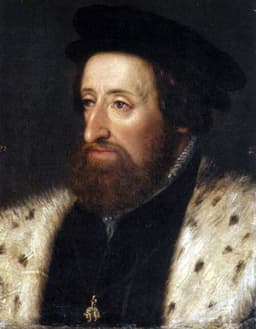
Ferdinand I
Emperor · Modern
55.8Total

Kabarega of Bunyoro
Emperor · Modern
56.8Total
Basic Information
Born
1503
1853
Died
1564
1923
Era
Modern
Modern
Nationality
Holy Roman Empire
Uganda
Occupation
Emperor
Emperor
Civilization
Western
Other
Score Comparison
Military (10%)
25.0
60.0
Political (20%)
70.0
68.0
Influence (20%)
56.4
58.0
Legacy (20%)
47.5
48.3
Leadership (15%)
72.0
53.2
Strategy (15%)
60.0
60.7
TOTAL
55.8
56.8
Ferdinand I — Complete Timeline
1555 AD
Peace of AugsburgPolitical Action
Ferdinand I played a key role in negotiating the Peace of Augsburg, which ended the religious wars between Catholics and Lutherans in the Holy Roman Empire. The treaty established the principle of 'cuius regio, eius religio' (whose realm, his religion), allowing princes to choose the religion of their territories. This was a landmark in religious tolerance.
Peace of AugsburgReligious ToleranceReformation
Impact: globalconstructive
1556 AD
Abdication of Charles VPolitical Action
Ferdinand I's brother, Emperor Charles V, abdicated the throne, dividing the Habsburg empire. Charles gave Spain and the Netherlands to his son Philip II, while Ferdinand received the Austrian lands and the title of Holy Roman Emperor. This formalized the split between the Spanish and Austrian branches of the Habsburgs.
AbdicationHabsburg DivisionImperial Succession
Impact: global
1558 AD
Coronation as Holy Roman EmperorPolitical Action◆ Major
Ferdinand I was crowned Holy Roman Emperor in Frankfurt, following the abdication of Charles V. His coronation marked the formal transfer of the imperial title to the Austrian branch of the Habsburgs. Ferdinand's reign focused on consolidating imperial authority and managing religious tensions.
CoronationImperial AuthorityHabsburg Dynasty
Impact: globalconstructive
Kabarega of Bunyoro — Complete Timeline
1869 AD
Accession as Omukama of BunyoroPolitical Action◆ Major
Kabarega became Omukama (king) of Bunyoro after the death of his father Kyebambe IV. He inherited a kingdom weakened by internal strife and external threats from Buganda and European powers.
SuccessionBunyoroUganda
Impact: regional
1870 AD
Military expansion and centralizationReform◆ Major
Kabarega modernized Bunyoro's army by introducing firearms and reorganizing military units. He expanded the kingdom's territory through conquests, subjugating neighboring chiefdoms and consolidating control over the Nile region.
Military ReformExpansionBunyoro
Impact: regional
1893 AD
Resisted British colonial expansionWar
Kabarega led a sustained guerrilla war against British forces and their Buganda allies, resisting the imposition of colonial rule. He used the terrain to his advantage, launching raids and ambushes that prolonged the conflict for years.
ResistanceColonialismWar
Impact: regional
1899 AD
Captured and exiled by the BritishPolitical Action◆ Major
Kabarega was captured by British forces after years of resistance. He was exiled to the Seychelles, ending his rule. His capture marked the final subjugation of Bunyoro under British colonial control.
CaptureExileColonialism
Impact: regionaltragic
1923 AD
Returned from exile and diedPolitical Action
Kabarega was allowed to return to Uganda in 1923 after years of exile. He died shortly after his return, never regaining his throne. His legacy as a resistance leader against colonialism endured in Bunyoro.
ReturnDeathLegacy
Impact: regionaltragic
This comparison has not been analyzed yet.
One-time AI generation (~1 minute). Scores and timeline are already available below.
Rankings
🥇
Kabarega of BunyoroLeader
Mil: 60.0Pol: 68.0Inf: 58.0
56.8
🥈
Ferdinand I
Mil: 25.0Pol: 70.0Inf: 56.4
55.8
+1.0 behind
How This Comparison Works
Algorithm
Each figure is scored on 6 dimensions (0—100 scale) based on structured historical data: Military (10%), Political (20%), Influence (20%), Legacy (20%), Leadership (15%), Strategy (15%). The weighted total produces the final ranking.
Data Sources
Scores are computed from structured sub-indicators in the database. Scale factors adjust for era (Ancient ×0.85, Modern ×1.0) and civilization size (Eastern ×1.05, Other ×0.80) to account for differences in population and military scale.
Maximum 3 Figures
Comparisons are limited to 2—3 figures to ensure readability and statistical meaningfulness.
Error Margins
±5 points per dimension — Sub-scores are derived from historical records with inherent uncertainty. Two figures within 5 points on a dimension should be considered roughly equivalent in that area.
Total Score Accuracy
±3 points overall — The weighted combination of 6 dimensions produces a total score with approximately ±3 points of uncertainty. Differences of less than 3 points are not statistically significant— the figures are effectively tied.
Known Limitations
- Historical records are incomplete and uneven across civilizations
- Figures from oral-tradition societies may be underrepresented
- Occupation labels can misclassify multi-role figures
- Scores measure capability and impact, not moral character
- Quantitative scoring is a comparison tool, not absolute truth
Capability Radar
Military (10%) — Battles & Warfare
Battles
35
65
Win Rate
40
55
Expansion
40
50
Political (20%) — Governance & Reform
Reform
65
55
Diplomacy
75
50
Economy
60
45
Influence (20%) — Cultural & Global Reach
Cultural
40
45
Global
40
35
Legacy (20%) — Historical Impact
Historical
50
50
Longevity
45
40
Leadership (15%) — Power & Stability
Tenure
70
60
Stability
55
40
Strategy (15%) — Tactics & Innovation
Strategy
45
65
Tactics
30
70
Reform
50
60
Similar Comparisons
Comments & Discussion
No comments yet. Be the first to share your thoughts!