Loading...
Ferdinand I vs Napoleon Bonaparte
Napoleon Bonaparte leads by 15.1 pts · 2 figures compared
…
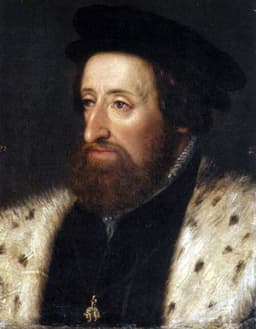
Ferdinand I
Emperor · Modern
55.8Total

Napoleon Bonaparte
General · Modern
70.9Total
Basic Information
Born
1503
1769
Died
1564
1821
Era
Modern
Modern
Nationality
Holy Roman Empire
France
Occupation
Emperor
General
Civilization
Western
Western
Score Comparison
Military (10%)
25.0
94.0
Political (20%)
70.0
72.0
Influence (20%)
56.4
40.0
Legacy (20%)
47.5
80.0
Leadership (15%)
72.0
78.0
Strategy (15%)
60.0
90.0
TOTAL
55.8
70.9
Ferdinand I — Complete Timeline
1555 AD
Peace of AugsburgPolitical Action
Ferdinand I played a key role in negotiating the Peace of Augsburg, which ended the religious wars between Catholics and Lutherans in the Holy Roman Empire. The treaty established the principle of 'cuius regio, eius religio' (whose realm, his religion), allowing princes to choose the religion of their territories. This was a landmark in religious tolerance.
Peace of AugsburgReligious ToleranceReformation
Impact: globalconstructive
1556 AD
Abdication of Charles VPolitical Action
Ferdinand I's brother, Emperor Charles V, abdicated the throne, dividing the Habsburg empire. Charles gave Spain and the Netherlands to his son Philip II, while Ferdinand received the Austrian lands and the title of Holy Roman Emperor. This formalized the split between the Spanish and Austrian branches of the Habsburgs.
AbdicationHabsburg DivisionImperial Succession
Impact: global
1558 AD
Coronation as Holy Roman EmperorPolitical Action◆ Major
Ferdinand I was crowned Holy Roman Emperor in Frankfurt, following the abdication of Charles V. His coronation marked the formal transfer of the imperial title to the Austrian branch of the Habsburgs. Ferdinand's reign focused on consolidating imperial authority and managing religious tensions.
CoronationImperial AuthorityHabsburg Dynasty
Impact: globalconstructive
Napoleon Bonaparte — Complete Timeline
1799 AD
Coup of 18 BrumaireOther◆ Major
Napoleon Bonaparte, with support from his brother Lucien and key political figures, overthrew the Directory in a bloodless coup. He established the Consulate with himself as First Consul, effectively becoming the ruler of France. This event ended the French Revolution's most unstable period.
French RevolutionCoupRise to Power
Impact: regional
1804 AD
Promulgation of the Napoleonic CodeOther◆ Major
Napoleon enacted the Civil Code of the French, known as the Napoleonic Code, a comprehensive set of laws that replaced the fragmented feudal legal systems. The code established legal equality, protected property rights, and secularized law. It became the basis for legal systems in many European and world countries.
Legal ReformNapoleonic CodeCivil Law
Impact: globalconstructive
1805 AD
Battle of AusterlitzWar◆ Major
Napoleon's Grande Arm
Napoleonic WarsBattleDecisive Victory
Impact: global
1812 AD
Invasion of RussiaWar◆ Major
Napoleon led the Grande Arm
Napoleonic WarsInvasionDisaster
Impact: globaldestructive
1815 AD
Battle of WaterlooWar◆ Major
Napoleon's French army was defeated by the combined forces of the Duke of Wellington's Anglo-Allied army and Gebhard Leberecht von Bl
Napoleonic WarsBattleFinal Defeat
Impact: globaldestructive
Expert Analysis
ferdinand-i-vs-napoleon-bonaparte
# The Emperor and the General: Ferdinand I and Napoleon Bonaparte
On a cold December morning in 1805, Napoleon Bonaparte stood atop a hill near Austerlitz, watching the morning mist lift over the frozen battlefields below. He was thirty-six years old, master of Europe, and about to win perhaps the greatest military victory of the age. Two hundred and fifty years earlier, another ruler faced a different kind of crisis—not with cannons and cavalry charges, but with ink-stained fingers and whispered negotiations. Ferdinand I, Holy Roman Emperor, spent his reign not conquering kingdoms, but stitching together a fragile peace between warring Catholics and Protestants. These two men, both products of the same Western civilization, could hardly have been more different. One built an empire through sheer force of will; the other preserved an empire through patient compromise. What drove them down such divergent paths?
Origins
Napoleon Bonaparte was born in 1769 on the island of Corsica, a rocky Mediterranean outpost that had only recently become French. His family was minor nobility, poor and proud. He spoke Italian before French, and throughout his life, he carried the chip of an outsider on his shoulder. The France of his youth was a powder keg—the ancien régime creaking toward collapse, the Enlightenment challenging every old truth. Napoleon absorbed Rousseau and Voltaire alongside his military training, a strange mix of romantic idealism and cold calculation.
Ferdinand I, born in 1503 in Alcalá de Henares, Spain, was a Habsburg through and through. He grew up in the shadow of his older brother Charles V, who inherited the most sprawling empire since Rome—Spain, the Netherlands, Austria, parts of Italy, and the Americas. Ferdinand was the second son, raised not for glory but for service. The world of his youth was dominated by Martin Luther’s Reformation, which had shattered the unity of Christendom. Every prince, every bishop, every peasant had to choose sides. Ferdinand learned early that power was not about conquest but about holding things together.
Rise to Power
Napoleon’s rise was a rocket. At twenty-four, he drove the British out of Toulon. At twenty-six, he crushed a royalist uprising in Paris with a "whiff of grapeshot." At twenty-seven, he led a ragged army into Italy and defeated the Austrians in a series of lightning campaigns. His genius was not just tactical but psychological—he understood that war was a contest of wills. He moved faster than his enemies thought possible, struck where they least expected, and turned every victory into political capital. By 1799, at age thirty, he was First Consul of France. By 1804, Emperor.
Ferdinand’s ascent was slower, more circuitous. He governed the Habsburg hereditary lands in Austria and Hungary for his brother Charles V, who was perpetually distracted by wars with France and the Ottoman Empire. Ferdinand was patient, competent, and unglamorous. When Charles abdicated in 1556, exhausted by a lifetime of trying to rule the world, Ferdinand inherited only the eastern half of the empire—Austria, Hungary, Bohemia, and the imperial crown. He was fifty-three years old, older than Napoleon would ever live to be.
Leadership & Governance
Napoleon governed like he fought—with speed, clarity, and absolute control. His Napoleonic Code standardized French law, abolished feudal privileges, and established the principle of equality before the law. He reformed education, built roads, and centralized the state. But he was a dictator. He crushed opposition, censored the press, and restored a titled nobility. His genius was organizational; his flaw was that he could never stop. Peace bored him. War defined him.
Ferdinand governed by negotiation. The Peace of Augsburg in 1555, which he helped broker, was a masterpiece of political realism. It established the principle *cuius regio, eius religio*—whose realm, his religion—allowing each German prince to choose Catholicism or Lutheranism for his territory. It was not a solution that satisfied anyone completely, but it ended decades of religious warfare. Ferdinand understood that in a fractured empire, the emperor’s power was limited. He could not command; he could only persuade. He spent his reign defending Hungary against the Ottoman Turks, not through glorious battles but through fortifications, diplomacy, and strategic marriages.
Triumph & Tragedy
Napoleon’s greatest triumph was Austerlitz in 1805, where he destroyed a combined Russian-Austrian army and forced the Holy Roman Empire to dissolve. His greatest tragedy was the invasion of Russia in 1812. He marched 600,000 men into the frozen vastness and returned with fewer than 100,000. The disaster broke his aura of invincibility. Two years later, he was exiled to Elba. He returned for one hundred days, only to be crushed at Waterloo in 1815. He died six years later on Saint Helena, a prisoner, his empire reduced to memory.
Ferdinand’s greatest triumph was the Peace of Augsburg, which gave Central Europe a generation of stability. His tragedy was more subtle. He never achieved the grandeur of his brother Charles V. He spent his life in the shadow of a more famous man, fighting a slow, grinding war against the Ottomans that never produced a decisive victory. He died in 1564, having held the empire together, but knowing that the religious divisions he had tried to manage would eventually tear it apart.
Character & Destiny
Napoleon was driven by an insatiable hunger. "Glory is fleeting," he once said, "but obscurity is forever." His personality was a furnace of ambition, intelligence, and insecurity. He needed to prove himself—to the French nobility who had looked down on him, to the crowned heads of Europe who dismissed him as a Corsican upstart. That drive made him brilliant, but it also made him reckless. He could not consolidate his victories because he could not stop seeking new ones.
Ferdinand was the opposite—moderate, cautious, aware of his limits. He did not seek glory; he sought stability. "Better a bad peace than a good war," he might have said. His personality was shaped by his position as the second son, the heir only by default. He ruled not through charisma but through patience, not through conquest but through compromise.
Legacy
Napoleon’s legacy is everywhere. The Napoleonic Code influenced legal systems across Europe and the Americas. He redrew the map of Europe, destroyed the Holy Roman Empire, and inspired nationalism from Germany to Italy. He is remembered as both a military genius and a tyrant, a man who liberated and enslaved in equal measure.
Ferdinand’s legacy is quieter but no less real. The Peace of Augsburg established the principle that states could determine their own religion, a precursor to modern ideas of sovereignty. His reign demonstrated that an empire could survive not through strength but through flexibility. He is remembered, if at all, as a footnote to his brother Charles V.
Conclusion
Standing at the opposite ends of the early modern age, Napoleon and Ferdinand embody two eternal responses to power. Napoleon believed that will could reshape the world; Ferdinand believed that the world could only be managed. Napoleon burned bright and fast, leaving a trail of fire; Ferdinand burned slow and steady, keeping the embers alive. Neither approach was perfect. Napoleon’s ambition destroyed him; Ferdinand’s caution limited him. But together, they remind us that history is not made only by the conquerors. Sometimes, the peacemakers leave the deeper mark.
Rankings
🥇
Napoleon BonaparteLeader
Mil: 94.0Pol: 72.0Inf: 40.0
70.9
🥈
Ferdinand I
Mil: 25.0Pol: 70.0Inf: 56.4
55.8
+15.1 behind
How This Comparison Works
Algorithm
Each figure is scored on 6 dimensions (0—100 scale) based on structured historical data: Military (10%), Political (20%), Influence (20%), Legacy (20%), Leadership (15%), Strategy (15%). The weighted total produces the final ranking.
Data Sources
Scores are computed from structured sub-indicators in the database. Scale factors adjust for era (Ancient ×0.85, Modern ×1.0) and civilization size (Eastern ×1.05, Other ×0.80) to account for differences in population and military scale.
Maximum 3 Figures
Comparisons are limited to 2—3 figures to ensure readability and statistical meaningfulness.
Error Margins
±5 points per dimension — Sub-scores are derived from historical records with inherent uncertainty. Two figures within 5 points on a dimension should be considered roughly equivalent in that area.
Total Score Accuracy
±3 points overall — The weighted combination of 6 dimensions produces a total score with approximately ±3 points of uncertainty. Differences of less than 3 points are not statistically significant— the figures are effectively tied.
Known Limitations
- Historical records are incomplete and uneven across civilizations
- Figures from oral-tradition societies may be underrepresented
- Occupation labels can misclassify multi-role figures
- Scores measure capability and impact, not moral character
- Quantitative scoring is a comparison tool, not absolute truth
Capability Radar
Military (10%) — Battles & Warfare
Battles
35
95
Win Rate
40
90
Expansion
40
95
Political (20%) — Governance & Reform
Reform
65
95
Diplomacy
75
80
Economy
60
85
Influence (20%) — Cultural & Global Reach
Cultural
40
85
Global
40
90
Legacy (20%) — Historical Impact
Historical
50
95
Longevity
45
90
Leadership (15%) — Power & Stability
Tenure
70
85
Stability
55
70
Strategy (15%) — Tactics & Innovation
Strategy
45
95
Tactics
30
98
Reform
50
92
Similar Comparisons
Comments & Discussion
No comments yet. Be the first to share your thoughts!