Loading...
Festus Mogae vs Julius Chan
Festus Mogae leads by 7.0 pts · 2 figures compared
…

Festus Mogae
Politician · Modern
57.9Total
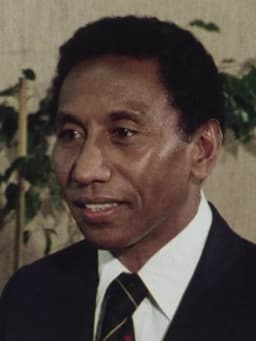
Julius Chan
Politician · Modern
50.9Total
Basic Information
Born
1939
1939
Died
—
—
Era
Modern
Modern
Nationality
Botswana
Papua New Guinea
Occupation
Politician
Politician
Civilization
Other
Other
Score Comparison
Military (10%)
49.0
23.3
Political (20%)
78.0
68.0
Influence (20%)
55.7
50.2
Legacy (20%)
45.0
40.0
Leadership (15%)
78.0
74.0
Strategy (15%)
43.9
47.2
TOTAL
57.9
50.9
Festus Mogae — Complete Timeline
1992 AD
Appointed Vice President of BotswanaPolitical Action◆ Major
Mogae was appointed Vice President by President Quett Masire. He was responsible for economic planning and helped manage Botswana's diamond wealth.
Vice PresidencyEconomic Management
Impact: nationalconstructive
1998 AD
Became President of BotswanaPolitical Action
Mogae became President of Botswana on April 1, 1998, succeeding Quett Masire. He continued the country's tradition of democratic governance and sound economic policies.
PresidencyDemocratic Succession
Impact: nationalconstructive
2001 AD
Launched the Botswana HIV/AIDS programReform
Mogae's government launched a comprehensive national HIV/AIDS treatment program, providing free antiretroviral drugs. This was one of Africa's most ambitious responses to the epidemic, reducing mortality rates.
Public HealthHIV/AIDS Response
Impact: nationalprogressive
2004 AD
Re-elected President (2004)Political Action◆ Major
Mogae was re-elected in the 2004 general election with a landslide victory. His second term focused on economic diversification and poverty reduction.
Re-electionEconomic Diversification
Impact: nationalconstructive
2008 AD
Retired as PresidentPolitical Action◆ Major
Mogae retired as President in April 2008, handing power to his Vice President, Ian Khama. His retirement was peaceful and constitutional, maintaining Botswana's democratic record.
RetirementDemocratic Transition
Impact: nationalconstructive
Julius Chan — Complete Timeline
1994 AD
1994 Appointment as Prime MinisterPolitical Action◆ Major
Chan became Prime Minister of Papua New Guinea for the first time, serving until 1997. His government focused on economic development and infrastructure projects.
GovernmentLeadershipEconomic Development
Impact: national
1997 AD
1997 Sandline AffairPolitical Action◆ Major
Chan's government hired the mercenary group Sandline International to suppress a rebellion on Bougainville Island. The deal sparked a political crisis, leading to protests and Chan's resignation in 1997.
MercenaryBougainvillePolitical Crisis
Impact: nationaldestructive
1997 Resignation as Prime MinisterPolitical Action◆ Major
Chan resigned as Prime Minister in July 1997 following the Sandline Affair and a vote of no confidence. He was succeeded by Bill Skate.
ResignationPolitical CrisisNo Confidence
Impact: national
1999 AD
1999 Return as Prime MinisterPolitical Action◆ Major
Chan returned as Prime Minister in 1999, serving until 2002. His second term focused on economic reforms and improving relations with Australia.
Return to PowerGovernmentEconomic Reform
Impact: national
2002 AD
2002 General Election DefeatPolitical Action◆ Major
Chan's government was defeated in the 2002 general election. He stepped down as Prime Minister, marking the end of his political career at the national level.
Election DefeatGovernment ChangeEnd of Career
Impact: national
Expert Analysis
Origins
Festus Mogae was born on August 21, 1939, in Serowe, Botswana, into a modest family. He studied economics at the University of Oxford and later at the University of Sussex, earning a master's degree in development economics. His education shaped his focus on fiscal discipline and long-term planning. Julius Chan was born on August 29, 1939, on Tanga Island, Papua New Guinea, to a Chinese immigrant father and a local mother. He attended the University of Papua New Guinea and later studied at the University of Queensland in Australia. His background in business and commerce influenced his pragmatic approach to governance.
Rise to Power
Mogae rose through Botswana's civil service, becoming Permanent Secretary to the President in the 1970s. He was appointed Vice President in 1992 under Quett Masire, overseeing economic planning and diamond revenue management. On April 1, 1998, he became President, continuing Botswana's tradition of stable, democratic transitions. Chan entered politics in 1972, winning a seat in the House of Assembly. He served as Finance Minister in the 1980s, building a reputation for economic management. He became Prime Minister for the first time in 1994, after the resignation of Paias Wingti. His ascent was marked by coalition-building and navigating ethnic tensions.
Leadership & Governance
Mogae's leadership was characterized by technocratic, consensus-driven governance. He maintained Botswana's fiscal conservatism, balancing budgets and avoiding debt. His government launched a comprehensive HIV/AIDS treatment program in 2002, providing free antiretroviral drugs to all citizens, which reduced infection rates from 37% to 25% by 2008. Chan's governance was more transactional and crisis-prone. He focused on infrastructure projects and economic liberalization but struggled with corruption and instability. His hiring of Sandline International in 1997 to quell the Bougainville rebellion backfired, leading to a constitutional crisis and his resignation. Mogae scored 78.0 in political leadership, while Chan scored 68.0, reflecting their differing effectiveness.
Triumph & Tragedy
Mogae's greatest triumph was his economic stewardship: Botswana achieved average GDP growth of 6% annually during his tenure, with low inflation and foreign reserves. His HIV/AIDS program was a model for Africa. His tragedy was the failure to diversify the economy away from diamonds, leaving Botswana vulnerable to commodity price shocks. Chan's triumph was overseeing economic growth in the 1990s, with GDP averaging 4% annually. His tragedy was the Sandline Affair, which tarnished his reputation and destabilized his government. He also failed to resolve the Bougainville conflict, which continued for years. Mogae's legacy score of 45.0 exceeds Chan's 40.0, reflecting more enduring achievements.
Character & Destiny
Mogae was disciplined, analytical, and risk-averse. He prioritized stability and gradual reform, avoiding bold moves that could disrupt Botswana's consensus. His character aligned with Botswana's political culture, leading to a smooth transition of power in 2008. Chan was ambitious and pragmatic, often taking risks to achieve goals. His willingness to hire mercenaries showed a decisive but flawed judgment. His destiny was shaped by the volatile politics of Papua New Guinea, where no prime minister had served a full term since independence. Chan's score of 74.0 in leadership reflects his resilience, but his strategic score of 47.2 indicates poor decision-making in crises.
Legacy
Mogae is remembered as a steward of Botswana's prosperity and a champion of public health. His HIV/AIDS program saved tens of thousands of lives and influenced global policy. Botswana remains a stable democracy, with peaceful transitions of power. Chan's legacy is mixed: he is credited with economic reforms but criticized for the Sandline Affair. Papua New Guinea's political instability persisted after his tenure. Mogae's influence score of 55.7 exceeds Chan's 50.2, as his model of development is studied in Africa. Chan's impact is more localized and contested.
Conclusion
Festus Mogae had a greater impact than Julius Chan. His total score of 57.9 versus Chan's 50.9 reflects superior leadership, governance, and legacy. Mogae's effective management of Botswana's diamond wealth and his transformative HIV/AIDS program produced tangible, lasting benefits. Chan's tenure was marred by crisis and unfulfilled potential. While both leaders faced challenges, Mogae's technocratic approach delivered stability and growth, whereas Chan's gamble with mercenaries undermined his achievements. In the history of developing nations, Mogae stands as a model of prudent governance, while Chan serves as a cautionary tale of ambition without institutional support.
Rankings
🥇
Festus MogaeLeader
Mil: 49.0Pol: 78.0Inf: 55.7
57.9
🥈
Julius Chan
Mil: 23.3Pol: 68.0Inf: 50.2
50.9
+7.0 behind
How This Comparison Works
Algorithm
Each figure is scored on 6 dimensions (0—100 scale) based on structured historical data: Military (10%), Political (20%), Influence (20%), Legacy (20%), Leadership (15%), Strategy (15%). The weighted total produces the final ranking.
Data Sources
Scores are computed from structured sub-indicators in the database. Scale factors adjust for era (Ancient ×0.85, Modern ×1.0) and civilization size (Eastern ×1.05, Other ×0.80) to account for differences in population and military scale.
Maximum 3 Figures
Comparisons are limited to 2—3 figures to ensure readability and statistical meaningfulness.
Error Margins
±5 points per dimension — Sub-scores are derived from historical records with inherent uncertainty. Two figures within 5 points on a dimension should be considered roughly equivalent in that area.
Total Score Accuracy
±3 points overall — The weighted combination of 6 dimensions produces a total score with approximately ±3 points of uncertainty. Differences of less than 3 points are not statistically significant— the figures are effectively tied.
Known Limitations
- Historical records are incomplete and uneven across civilizations
- Figures from oral-tradition societies may be underrepresented
- Occupation labels can misclassify multi-role figures
- Scores measure capability and impact, not moral character
- Quantitative scoring is a comparison tool, not absolute truth
Capability Radar
Military (10%) — Battles & Warfare
Battles
24
23
Win Rate
24
30
Expansion
27
32
Political (20%) — Governance & Reform
Reform
75
45
Diplomacy
70
50
Economy
85
40
Influence (20%) — Cultural & Global Reach
Cultural
30
20
Global
35
20
Legacy (20%) — Historical Impact
Historical
40
25
Longevity
30
15
Leadership (15%) — Power & Stability
Tenure
60
55
Stability
80
35
Strategy (15%) — Tactics & Innovation
Strategy
29
36
Tactics
34
36
Reform
35
41
Similar Comparisons
Comments & Discussion
No comments yet. Be the first to share your thoughts!