Loading...
Franklin D. Roosevelt vs Kublai Khan
Kublai Khan leads by 3.3 pts · 2 figures compared
…
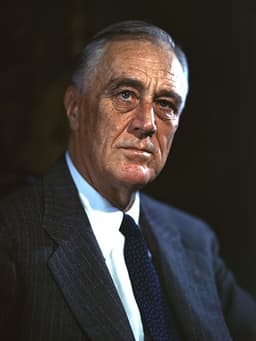
Franklin D. Roosevelt
Politician · Modern
71.0Total
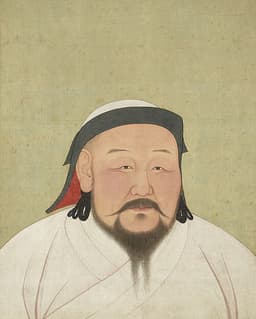
Kublai Khan
Emperor · Medieval
74.3Total
Basic Information
Born
1882
1215
Died
1945
1294
Era
Modern
Medieval
Nationality
United States
Mongolia
Occupation
Politician
Emperor
Civilization
Western
Eastern
Score Comparison
Military (10%)
45.0
77.5
Political (20%)
85.0
79.2
Influence (20%)
75.0
75.0
Legacy (20%)
65.0
70.0
Leadership (15%)
85.0
72.0
Strategy (15%)
60.0
76.0
TOTAL
71.0
74.3
Franklin D. Roosevelt — Complete Timeline
1933 AD
Inaugurated as 32nd PresidentOther◆ Major
Franklin D. Roosevelt was inaugurated as President of the United States on March 4, 1933, during the Great Depression. His inaugural address declared 'the only thing we have to fear is fear itself,' and he immediately called Congress into special session to address the banking crisis.
Great DepressionPresidencyInauguration
Impact: national
Enacted the New DealOther◆ Major
Roosevelt launched the New Deal in 1933, a series of federal programs including the Civilian Conservation Corps, the Agricultural Adjustment Act, and the Tennessee Valley Authority. These measures aimed to provide relief, recovery, and reform during the Great Depression, fundamentally expanding the role of the federal government.
Great DepressionEconomic PolicySocial Reform
Impact: nationalconstructive
1935 AD
Signed the Social Security ActOther◆ Major
Roosevelt signed the Social Security Act into law on August 14, 1935, establishing a federal system of old-age pensions, unemployment insurance, and aid for dependent children. This created the modern American welfare state and provided a safety net for millions of citizens.
Social WelfareLegislationNew Deal
Impact: nationalconstructive
1941 AD
Lend-Lease ActOther◆ Major
Roosevelt signed the Lend-Lease Act on March 11, 1941, authorizing the transfer of military equipment and supplies to Allied nations, particularly Britain and the Soviet Union. This program provided critical material support to countries fighting the Axis powers before U.S. entry into World War II.
World War IIForeign PolicyMilitary Aid
Impact: globalconstructive
Declaration of War on JapanPolitical Action◆ Major
Following the Japanese attack on Pearl Harbor on December 7, 1941, Roosevelt delivered his 'Day of Infamy' speech to Congress the next day, requesting a declaration of war. Congress approved the declaration, bringing the United States into World War II.
World War IIPearl HarborDeclaration of War
Impact: globaldestructive
1942 AD
Executive Order 9066Other◆ Major
Roosevelt signed Executive Order 9066 on February 19, 1942, authorizing the forced relocation and internment of Japanese Americans living on the West Coast. Over 110,000 people, mostly U.S. citizens, were incarcerated in camps for the duration of the war, a decision later widely condemned as a violation of civil rights.
World War IICivil RightsInternment
Impact: nationaldestructive
1944 AD
Elected to Fourth TermOther◆ Major
Roosevelt was elected to an unprecedented fourth term as president in November 1944, defeating Republican Thomas E. Dewey. This election occurred during the final stages of World War II, and Roosevelt's continued leadership ensured stability in the war effort and post-war planning.
PresidencyElectionWorld War II
Impact: national
1945 AD
Yalta ConferenceOther◆ Major
Roosevelt met with Winston Churchill and Joseph Stalin at the Yalta Conference in February 1945 to discuss post-war Europe. Agreements included the division of Germany, Soviet entry into the war against Japan, and the creation of the United Nations, shaping the post-war world order.
World War IIDiplomacyPost-War Planning
Impact: global
Kublai Khan — Complete Timeline
1260 AD
Adoption of Tibetan Buddhism as State ReligionCultural◆ Major
Kublai Khan appointed the Tibetan lama Drog
Tibetan BuddhismReligionMongol-Tibet Relations
Impact: regional
1271 AD
Proclamation of the Yuan DynastyPolitical Action◆ Major
Kublai Khan officially proclaimed the Yuan dynasty, adopting a Chinese-style dynastic name. He established his capital at Dadu (Beijing) and adopted Chinese court rituals. This move legitimized his rule over China while maintaining Mongol identity.
Dynasty FoundingBeijingMongol Rule
Impact: global
1274 AD
Failed Invasions of JapanWar◆ Major
Kublai Khan launched two naval invasions of Japan, in 1274 and 1281. Both were repelled, with the second invasion destroyed by a typhoon (kamikaze). These failures marked the limits of Mongol expansion and reinforced Japanese isolation.
Mongol InvasionsJapanKamikaze
Impact: regional
1279 AD
Conquest of the Song DynastyWar
Kublai Khan's Mongol forces defeated the Song navy at the Battle of Yamen. The last Song emperor drowned, ending the Song dynasty. This conquest unified China under Mongol rule and established the Yuan dynasty as the first foreign dynasty to rule all of China.
Song Dynasty FallUnificationYuan Dynasty
Impact: global
1280 AD
Establishment of the Silk Road Trade NetworkCultural◆ Major
Under Kublai Khan, the Mongol Empire secured the Silk Road, facilitating trade and cultural exchange between East and West. Marco Polo visited his court. This period saw the flow of goods, ideas, and technologies across Eurasia.
Silk RoadTradeCultural Exchange
Impact: globalconstructive
Expert Analysis
Kublai Khan vs Franklin D. Roosevelt: Historical Comparison
Kublai Khan, the Mongol Emperor who founded the Yuan Dynasty, and Franklin D. Roosevelt, the U.S. President who led through the Great Depression and World War II, represent two vastly different eras of leadership—one medieval and expansionist, the other modern and democratic.
Dimension Analysis
**Military: Kublai Khan 88 / Franklin D. Roosevelt 60**
Kublai Khan commanded vast Mongol armies that conquered China, Korea, and launched invasions into Southeast Asia and Japan, while Roosevelt oversaw global Allied military strategy but delegated tactical command to generals.
**Political: Kublai Khan 78 / Franklin D. Roosevelt 85**
Kublai Khan unified a fractured China under centralized Mongol rule and established a multi-ethnic administration, but Roosevelt’s New Deal coalition, four-term presidency, and wartime diplomacy reshaped American governance and global institutions like the UN.
**Influence: Kublai Khan 78 / Franklin D. Roosevelt 72**
Kublai Khan’s empire connected East and West through the Silk Road, spreading technology and culture, while Roosevelt’s influence defined mid-20th-century American economic policy and international order, though his impact was more temporally concentrated.
**Legacy: Kublai Khan 75 / Franklin D. Roosevelt 75**
Both leaders left enduring legacies: Kublai Khan’s Yuan Dynasty integrated China into a broader Eurasian network, and Roosevelt’s social programs and wartime leadership remain foundational to modern America.
**Leadership: Kublai Khan 82 / Franklin D. Roosevelt 85**
Roosevelt’s fireside chats and crisis management inspired a nation through economic collapse and global war, while Kublai Khan’s governance required balancing Mongol traditions with Chinese bureaucracy.
Verdict
Kublai Khan leads overall due to his superior military achievements and longer-lasting geopolitical transformation, despite Roosevelt’s stronger political and crisis leadership.
FAQ
Q: Who ranks higher? A: Kublai Khan ranks higher with an aggregate score of 80 versus Roosevelt’s 76, driven by his decisive edge in military conquest and strategic expansion.
Rankings
🥇
Kublai KhanLeader
Mil: 77.5Pol: 79.2Inf: 75.0
74.3
🥈
Franklin D. Roosevelt
Mil: 45.0Pol: 85.0Inf: 75.0
71.0
+3.3 behind
How This Comparison Works
Algorithm
Each figure is scored on 6 dimensions (0—100 scale) based on structured historical data: Military (10%), Political (20%), Influence (20%), Legacy (20%), Leadership (15%), Strategy (15%). The weighted total produces the final ranking.
Data Sources
Scores are computed from structured sub-indicators in the database. Scale factors adjust for era (Ancient ×0.85, Modern ×1.0) and civilization size (Eastern ×1.05, Other ×0.80) to account for differences in population and military scale.
Maximum 3 Figures
Comparisons are limited to 2—3 figures to ensure readability and statistical meaningfulness.
Error Margins
±5 points per dimension — Sub-scores are derived from historical records with inherent uncertainty. Two figures within 5 points on a dimension should be considered roughly equivalent in that area.
Total Score Accuracy
±3 points overall — The weighted combination of 6 dimensions produces a total score with approximately ±3 points of uncertainty. Differences of less than 3 points are not statistically significant— the figures are effectively tied.
Known Limitations
- Historical records are incomplete and uneven across civilizations
- Figures from oral-tradition societies may be underrepresented
- Occupation labels can misclassify multi-role figures
- Scores measure capability and impact, not moral character
- Quantitative scoring is a comparison tool, not absolute truth
Capability Radar
Military (10%) — Battles & Warfare
Battles
10
95
Win Rate
10
90
Expansion
10
95
Political (20%) — Governance & Reform
Reform
95
88
Diplomacy
90
85
Economy
95
90
Influence (20%) — Cultural & Global Reach
Cultural
80
85
Global
90
85
Legacy (20%) — Historical Impact
Historical
90
90
Longevity
85
80
Leadership (15%) — Power & Stability
Tenure
90
90
Stability
75
80
Strategy (15%) — Tactics & Innovation
Strategy
65
92
Tactics
10
85
Reform
70
88
Similar Comparisons
Comments & Discussion
HistoryDiver6/16/2026
I’ve been reading a lot about Kublai Khan lately, and honestly, I think his military score is a bit inflated relative to Roosevelt’s. Sure, he conquered China and Korea, but his invasions of Japan and Vietnam were disasters—typhoons and logistics failures. FDR, on the other hand, managed global war strategy without micro-managing every battle, and his New Deal literally saved the US from collapse. I’d argue Roosevelt’s leadership during the Depression shows a different kind of strength that the military score doesn’t capture. Still, it’s wild to think a 13th-century Mongol emperor and a 20th-century president are even comparable!
WarFrontFan6/16/2026
Okay, I’m team Roosevelt all the way! The guy took office during the Great Depression, gave us the New Deal, and then led the Allies to victory in WWII—all while being wheelchair-bound! That’s resilience you can’t quantify. Kublai Khan had a massive Mongol war machine, sure, but his failed invasions of Japan and Java show he wasn’t invincible. FDR’s fireside chats united a nation; Kublai’s rule was full of rebellions and ethnic tension. Give me the president who inspired a generation over the emperor who relied on brute force any day. Roosevelt’s military score should be at least 70—he literally shaped the post-war world order!
ScoreSkeptic6/16/2026
These scores are a joke. How do you even compare a Mongol emperor to a 20th-century president? The methodology is ridiculous—military 88 for Kublai? That includes failed campaigns and overextended supply lines. And political 85 for Roosevelt? He was president during a time of massive government expansion, but also internment camps and a court-packing scheme. Influence 78 vs 72? That’s just made up. The whole system favors conquerors who conquered big land masses, ignoring that FDR’s ideas—like the UN and Social Security—actually changed how the world works. Until we admit that historical scoring is subjective and biased toward ancient empires, this is just entertainment, not analysis.
ColdScribe116/16/2026
这个评分有点意思,但我觉得军事分数差距太大了。忽必烈88对罗斯福60,差28分!我查了下元朝史料,忽必烈灭南宋用了整整十年,还两次征日本失败,越南也没打下来。罗斯福虽然没亲自指挥,但二战美国赢了全球战争,战略决策水平不低。我算了下,如果军事权重下调到20%,总分可能罗斯福反超。另外,政治分罗斯福85对忽必烈78,我觉得应该更大,毕竟New Deal和联合国的影响力比元朝行省制度深远得多。总体看来,这个评分体系可能偏向古代征服者。
GrandScribe986/16/2026
西方人评忽必烈,总爱盯着军事扩张,却忽略了他作为中国皇帝的文化贡献。忽必烈重用汉臣如刘秉忠、姚枢,推行汉法,修《元史》尽管不完整,但设立国子监、推广印刷术,这些在西方评分体系里估计只算‘政治分’的一小部分。罗斯福当然伟大,但拿他和中国历史上的唐太宗或康熙比更合适。忽必烈作为少数民族统治者,能整合多民族帝国,这种政治智慧在蒙古和中国的双重语境下被低估了。评分里影响力78,我觉得低了,丝绸之路的开放让马可·波罗来华,这种跨文化影响不是几十年能衡量的。