Loading...
This comparison has not been analyzed yet.
One-time AI generation (~1 minute). Scores and timeline are already available below.
Franklin D. Roosevelt vs Lynden Pindling
Franklin D. Roosevelt leads by 12.1 pts · 2 figures compared
…
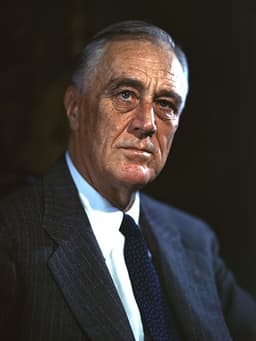
Franklin D. Roosevelt
Politician · Modern
71.0Total

Lynden Pindling
Politician · Modern
58.9Total
Basic Information
Born
1882
1930
Died
1945
—
Era
Modern
Modern
Nationality
United States
Bahamas
Occupation
Politician
Politician
Civilization
Western
Western
Score Comparison
Military (10%)
45.0
49.1
Political (20%)
85.0
70.0
Influence (20%)
75.0
56.7
Legacy (20%)
65.0
52.0
Leadership (15%)
85.0
80.0
Strategy (15%)
60.0
43.5
TOTAL
71.0
58.9
Franklin D. Roosevelt — Complete Timeline
1933 AD
Inaugurated as 32nd PresidentOther◆ Major
Franklin D. Roosevelt was inaugurated as President of the United States on March 4, 1933, during the Great Depression. His inaugural address declared 'the only thing we have to fear is fear itself,' and he immediately called Congress into special session to address the banking crisis.
Great DepressionPresidencyInauguration
Impact: national
Enacted the New DealOther◆ Major
Roosevelt launched the New Deal in 1933, a series of federal programs including the Civilian Conservation Corps, the Agricultural Adjustment Act, and the Tennessee Valley Authority. These measures aimed to provide relief, recovery, and reform during the Great Depression, fundamentally expanding the role of the federal government.
Great DepressionEconomic PolicySocial Reform
Impact: nationalconstructive
1935 AD
Signed the Social Security ActOther◆ Major
Roosevelt signed the Social Security Act into law on August 14, 1935, establishing a federal system of old-age pensions, unemployment insurance, and aid for dependent children. This created the modern American welfare state and provided a safety net for millions of citizens.
Social WelfareLegislationNew Deal
Impact: nationalconstructive
1941 AD
Lend-Lease ActOther◆ Major
Roosevelt signed the Lend-Lease Act on March 11, 1941, authorizing the transfer of military equipment and supplies to Allied nations, particularly Britain and the Soviet Union. This program provided critical material support to countries fighting the Axis powers before U.S. entry into World War II.
World War IIForeign PolicyMilitary Aid
Impact: globalconstructive
Declaration of War on JapanPolitical Action◆ Major
Following the Japanese attack on Pearl Harbor on December 7, 1941, Roosevelt delivered his 'Day of Infamy' speech to Congress the next day, requesting a declaration of war. Congress approved the declaration, bringing the United States into World War II.
World War IIPearl HarborDeclaration of War
Impact: globaldestructive
1942 AD
Executive Order 9066Other◆ Major
Roosevelt signed Executive Order 9066 on February 19, 1942, authorizing the forced relocation and internment of Japanese Americans living on the West Coast. Over 110,000 people, mostly U.S. citizens, were incarcerated in camps for the duration of the war, a decision later widely condemned as a violation of civil rights.
World War IICivil RightsInternment
Impact: nationaldestructive
1944 AD
Elected to Fourth TermOther◆ Major
Roosevelt was elected to an unprecedented fourth term as president in November 1944, defeating Republican Thomas E. Dewey. This election occurred during the final stages of World War II, and Roosevelt's continued leadership ensured stability in the war effort and post-war planning.
PresidencyElectionWorld War II
Impact: national
1945 AD
Yalta ConferenceOther◆ Major
Roosevelt met with Winston Churchill and Joseph Stalin at the Yalta Conference in February 1945 to discuss post-war Europe. Agreements included the division of Germany, Soviet entry into the war against Japan, and the creation of the United Nations, shaping the post-war world order.
World War IIDiplomacyPost-War Planning
Impact: global
Lynden Pindling — Complete Timeline
1953 AD
Founded the Progressive Liberal PartyPolitical Action◆ Major
Pindling was a founding member of the Progressive Liberal Party (PLP), which became the dominant political force in the Bahamas. The PLP championed majority rule and independence.
Political PartyFoundingPLP
Impact: nationalconstructive
1967 AD
Won the 1967 General ElectionPolitical Action
Pindling's PLP won the 1967 general election, ending centuries of white minority rule in the Bahamas. This victory marked the beginning of majority rule and paved the way for independence.
Election VictoryMajority RuleEnd of Minority Rule
Impact: nationalprogressive
1973 AD
Led Bahamas to IndependencePolitical Action
Pindling, as Premier, led the Bahamas to independence from the United Kingdom on July 10, 1973. He became the first Prime Minister of the newly sovereign nation, a key moment in Caribbean decolonization.
IndependenceNation-buildingDecolonization
Impact: nationalconstructive
1992 AD
Resigned Amid Corruption AllegationsPolitical Action◆ Major
Pindling resigned as Prime Minister in 1992 after the PLP lost the general election. His later years were marred by allegations of corruption and links to drug trafficking, though he was never convicted.
ResignationCorruption AllegationsElection Defeat
Impact: nationaltragic
This comparison has not been analyzed yet.
One-time AI generation (~1 minute). Scores and timeline are already available below.
Rankings
🥇
Franklin D. RooseveltLeader
Mil: 45.0Pol: 85.0Inf: 75.0
71.0
🥈
Lynden Pindling
Mil: 49.1Pol: 70.0Inf: 56.7
58.9
+12.1 behind
How This Comparison Works
Algorithm
Each figure is scored on 6 dimensions (0—100 scale) based on structured historical data: Military (10%), Political (20%), Influence (20%), Legacy (20%), Leadership (15%), Strategy (15%). The weighted total produces the final ranking.
Data Sources
Scores are computed from structured sub-indicators in the database. Scale factors adjust for era (Ancient ×0.85, Modern ×1.0) and civilization size (Eastern ×1.05, Other ×0.80) to account for differences in population and military scale.
Maximum 3 Figures
Comparisons are limited to 2—3 figures to ensure readability and statistical meaningfulness.
Error Margins
±5 points per dimension — Sub-scores are derived from historical records with inherent uncertainty. Two figures within 5 points on a dimension should be considered roughly equivalent in that area.
Total Score Accuracy
±3 points overall — The weighted combination of 6 dimensions produces a total score with approximately ±3 points of uncertainty. Differences of less than 3 points are not statistically significant— the figures are effectively tied.
Known Limitations
- Historical records are incomplete and uneven across civilizations
- Figures from oral-tradition societies may be underrepresented
- Occupation labels can misclassify multi-role figures
- Scores measure capability and impact, not moral character
- Quantitative scoring is a comparison tool, not absolute truth
Capability Radar
Military (10%) — Battles & Warfare
Battles
10
31
Win Rate
10
29
Expansion
10
37
Political (20%) — Governance & Reform
Reform
95
75
Diplomacy
90
80
Economy
95
65
Influence (20%) — Cultural & Global Reach
Cultural
80
60
Global
90
55
Legacy (20%) — Historical Impact
Historical
90
70
Longevity
85
55
Leadership (15%) — Power & Stability
Tenure
90
85
Stability
75
70
Strategy (15%) — Tactics & Innovation
Strategy
65
37
Tactics
10
42
Reform
70
46
Similar Comparisons
Comments & Discussion
No comments yet. Be the first to share your thoughts!