Loading...
Franklin D. Roosevelt vs Nelson Mandela
Franklin D. Roosevelt leads by 14.0 pts · 2 figures compared
…
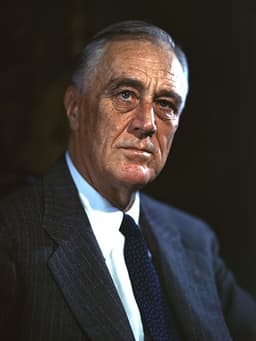
Franklin D. Roosevelt
Politician · Modern
71.0Total
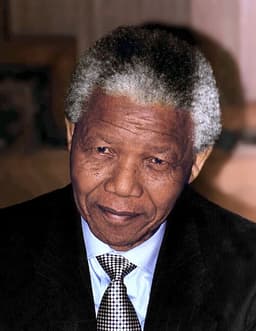
Nelson Mandela
Politician · Modern
57.0Total
Basic Information
Born
1882
1918
Died
1945
2013
Era
Modern
Modern
Nationality
United States
South Africa
Occupation
Politician
Politician
Civilization
Western
Other
Score Comparison
Military (10%)
45.0
10.0
Political (20%)
85.0
78.0
Influence (20%)
75.0
40.0
Legacy (20%)
65.0
68.0
Leadership (15%)
85.0
82.0
Strategy (15%)
60.0
50.0
TOTAL
71.0
57.0
Franklin D. Roosevelt — Complete Timeline
1933 AD
Inaugurated as 32nd PresidentOther◆ Major
Franklin D. Roosevelt was inaugurated as President of the United States on March 4, 1933, during the Great Depression. His inaugural address declared 'the only thing we have to fear is fear itself,' and he immediately called Congress into special session to address the banking crisis.
Great DepressionPresidencyInauguration
Impact: national
Enacted the New DealOther◆ Major
Roosevelt launched the New Deal in 1933, a series of federal programs including the Civilian Conservation Corps, the Agricultural Adjustment Act, and the Tennessee Valley Authority. These measures aimed to provide relief, recovery, and reform during the Great Depression, fundamentally expanding the role of the federal government.
Great DepressionEconomic PolicySocial Reform
Impact: nationalconstructive
1935 AD
Signed the Social Security ActOther◆ Major
Roosevelt signed the Social Security Act into law on August 14, 1935, establishing a federal system of old-age pensions, unemployment insurance, and aid for dependent children. This created the modern American welfare state and provided a safety net for millions of citizens.
Social WelfareLegislationNew Deal
Impact: nationalconstructive
1941 AD
Lend-Lease ActOther◆ Major
Roosevelt signed the Lend-Lease Act on March 11, 1941, authorizing the transfer of military equipment and supplies to Allied nations, particularly Britain and the Soviet Union. This program provided critical material support to countries fighting the Axis powers before U.S. entry into World War II.
World War IIForeign PolicyMilitary Aid
Impact: globalconstructive
Declaration of War on JapanPolitical Action◆ Major
Following the Japanese attack on Pearl Harbor on December 7, 1941, Roosevelt delivered his 'Day of Infamy' speech to Congress the next day, requesting a declaration of war. Congress approved the declaration, bringing the United States into World War II.
World War IIPearl HarborDeclaration of War
Impact: globaldestructive
1942 AD
Executive Order 9066Other◆ Major
Roosevelt signed Executive Order 9066 on February 19, 1942, authorizing the forced relocation and internment of Japanese Americans living on the West Coast. Over 110,000 people, mostly U.S. citizens, were incarcerated in camps for the duration of the war, a decision later widely condemned as a violation of civil rights.
World War IICivil RightsInternment
Impact: nationaldestructive
1944 AD
Elected to Fourth TermOther◆ Major
Roosevelt was elected to an unprecedented fourth term as president in November 1944, defeating Republican Thomas E. Dewey. This election occurred during the final stages of World War II, and Roosevelt's continued leadership ensured stability in the war effort and post-war planning.
PresidencyElectionWorld War II
Impact: national
1945 AD
Yalta ConferenceOther◆ Major
Roosevelt met with Winston Churchill and Joseph Stalin at the Yalta Conference in February 1945 to discuss post-war Europe. Agreements included the division of Germany, Soviet entry into the war against Japan, and the creation of the United Nations, shaping the post-war world order.
World War IIDiplomacyPost-War Planning
Impact: global
Nelson Mandela — Complete Timeline
1964 AD
Rivonia TrialPolitical Action
Nelson Mandela and other anti-apartheid leaders were tried for sabotage and conspiracy. Mandela was sentenced to life imprisonment, delivering a speech from the dock that became a rallying cry against apartheid. The trial drew international attention to the anti-apartheid struggle.
Impact: global
1990 AD
Release from PrisonPolitical Action
After 27 years of imprisonment, Mandela was released from Victor Verster Prison by President F.W. de Klerk. His release was a pivotal moment in South Africa's transition from apartheid to multiracial democracy, leading to negotiations for a new constitution.
Impact: globalprogressive
1993 AD
Awarding of the Nobel Peace PrizeCultural◆ Major
Mandela and F.W. de Klerk were jointly awarded the Nobel Peace Prize for their roles in ending apartheid and laying the foundations for a democratic South Africa. The award recognized their peaceful transition and commitment to reconciliation.
Impact: globalprogressive
1994 AD
Inauguration as President of South AfricaPolitical Action
Mandela was inaugurated as South Africa's first Black president after the country's first fully democratic elections. His presidency focused on national reconciliation, establishing the Truth and Reconciliation Commission, and dismantling the legacy of apartheid.
Impact: globalprogressive
Expert Analysis
Franklin D. Roosevelt vs Nelson Mandela
### The Prisoner and the Patrician
On a gray January morning in 1933, Franklin Delano Roosevelt stood in the freezing rain on the steps of the United States Capitol, his leg braces locked beneath his trousers, and told a nation gripped by fear that the only thing they had to fear was fear itself. Sixty-one years later, on a sun-drenched hillside in Pretoria, Nelson Mandela raised his right hand and took the oath of office as South Africa’s first Black president, a man who had spent twenty-seven years in a cell smaller than Roosevelt’s bathroom. Both men were called saviors. Both were called traitors. But between the patrician from Hyde Park and the prisoner from Robben Island lies a chasm not merely of geography, but of how power is seized, wielded, and surrendered.
### Origins
Roosevelt was born in 1882 into the American aristocracy—Hudson Valley gentry, private tutors, summers in Europe. His father was a railroad magnate; his mother, Sara, was the family’s iron will. He grew up believing that the world was his to shape, and that the wealthy owed a duty to the less fortunate. It was a benevolent, paternalistic creed, forged in the certainty that he would one day lead.
Mandela, born in 1918 in the village of Mvezo, was the son of a Thembu chief. His given name, Rolihlahla, meant “pulling the branch of a tree”—a euphemism for troublemaker. He herded cattle, learned tribal history, and was the first in his family to attend school, where a teacher gave him the English name Nelson. Where Roosevelt inherited a sense of entitlement, Mandela inherited a sense of duty to his people. One was raised to command; the other was raised to serve.
### Rise to Power
Roosevelt’s path was a staircase built by others. He served as a state senator, Assistant Secretary of the Navy, and ran for Vice President in 1920. Polio struck in 1921, leaving him paralyzed from the waist down. The disease could have ended him. Instead, it became the crucible. He learned to hide his disability, to project an indomitable cheerfulness, and to trust others to execute his will. He was elected governor of New York in 1928, and in 1932, with the Great Depression crushing America, he won the presidency in a landslide. He entered office not as a revolutionary, but as a reformer who believed the system could be saved.
Mandela’s rise was a ladder pulled up behind him at every rung. He joined the African National Congress in 1944, co-founding its Youth League. At first, he believed in nonviolent protest. But after the Sharpeville massacre in 1960, when police killed sixty-nine unarmed protesters, he concluded that the state would never yield to petitions. He helped found Umkhonto we Sizwe, the armed wing of the ANC, and trained in guerrilla warfare. In 1962, he was arrested. At the Rivonia Trial in 1964, facing the death penalty, he gave a four-hour speech from the dock, ending with the words: “I am prepared to die.” He was sentenced to life imprisonment.
### Leadership & Governance
Roosevelt governed through sheer force of personality and institutional power. He used the radio to speak directly to the American people—the “fireside chats”—turning the presidency into a national hearth. His New Deal created Social Security, the minimum wage, and massive public works projects. He was not a systematic thinker; he was a pragmatist who tried everything, kept what worked, and discarded the rest. His military score of 60 reflects his role as a wartime commander-in-chief who made strategic decisions—the invasion of North Africa, the D-Day timetable—but who relied heavily on generals like Marshall and Eisenhower. His political score of 85 is testament to his ability to build a coalition of urban workers, Southern whites, Blacks, and intellectuals that reshaped American politics for decades.
Mandela governed through moral authority. When he was released from prison in 1990, he did not emerge bitter. He emerged with a plan. He understood that apartheid could not be ended by force—the white minority had the guns, the economy, the army. It had to be ended by negotiation. He spent four years in painstaking talks with President F.W. de Klerk, a man he had every reason to hate. Together, they won the Nobel Peace Prize in 1993. As president from 1994 to 1999, Mandela did not seek revenge. He established the Truth and Reconciliation Commission, which offered amnesty in exchange for confession. He wore the jersey of the white national rugby team, the Springboks, at the 1995 World Cup, a gesture that stunned the country and helped heal its wounds. His military score of 10 is almost nonexistent—he was not a warrior, but a reconciler.
### Triumph & Tragedy
Roosevelt’s greatest triumph was leading the United States through the Great Depression and to victory in World War II. He died on April 12, 1945, just weeks before Germany surrendered, never seeing the final victory he had orchestrated. His greatest tragedy was the internment of 120,000 Japanese Americans during the war—a decision driven by racism and political calculation that stains his legacy. He also failed to fully address racial segregation, kowtowing to Southern Democrats to preserve his coalition.
Mandela’s greatest triumph was the 1994 election itself—a peaceful transition from a white supremacist state to a multiracial democracy, an event many had predicted would trigger a civil war. His greatest tragedy was the AIDS crisis. During his presidency, HIV ravaged South Africa. Mandela, perhaps out of deference to his successor Thabo Mbeki, did not speak out forcefully enough. He admitted this failure later in life, calling it a mistake.
### Character & Destiny
Roosevelt was a man of immense charm and profound secrecy. He compartmentalized his life—his paralysis, his extramarital affair with Lucy Mercer, his wartime diplomacy. He trusted no one completely and manipulated everyone. He was a fox who pretended to be a lion. His character made him effective but also opaque; even his wife Eleanor sometimes felt she did not know him.
Mandela was a man of iron discipline and deliberate humility. He learned in prison to control his anger, to listen, to find common ground with his jailers. He was a lion who pretended to be a fox. He described himself as an “ordinary man” who had been given an extraordinary opportunity. His character made him trusted, but it also made him remote—a symbol more than a man.
### Legacy
Roosevelt’s legacy is the modern American state. Social Security, the regulatory state, the idea that the federal government is responsible for the economic well-being of its citizens—all of this flows from him. His influence score of 72 and legacy score of 75 reflect a world still shaped by his decisions. Yet he is also a figure of controversy: was he a savior or a statist? A visionary or a political operator?
Mandela’s legacy is the idea that reconciliation is possible after atrocity. His influence score of 80 and legacy score of 78 are higher than Roosevelt’s in those categories—perhaps because his story is more universal. He is not the father of a superpower, but the patron saint of forgiveness. His image appears on murals from Palestine to Soweto, a symbol that the worst of men can become the best.
### Conclusion
Roosevelt and Mandela both changed the world. But they did so from opposite ends of the human experience. Roosevelt had everything and lost the use of his legs; Mandela had nothing and lost his freedom. One used power to build institutions; the other used suffering to build a nation. Roosevelt’s America emerged from crisis as a superpower; Mandela’s South Africa emerged from apartheid as a fragile hope. Perhaps the deepest difference is this: Roosevelt believed in the state, and Mandela believed in the people. In the end, it was the prisoner, not the patrician, who taught the world that the only thing worth fearing is the failure to forgive.
Rankings
🥇
Franklin D. RooseveltLeader
Mil: 45.0Pol: 85.0Inf: 75.0
71.0
🥈
Nelson Mandela
Mil: 10.0Pol: 78.0Inf: 40.0
57.0
+14.0 behind
How This Comparison Works
Algorithm
Each figure is scored on 6 dimensions (0—100 scale) based on structured historical data: Military (10%), Political (20%), Influence (20%), Legacy (20%), Leadership (15%), Strategy (15%). The weighted total produces the final ranking.
Data Sources
Scores are computed from structured sub-indicators in the database. Scale factors adjust for era (Ancient ×0.85, Modern ×1.0) and civilization size (Eastern ×1.05, Other ×0.80) to account for differences in population and military scale.
Maximum 3 Figures
Comparisons are limited to 2—3 figures to ensure readability and statistical meaningfulness.
Error Margins
±5 points per dimension — Sub-scores are derived from historical records with inherent uncertainty. Two figures within 5 points on a dimension should be considered roughly equivalent in that area.
Total Score Accuracy
±3 points overall — The weighted combination of 6 dimensions produces a total score with approximately ±3 points of uncertainty. Differences of less than 3 points are not statistically significant— the figures are effectively tied.
Known Limitations
- Historical records are incomplete and uneven across civilizations
- Figures from oral-tradition societies may be underrepresented
- Occupation labels can misclassify multi-role figures
- Scores measure capability and impact, not moral character
- Quantitative scoring is a comparison tool, not absolute truth
Capability Radar
Military (10%) — Battles & Warfare
Battles
10
0
Win Rate
10
7
Expansion
10
9
Political (20%) — Governance & Reform
Reform
95
95
Diplomacy
90
95
Economy
95
60
Influence (20%) — Cultural & Global Reach
Cultural
80
85
Global
90
90
Legacy (20%) — Historical Impact
Historical
90
90
Longevity
85
80
Leadership (15%) — Power & Stability
Tenure
90
60
Stability
75
80
Strategy (15%) — Tactics & Innovation
Strategy
65
8
Tactics
10
12
Reform
70
17
Similar Comparisons
Comments & Discussion
No comments yet. Be the first to share your thoughts!