Loading...
Franklin D. Roosevelt vs Yoweri Museveni
Franklin D. Roosevelt leads by 7.1 pts · 2 figures compared
…
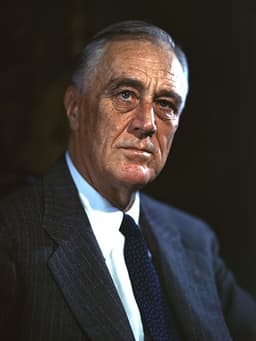
Franklin D. Roosevelt
Politician · Modern
71.0Total
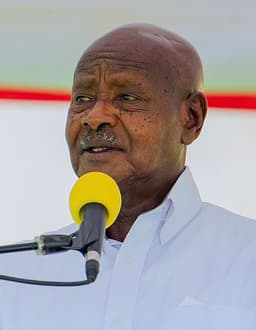
Yoweri Museveni
Politician · Modern
63.9Total
Basic Information
Born
1882
1944
Died
1945
—
Era
Modern
Modern
Nationality
United States
Uganda
Occupation
Politician
Politician
Civilization
Western
Other
Score Comparison
Military (10%)
45.0
67.5
Political (20%)
85.0
72.0
Influence (20%)
75.0
61.0
Legacy (20%)
65.0
50.0
Leadership (15%)
85.0
80.0
Strategy (15%)
60.0
66.3
TOTAL
71.0
63.9
Franklin D. Roosevelt — Complete Timeline
1933 AD
Inaugurated as 32nd PresidentOther◆ Major
Franklin D. Roosevelt was inaugurated as President of the United States on March 4, 1933, during the Great Depression. His inaugural address declared 'the only thing we have to fear is fear itself,' and he immediately called Congress into special session to address the banking crisis.
Great DepressionPresidencyInauguration
Impact: national
Enacted the New DealOther◆ Major
Roosevelt launched the New Deal in 1933, a series of federal programs including the Civilian Conservation Corps, the Agricultural Adjustment Act, and the Tennessee Valley Authority. These measures aimed to provide relief, recovery, and reform during the Great Depression, fundamentally expanding the role of the federal government.
Great DepressionEconomic PolicySocial Reform
Impact: nationalconstructive
1935 AD
Signed the Social Security ActOther◆ Major
Roosevelt signed the Social Security Act into law on August 14, 1935, establishing a federal system of old-age pensions, unemployment insurance, and aid for dependent children. This created the modern American welfare state and provided a safety net for millions of citizens.
Social WelfareLegislationNew Deal
Impact: nationalconstructive
1941 AD
Lend-Lease ActOther◆ Major
Roosevelt signed the Lend-Lease Act on March 11, 1941, authorizing the transfer of military equipment and supplies to Allied nations, particularly Britain and the Soviet Union. This program provided critical material support to countries fighting the Axis powers before U.S. entry into World War II.
World War IIForeign PolicyMilitary Aid
Impact: globalconstructive
Declaration of War on JapanPolitical Action◆ Major
Following the Japanese attack on Pearl Harbor on December 7, 1941, Roosevelt delivered his 'Day of Infamy' speech to Congress the next day, requesting a declaration of war. Congress approved the declaration, bringing the United States into World War II.
World War IIPearl HarborDeclaration of War
Impact: globaldestructive
1942 AD
Executive Order 9066Other◆ Major
Roosevelt signed Executive Order 9066 on February 19, 1942, authorizing the forced relocation and internment of Japanese Americans living on the West Coast. Over 110,000 people, mostly U.S. citizens, were incarcerated in camps for the duration of the war, a decision later widely condemned as a violation of civil rights.
World War IICivil RightsInternment
Impact: nationaldestructive
1944 AD
Elected to Fourth TermOther◆ Major
Roosevelt was elected to an unprecedented fourth term as president in November 1944, defeating Republican Thomas E. Dewey. This election occurred during the final stages of World War II, and Roosevelt's continued leadership ensured stability in the war effort and post-war planning.
PresidencyElectionWorld War II
Impact: national
1945 AD
Yalta ConferenceOther◆ Major
Roosevelt met with Winston Churchill and Joseph Stalin at the Yalta Conference in February 1945 to discuss post-war Europe. Agreements included the division of Germany, Soviet entry into the war against Japan, and the creation of the United Nations, shaping the post-war world order.
World War IIDiplomacyPost-War Planning
Impact: global
Yoweri Museveni — Complete Timeline
1986 AD
Bush War Victory and Capture of KampalaWar
Museveni's National Resistance Army (NRA) captured Kampala, ending the Ugandan Bush War. He was sworn in as President on January 29, 1986, overthrowing the government of Tito Okello and beginning his long rule.
Ugandan Bush WarSeizure of PowerNRA
Impact: national
Introduction of the Movement SystemPolitical Action◆ Major
Museveni established a 'no-party' Movement system, banning political party activity. This system concentrated power in the National Resistance Movement (NRM) and was justified as necessary to prevent ethnic conflict, but was criticized as authoritarian.
Political SystemNRMAuthoritarianism
Impact: national
1998 AD
Invasion of the Democratic Republic of CongoWar◆ Major
Ugandan forces, allied with Rwanda, invaded the Democratic Republic of Congo (DRC) to overthrow Laurent Kabila. This intervention escalated the Second Congo War, drawing in multiple African nations and causing widespread devastation.
Second Congo WarRegional ConflictIntervention
Impact: regionaldestructive
2005 AD
Constitutional Amendment Removing Term LimitsPolitical Action◆ Major
Museveni's government pushed through a constitutional amendment removing presidential term limits. This allowed him to run for a third term in 2006 and subsequent elections, consolidating his hold on power and drawing domestic and international criticism.
Constitutional ChangeTerm LimitsPower Consolidation
Impact: nationaldestructive
2014 AD
Anti-Homosexuality ActPolitical Action◆ Major
Museveni signed the Anti-Homosexuality Act, which imposed life imprisonment for certain same-sex acts. The law was widely condemned internationally, leading to aid cuts from some Western nations, though it was later annulled by the Constitutional Court on procedural grounds.
LGBTQ RightsLegislationInternational Condemnation
Impact: nationaldestructive
Expert Analysis
Franklin D. Roosevelt vs Yoweri Museveni
# The Long Shadow of Power
On a bitter January morning in 1933, Franklin Delano Roosevelt placed his hand on a family Bible and swore to lead a nation paralyzed by economic collapse. Half a century later and half a world away, a young guerrilla commander named Yoweri Museveni watched his ragtag army march into Kampala, ending a brutal civil war in Uganda. Both men inherited broken nations. Both promised restoration. But what Roosevelt built in twelve years—a social contract between government and citizen that would define American life for generations—Museveni has spent nearly four decades systematically dismantling. The difference between them is not simply one of geography or ideology. It is a story of what happens when power becomes an end in itself.
Origins
Roosevelt was born into American aristocracy in 1882, a Hudson Valley patrician whose family had accumulated wealth and political connections since the colonial era. His education at Groton, Harvard, and Columbia Law School was designed to produce a statesman. Yet the crucible that truly shaped him was not privilege but paralysis. Stricken by polio in 1921 at age thirty-nine, Roosevelt spent years learning to walk again with steel braces, his legs dead but his will unbroken. The experience taught him something that no amount of privilege could: the texture of suffering, the patience required to endure, the necessity of adapting or perishing.
Museveni was born in 1944 in what was then the British protectorate of Uganda, the son of a cattle herder. His early education came at missionary schools, but his true schooling began at the University of Dar es Salaam in Tanzania, where he absorbed Marxist theory and the revolutionary fervor sweeping postcolonial Africa. While Roosevelt learned politics in drawing rooms and legislative chambers, Museveni learned it in the bush, studying Mao Zedong’s guerrilla warfare manuals and Fidel Castro’s speeches. His teacher was not polio but war.
Rise to Power
Roosevelt’s ascent followed the established channels of American democracy. He served in the New York State Senate, as Assistant Secretary of the Navy under Woodrow Wilson, and as Governor of New York during the early years of the Depression. He was elected president in November 1932 with 57 percent of the popular vote, a landslide that gave him a mandate for change. The path was conventional, but the crisis was not. By the time he took office, unemployment had reached 25 percent, banks were collapsing by the hundreds, and farmers were armed against foreclosure.
Museveni’s rise was forged in violence. After participating in the overthrow of Idi Amin in 1979, he watched the subsequent governments fail and plunged Uganda back into civil war. For five years, from 1981 to 1986, he led the National Resistance Army from the forests and swamps of the Luwero Triangle. His forces were outnumbered and outgunned, but they won through discipline, ideology, and the support of peasants who had been brutalized by successive regimes. When his NRA captured Kampala on January 26, 1986, Museveni was forty-one years old, a revolutionary who had never held elected office.
Leadership & Governance
Roosevelt’s New Deal was not a single plan but a cascade of experiments: the Civilian Conservation Corps put young men to work in forests; the Works Progress Administration built bridges, schools, and hospitals; the Social Security Act of 1935 created a safety net for the elderly and unemployed. He governed through persuasion, using his legendary “fireside chats” to speak directly to the American people, explaining complex policies in simple language. His political genius lay in making democracy feel urgent and participatory. When the Supreme Court struck down key New Deal legislation, he proposed expanding the court—a power grab that failed, but that signaled his willingness to push boundaries.
Museveni’s governance followed a different logic. In his early years, he was genuinely popular, restoring stability to a country that had known only Amin’s terror and Obote’s chaos. He introduced the “Movement System” in 1986, a no-party framework that he claimed would transcend ethnic divisions. In practice, it concentrated all power in his hands. Political parties were banned, elections became referendums on his rule, and the military—his former comrades—became an instrument of political control. The constitutional amendment of 2005, which removed presidential term limits, was the decisive moment: the revolutionary had become the autocrat.
Triumph & Tragedy
Roosevelt’s greatest triumph was not any single policy but the transformation of the American presidency itself. He led the nation through the Depression and then through World War II, forging the alliance that defeated Nazi Germany. His tragedy was incomplete: he died on April 12, 1945, just weeks before victory in Europe, never seeing the peace he had helped design. Yet his legacy was secured by his death. He could not undo what he had built.
Museveni’s triumph was the Bush War victory of 1986, when he ended Uganda’s cycle of state collapse and mass murder. For a decade, he was hailed as part of a “new breed” of African leaders. His tragedy is unfolding still. The invasion of the Democratic Republic of Congo in 1998, which dragged Uganda into a regional war that left millions dead, revealed the imperial ambitions beneath the revolutionary rhetoric. The Anti-Homosexuality Act of 2014, which imposed life imprisonment for same-sex acts, showed how a liberation movement could become an instrument of oppression. And the endless constitutional manipulations—term limits removed, retirement ages abolished—have turned a promising democracy into a personal dynasty.
Character & Destiny
Roosevelt was a pragmatist who believed in the possibility of reform within democratic structures. He was manipulative, secretive, and occasionally ruthless, but he never questioned the legitimacy of elections or the rule of law. His physical disability may have given him a certain humility: he knew that he depended on others, that he could not do everything alone.
Museveni, by contrast, seems to have been shaped by the absolute nature of guerrilla warfare. In the bush, a commander’s word is law, dissent is treason, and victory justifies everything. He has never fully transitioned from that mindset. Where Roosevelt saw governance as a perpetual negotiation, Museveni sees it as a permanent command. The longer he has ruled, the more he has come to believe that only he can hold Uganda together—a conviction that has become a self-fulfilling prophecy.
Legacy
Roosevelt’s legacy is institutional. Social Security, the Securities and Exchange Commission, the Federal Deposit Insurance Corporation—these survive him by decades, woven into the fabric of American life. He is remembered as the man who saved capitalism from itself and democracy from despair. His four terms led to the Twenty-Second Amendment, limiting future presidents to two, a strange but fitting tribute: the nation limited what he had done because it could not trust itself with another like him.
Museveni’s legacy is still being written, but the early returns are not kind. He is remembered in Uganda as both the liberator of 1986 and the autocrat who betrayed that liberation. The Movement System, once defended as an African solution to African problems, is now seen as a blueprint for perpetual rule. His military success has been overshadowed by political failure. The scores of history—Military 61.8, Political 72.0, Legacy 66.8—tell a story of potential squandered.
Conclusion
Roosevelt and Museveni both came to power in moments of national crisis. Both were charismatic, intelligent, and ambitious. But Roosevelt governed within a system that constrained him, while Museveni built a system that empowered him. The difference is not in their personalities but in their institutions. Roosevelt inherited a democracy that had stood for 150 years; Museveni inherited a failed state that had known only colonial rule and tyranny. One strengthened the cage that held him; the other dismantled it bar by bar.
The lesson is uncomfortable. Great leadership requires not only great leaders but great structures. Without them, even the most promising liberator can become the next tyrant. And the people who cheered him through the gates of Kampala may live to see him close those gates behind them.
Rankings
🥇
Franklin D. RooseveltLeader
Mil: 45.0Pol: 85.0Inf: 75.0
71.0
🥈
Yoweri Museveni
Mil: 67.5Pol: 72.0Inf: 61.0
63.9
+7.1 behind
How This Comparison Works
Algorithm
Each figure is scored on 6 dimensions (0—100 scale) based on structured historical data: Military (10%), Political (20%), Influence (20%), Legacy (20%), Leadership (15%), Strategy (15%). The weighted total produces the final ranking.
Data Sources
Scores are computed from structured sub-indicators in the database. Scale factors adjust for era (Ancient ×0.85, Modern ×1.0) and civilization size (Eastern ×1.05, Other ×0.80) to account for differences in population and military scale.
Maximum 3 Figures
Comparisons are limited to 2—3 figures to ensure readability and statistical meaningfulness.
Error Margins
±5 points per dimension — Sub-scores are derived from historical records with inherent uncertainty. Two figures within 5 points on a dimension should be considered roughly equivalent in that area.
Total Score Accuracy
±3 points overall — The weighted combination of 6 dimensions produces a total score with approximately ±3 points of uncertainty. Differences of less than 3 points are not statistically significant— the figures are effectively tied.
Known Limitations
- Historical records are incomplete and uneven across civilizations
- Figures from oral-tradition societies may be underrepresented
- Occupation labels can misclassify multi-role figures
- Scores measure capability and impact, not moral character
- Quantitative scoring is a comparison tool, not absolute truth
Capability Radar
Military (10%) — Battles & Warfare
Battles
10
65
Win Rate
10
70
Expansion
10
55
Political (20%) — Governance & Reform
Reform
95
60
Diplomacy
90
70
Economy
95
55
Influence (20%) — Cultural & Global Reach
Cultural
80
45
Global
90
50
Legacy (20%) — Historical Impact
Historical
90
55
Longevity
85
50
Leadership (15%) — Power & Stability
Tenure
90
85
Stability
75
50
Strategy (15%) — Tactics & Innovation
Strategy
65
80
Tactics
10
75
Reform
70
60
Similar Comparisons
Comments & Discussion
Bessie's Battle6/16/2026
Comparing FDR's polio recovery to Museveni's guerrilla struggle is romanticizing both. FDR had privilege and a safety net; his "crippling" was a headline, not a daily fight for food. Museveni's war was real—over 300,000 Ugandans died in his rebellion. But one man's suffering built social security; the other built a 38-year presidency where opposition figures get "accidents." Suffering teaches nothing unless you hold the leash.
老炮儿看历史6/16/2026
罗斯福的12年新政?那是拿政府借钱当饭吃,赤字翻了十倍,最后靠二战才还清。穆塞韦尼呢?他1986年上台时说“要恢复法治”,结果1995年修宪取消了总统任期限制,2005年又改了一次。这俩人的相似之处?都喜欢先画大饼,再改规矩。罗斯福的画饼被神化了,穆塞韦尼的只是没那么多人替他吹。
SolidaritySteve6/16/2026
Here's the real difference: FDR passed the GI Bill in 1944—gave 8 million veterans college, homes, jobs. That's generational investment. Museveni, in 1986, promised Uganda's "no-party democracy" would include everyone. By 2005, he'd banned opposition rallies, jailed challengers, and his family controls 80% of coffee exports. One built a middle class; the other built a dynasty. Call it what it is.
数据党6/16/2026
别扯什么“社会契约”了。罗斯福时期GDP增长了58%,但联邦债务从1933年的230亿美元飙到1945年的2580亿。穆塞韦尼的乌干达人均GDP从1986年的200美元涨到2023年的800美元,但基尼系数从0.36跳到0.43。两人都靠扩张政府规模来维持权力,只是罗斯福有战争红利,穆塞韦尼有腐败租金。数字不会撒谎:权力越久,公正越远。
CynicalSaber6/16/2026
The "crippled aristocrat" narrative is noble-fetishizing. FDR hid his paralysis from the public—press photos never showed his wheelchair. That's a media control strategy, not vulnerability. Museveni did the same: he hid his 1970s complicity in Idi Amin's massacres until a 2012 investigation by Uganda's Human Rights Commission. Both men curated their images like museum exhibits. Let's stop pretending polio made FDR a saint or that guerrilla roots made Museveni a democrat.