Loading...
Frederick Augustus III of Saxony vs Leopold I
Leopold I leads by 27.3 pts · 2 figures compared
…

Frederick Augustus III of Saxony
Emperor · Modern
40.7Total
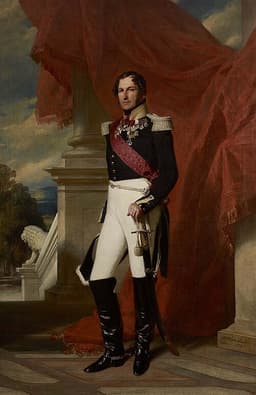
Leopold I
Emperor · Modern
68.0Total
Basic Information
Born
1865
1640
Died
1932
1705
Era
Modern
Modern
Nationality
Saxony
Holy Roman Empire
Occupation
Emperor
Emperor
Civilization
Western
Western
Score Comparison
Military (10%)
17.2
74.0
Political (20%)
27.9
78.0
Influence (20%)
46.3
72.0
Legacy (20%)
35.8
52.0
Leadership (15%)
55.3
75.0
Strategy (15%)
60.0
66.3
TOTAL
40.7
68.0
Frederick Augustus III of Saxony — Complete Timeline
1904 AD
Accession as King of SaxonyPolitical Action◆ Major
Frederick Augustus III became King of Saxony on 15 October 1904, succeeding his father George. His reign was marked by relative political stability and cultural patronage.
SaxonySuccession
Impact: national
1918 AD
World War I abdicationPolitical Action
On 13 November 1918, during the German Revolution, Frederick Augustus III abdicated the throne of Saxony. He was the last king of Saxony, and his abdication ended the Wettin dynasty's rule. He famously remarked 'Then make your own mess!' to the revolutionaries.
German RevolutionEnd of monarchySaxony
Impact: nationaltragic
Peaceful transition to republicPolitical Action
After his abdication, Frederick Augustus III did not resist the establishment of the Free State of Saxony. He retired to private life at Schloss Sibyllenort, avoiding the violence that accompanied other German monarchies' falls.
SaxonyRepublicAbdication
Impact: national
1932 AD
Death in exileOther
Frederick Augustus III died on 18 February 1932 at Schloss Sibyllenort in Silesia (then Germany, now Poland). He was the last surviving German king from the imperial era.
DeathExile
Leopold I — Complete Timeline
1683 AD
Battle of ViennaWar
Leopold I, as Holy Roman Emperor, organized the relief of Vienna from the Ottoman siege. A combined imperial, Polish, and German army under John III Sobieski defeated the Ottoman forces, halting Ottoman expansion into Central Europe and marking the beginning of the Great Turkish War.
Great Turkish WarOttoman EmpireSiege
Impact: global
1688 AD
War of the Grand AllianceWar◆ Major
Leopold I led the Holy Roman Empire in the War of the Grand Alliance against Louis XIV of France. The conflict, fought across Europe and the colonies, ended with the Treaty of Ryswick in 1697, which confirmed French gains but checked French expansion.
War of the Grand AllianceLouis XIVTreaty of Ryswick
Impact: global
1699 AD
Treaty of KarlowitzPolitical Action
Leopold I's forces, under Prince Eugene of Savoy, defeated the Ottomans, leading to the Treaty of Karlowitz. The treaty ceded Hungary, Transylvania, and Slavonia to the Habsburgs, establishing Austria as a major European power and ending Ottoman dominance in the region.
Great Turkish WarTreatyHabsburg Expansion
Impact: regional
Expert Analysis
Origins
Frederick Augustus III of Saxony was born on 25 May 1865 in Dresden, the eldest son of King George of Saxony and Princess Maria Anna of Portugal. He grew up in a royal household with a strong military tradition, attending the Saxon Cadet Corps and later studying at the University of Leipzig. His upbringing was typical for a German prince of the era, emphasizing duty, military service, and conservative values.
Leopold I, Holy Roman Emperor, was born on 9 June 1640 in Vienna, the second son of Emperor Ferdinand III and Maria Anna of Spain. Initially destined for the church, he received a thorough Jesuit education, studying theology, philosophy, and languages. However, after the death of his older brother Ferdinand IV in 1654, Leopold became heir apparent and was prepared for rule. His early life was marked by the ongoing Thirty Years' War and the complex politics of the Habsburg monarchy.
Rise to Power
Frederick Augustus III ascended the throne of Saxony on 15 October 1904, following his father's death. His reign was initially stable, continuing the constitutional monarchy established in 1831. He maintained a low political profile, focusing on ceremonial duties and supporting the arts. The outbreak of World War I in 1914 placed Saxony under strain, but the king remained a figurehead, with actual power held by the military and the Chancellor.
Leopold I became emperor in 1658 after his father's death, but his rise was contested. He faced challenges from France, which sought to limit Habsburg power, and from the Ottomans, who threatened Hungary. His early reign was marked by the War of the Austrian Succession (though that came later) and the constant need to assert authority over the fragmented Holy Roman Empire. He secured his position through a combination of diplomacy, marriage alliances, and military campaigns.
Leadership & Governance
Frederick Augustus III ruled as a constitutional monarch, with limited political power. His governance style was passive; he did not seek to expand royal authority and accepted the democratic trends of his time. During World War I, he supported the German war effort but had little influence on strategy. In 1918, when revolution swept Germany, he abdicated without resistance, famously saying, "Macht doch euern Dreck alleene!" (Do your own mess!). This reflected his willingness to step aside rather than risk civil war.
Leopold I was an absolute ruler in the Baroque mold, though constrained by the imperial diet and the electors. He centralized administration, promoted the Counter-Reformation, and built a strong standing army. His governance emphasized dynastic power and Catholic orthodoxy. He personally oversaw the relief of Vienna in 1683 and the subsequent campaigns that drove the Ottomans from Hungary. His leadership was decisive and strategic, though he often delegated military command to capable generals like Prince Eugene of Savoy.
Triumph & Tragedy
Frederick Augustus III's greatest success was his peaceful abdication and transition to a republic, avoiding bloodshed. He managed to preserve his personal wealth and estates, living comfortably until his death in 1932. However, his reign was a tragedy in terms of legacy: he was the last king of Saxony, and his dynasty ended after 800 years. He failed to adapt to the changing political landscape, and his passivity contributed to the monarchy's collapse.
Leopold I's triumph was the liberation of Vienna and the subsequent Treaty of Karlowitz (1699), which ended Ottoman expansion and gave Hungary to the Habsburgs. He also successfully fought Louis XIV in the War of the Grand Alliance, preserving the balance of power. His tragedy was the devastation of the Holy Roman Empire by French aggression and the persistence of religious conflict. He died in 1705, seeing his son Joseph I inherit a stronger but war-weary empire.
Character & Destiny
Frederick Augustus III was characterized by his detachment and lack of ambition. He preferred hunting and the arts to politics. His character shaped his destiny: his abdication was inevitable given his reluctance to lead. Historians view him as a figurehead who failed to assert authority, scoring only 27.9 in political skill.
Leopold I was a devout, patient, and calculating ruler. His Jesuit education instilled a sense of duty and a strategic mindset. His character drove him to defend Christendom and expand Habsburg power, leading to military and political successes. He scored 78.0 in political skill and 75.0 in leadership, reflecting his effectiveness.
Legacy
Frederick Augustus III's legacy is minimal: he is remembered as the last king of Saxony, a footnote in German history. His abdication paved the way for the Free State of Saxony, but his personal impact was negligible. His legacy score is 35.8.
Leopold I's legacy is substantial: he established the Habsburgs as a major power in Central Europe, defeated the Ottomans, and set the stage for the Austrian Empire. His military and diplomatic achievements influenced European politics for centuries. His legacy score of 52.0 reflects this enduring impact.
Conclusion
Leopold I had far greater impact than Frederick Augustus III. With a total score of 68.0 against 40.7, Leopold's military and political achievements dwarf those of the Saxon king. While Frederick Augustus III presided over a peaceful transition, his reign was essentially passive. Leopold I actively shaped the course of European history through his wars and diplomacy. Therefore, Leopold I is the more significant historical figure.
Rankings
🥇
Leopold ILeader
Mil: 74.0Pol: 78.0Inf: 72.0
68.0
🥈
Frederick Augustus III of Saxony
Mil: 17.2Pol: 27.9Inf: 46.3
40.7
+27.3 behind
How This Comparison Works
Algorithm
Each figure is scored on 6 dimensions (0—100 scale) based on structured historical data: Military (10%), Political (20%), Influence (20%), Legacy (20%), Leadership (15%), Strategy (15%). The weighted total produces the final ranking.
Data Sources
Scores are computed from structured sub-indicators in the database. Scale factors adjust for era (Ancient ×0.85, Modern ×1.0) and civilization size (Eastern ×1.05, Other ×0.80) to account for differences in population and military scale.
Maximum 3 Figures
Comparisons are limited to 2—3 figures to ensure readability and statistical meaningfulness.
Error Margins
±5 points per dimension — Sub-scores are derived from historical records with inherent uncertainty. Two figures within 5 points on a dimension should be considered roughly equivalent in that area.
Total Score Accuracy
±3 points overall — The weighted combination of 6 dimensions produces a total score with approximately ±3 points of uncertainty. Differences of less than 3 points are not statistically significant— the figures are effectively tied.
Known Limitations
- Historical records are incomplete and uneven across civilizations
- Figures from oral-tradition societies may be underrepresented
- Occupation labels can misclassify multi-role figures
- Scores measure capability and impact, not moral character
- Quantitative scoring is a comparison tool, not absolute truth
Capability Radar
Military (10%) — Battles & Warfare
Battles
34
85
Win Rate
41
80
Expansion
43
80
Political (20%) — Governance & Reform
Reform
10
75
Diplomacy
25
85
Economy
15
70
Influence (20%) — Cultural & Global Reach
Cultural
10
65
Global
5
70
Legacy (20%) — Historical Impact
Historical
15
75
Longevity
10
70
Leadership (15%) — Power & Stability
Tenure
20
90
Stability
30
75
Strategy (15%) — Tactics & Innovation
Strategy
47
85
Tactics
51
70
Reform
52
75
Similar Comparisons
Comments & Discussion
No comments yet. Be the first to share your thoughts!