Loading...
Leopold I vs Napoleon Bonaparte
Napoleon Bonaparte leads by 2.9 pts · 2 figures compared
…
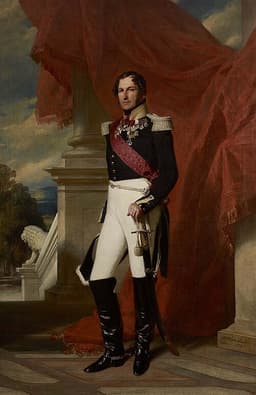
Leopold I
Emperor · Modern
68.0Total

Napoleon Bonaparte
General · Modern
70.9Total
Basic Information
Born
1640
1769
Died
1705
1821
Era
Modern
Modern
Nationality
Holy Roman Empire
France
Occupation
Emperor
General
Civilization
Western
Western
Score Comparison
Military (10%)
74.0
94.0
Political (20%)
78.0
72.0
Influence (20%)
72.0
40.0
Legacy (20%)
52.0
80.0
Leadership (15%)
75.0
78.0
Strategy (15%)
66.3
90.0
TOTAL
68.0
70.9
Leopold I — Complete Timeline
1683 AD
Battle of ViennaWar
Leopold I, as Holy Roman Emperor, organized the relief of Vienna from the Ottoman siege. A combined imperial, Polish, and German army under John III Sobieski defeated the Ottoman forces, halting Ottoman expansion into Central Europe and marking the beginning of the Great Turkish War.
Great Turkish WarOttoman EmpireSiege
Impact: global
1688 AD
War of the Grand AllianceWar◆ Major
Leopold I led the Holy Roman Empire in the War of the Grand Alliance against Louis XIV of France. The conflict, fought across Europe and the colonies, ended with the Treaty of Ryswick in 1697, which confirmed French gains but checked French expansion.
War of the Grand AllianceLouis XIVTreaty of Ryswick
Impact: global
1699 AD
Treaty of KarlowitzPolitical Action
Leopold I's forces, under Prince Eugene of Savoy, defeated the Ottomans, leading to the Treaty of Karlowitz. The treaty ceded Hungary, Transylvania, and Slavonia to the Habsburgs, establishing Austria as a major European power and ending Ottoman dominance in the region.
Great Turkish WarTreatyHabsburg Expansion
Impact: regional
Napoleon Bonaparte — Complete Timeline
1799 AD
Coup of 18 BrumaireOther◆ Major
Napoleon Bonaparte, with support from his brother Lucien and key political figures, overthrew the Directory in a bloodless coup. He established the Consulate with himself as First Consul, effectively becoming the ruler of France. This event ended the French Revolution's most unstable period.
French RevolutionCoupRise to Power
Impact: regional
1804 AD
Promulgation of the Napoleonic CodeOther◆ Major
Napoleon enacted the Civil Code of the French, known as the Napoleonic Code, a comprehensive set of laws that replaced the fragmented feudal legal systems. The code established legal equality, protected property rights, and secularized law. It became the basis for legal systems in many European and world countries.
Legal ReformNapoleonic CodeCivil Law
Impact: globalconstructive
1805 AD
Battle of AusterlitzWar◆ Major
Napoleon's Grande Arm
Napoleonic WarsBattleDecisive Victory
Impact: global
1812 AD
Invasion of RussiaWar◆ Major
Napoleon led the Grande Arm
Napoleonic WarsInvasionDisaster
Impact: globaldestructive
1815 AD
Battle of WaterlooWar◆ Major
Napoleon's French army was defeated by the combined forces of the Duke of Wellington's Anglo-Allied army and Gebhard Leberecht von Bl
Napoleonic WarsBattleFinal Defeat
Impact: globaldestructive
Expert Analysis
leopold-i-vs-napoleon-bonaparte
# The Emperor and the Corsican: Two Visions of Power in an Age of Transformation
On a September morning in 1683, Leopold I watched from a hilltop as Polish cavalry thundered down the slopes of the Vienna Woods, breaking the Ottoman siege that had held his capital in a stranglehold for two months. The emperor, a Habsburg who ruled from a gilded palace while his generals fought, had just saved Christendom. A century and a quarter later, on a June evening in 1815, Napoleon Bonaparte stood in the mud near Waterloo, watching his Imperial Guard crumble before British squares. The self-made emperor, who had led his armies from the front for two decades, had just lost everything. These two men, both called emperor, both shaped by war, could not have been more different—and their differences tell us something profound about how power works, and how it fails.
Origins
Leopold I was born in 1640 into the most ancient dynasty in Europe. The Habsburgs had worn the imperial crown for centuries, their family tree tangled with every royal house on the continent. Leopold grew up in the Hofburg Palace in Vienna, surrounded by ceremony, trained from childhood to rule. He was devout, scholarly, and cautious—a man who composed music in his spare time and prayed daily. His world was one of inherited legitimacy, where power flowed from God through bloodlines.
Napoleon Bonaparte, born in 1769 on the island of Corsica, came from nothing. His family were minor nobles on a backwater island that France had only recently purchased from Genoa. He spoke Italian before French, and his accent marked him as an outsider throughout his life. Where Leopold inherited a throne, Napoleon clawed his way up through the artillery corps of a revolutionary army. His world was one of merit and chaos, where talent could unseat kings.
Rise to Power
Leopold became emperor in 1658 at age eighteen, but he did not seize power—it was placed upon him. His reign was a slow accumulation of authority, marked by patient diplomacy and careful marriage alliances. His greatest challenge came in 1683, when the Ottoman Empire, at the height of its power, marched on Vienna. Leopold did not lead the relief army; he fled to Passau and organized from a distance. He relied on the military genius of Charles V of Lorraine and the political gamble of allying with the Polish king John III Sobieski. The victory at Vienna was not his personally, but he knew how to harvest its fruits.
Napoleon’s rise was meteoric and personal. At twenty-four, he cleared the streets of Paris with a “whiff of grapeshot” during the royalist uprising of 1795. At twenty-seven, he conquered Italy. At thirty, he staged a coup and made himself First Consul. At thirty-five, he crowned himself Emperor in Notre Dame, taking the crown from the Pope’s hands and placing it on his own head. Every step was a gamble, every promotion a victory won by his own sword. He had no ancestors to thank.
Leadership & Governance
Leopold governed through delegation. He surrounded himself with capable ministers and generals—Prince Eugene of Savoy, the greatest military commander of the age, effectively ran his armies for decades. Leopold’s political wisdom lay in knowing when to fight and when to negotiate. The War of the Grand Alliance (1688–1697) against Louis XIV was a grinding conflict that exhausted France without destroying it. The Treaty of Karlowitz in 1699, which ended the Ottoman threat, was a masterpiece of Habsburg statecraft: Leopold gained Hungary, Transylvania, and Croatia without overextending his empire. He was a builder, not a conqueror.
Napoleon governed through force of personality. He wrote the Napoleonic Code, which reformed French law and influenced legal systems across Europe. He built roads, schools, and banks. But he could not stop fighting. His military genius was undeniable—his scores of 94 in military and 93 in strategy reflect a man who understood terrain, timing, and morale better than anyone since Alexander. Yet he lacked political restraint. He invaded Spain, a quagmire. He invaded Russia, a catastrophe. He could win battles but could not end wars.
Triumph & Tragedy
Leopold’s greatest moment was the Battle of Vienna in 1683. He did not fight, but he organized the coalition, secured the funding, and waited through the long summer as the city held. When the relief came, it was the beginning of Habsburg dominance in Central Europe that would last for two centuries. His tragedy was personal: his first wife died young, his children died in infancy, and his empire was constantly threatened from both east and west. But he died in his bed in 1705, still emperor, still secure.
Napoleon’s greatest moment was Austerlitz in 1805, where he destroyed a combined Russian and Austrian army in a single day. He was at the height of his power, master of Europe from Madrid to Warsaw. His tragedy was St. Helena, the remote Atlantic island where he died in 1821, abandoned by his allies, outlived by his legend. He had conquered an empire in ten years and lost it in two.
Character & Destiny
Leopold was cautious, devout, and patient. He understood that empires are built slowly, that power is maintained by institutions, not by the brilliance of any single man. He was not a military genius—his strategy score of 66 is the lowest of his metrics—but he was a political survivor. He knew when to retreat, when to negotiate, and when to let others take the credit.
Napoleon was restless, ambitious, and arrogant. He believed that his will could reshape the world. He was a military genius but a political disaster. His leadership score of 80 is respectable, but his political score of 75 reveals the flaw: he could inspire men to die for him but could not build a system that outlasted him. He once said, “Power is my mistress,” and like many men who love their mistresses too much, he was destroyed by her.
Legacy
Leopold I is remembered as a consolidator, not a conqueror. He strengthened the Habsburg monarchy, expanded its territories, and defended Europe from the Ottomans. His legacy is visible in the map of modern Europe: the Treaty of Karlowitz set the borders that would define the Balkans for centuries. He is not a household name, but he is a figure of quiet, lasting significance.
Napoleon Bonaparte is one of the most famous men in history. His name is synonymous with ambition, genius, and hubris. The Napoleonic Code remains the foundation of civil law in much of the world. His campaigns are studied in every military academy. But his legacy is ambiguous: he spread revolutionary ideals across Europe, but he also destroyed them in the pursuit of personal power.
Conclusion
Two emperors, two worlds. Leopold I inherited a throne and kept it by knowing his limits. Napoleon Bonaparte seized a crown and lost it by refusing to acknowledge any. One was a builder, the other a destroyer. One died in his palace, the other on a rock in the Atlantic. In the end, the cautious Habsburg who never won a battle may have been the wiser man. For power, as both men learned, is not about how high you rise—it is about how long you stay.
Rankings
🥇
Napoleon BonaparteLeader
Mil: 94.0Pol: 72.0Inf: 40.0
70.9
🥈
Leopold I
Mil: 74.0Pol: 78.0Inf: 72.0
68.0
+2.9 behind
How This Comparison Works
Algorithm
Each figure is scored on 6 dimensions (0—100 scale) based on structured historical data: Military (10%), Political (20%), Influence (20%), Legacy (20%), Leadership (15%), Strategy (15%). The weighted total produces the final ranking.
Data Sources
Scores are computed from structured sub-indicators in the database. Scale factors adjust for era (Ancient ×0.85, Modern ×1.0) and civilization size (Eastern ×1.05, Other ×0.80) to account for differences in population and military scale.
Maximum 3 Figures
Comparisons are limited to 2—3 figures to ensure readability and statistical meaningfulness.
Error Margins
±5 points per dimension — Sub-scores are derived from historical records with inherent uncertainty. Two figures within 5 points on a dimension should be considered roughly equivalent in that area.
Total Score Accuracy
±3 points overall — The weighted combination of 6 dimensions produces a total score with approximately ±3 points of uncertainty. Differences of less than 3 points are not statistically significant— the figures are effectively tied.
Known Limitations
- Historical records are incomplete and uneven across civilizations
- Figures from oral-tradition societies may be underrepresented
- Occupation labels can misclassify multi-role figures
- Scores measure capability and impact, not moral character
- Quantitative scoring is a comparison tool, not absolute truth
Capability Radar
Military (10%) — Battles & Warfare
Battles
85
95
Win Rate
80
90
Expansion
80
95
Political (20%) — Governance & Reform
Reform
75
95
Diplomacy
85
80
Economy
70
85
Influence (20%) — Cultural & Global Reach
Cultural
65
85
Global
70
90
Legacy (20%) — Historical Impact
Historical
75
95
Longevity
70
90
Leadership (15%) — Power & Stability
Tenure
90
85
Stability
75
70
Strategy (15%) — Tactics & Innovation
Strategy
85
95
Tactics
70
98
Reform
75
92
Similar Comparisons
Comments & Discussion
No comments yet. Be the first to share your thoughts!