Loading...
Frederick Henry of Orange vs Michiel de Ruyter
Frederick Henry of Orange leads by 7.7 pts · 2 figures compared
…

Frederick Henry of Orange
General · Modern
68.7Total
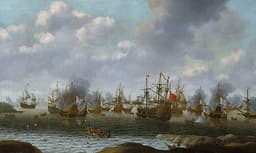
Michiel de Ruyter
General · Modern
61.0Total
Basic Information
Born
1584
1607
Died
1647
1676
Era
Modern
Modern
Nationality
Netherlands
Netherlands
Occupation
General
General
Civilization
Western
Western
Score Comparison
Military (10%)
76.0
74.0
Political (20%)
70.0
45.0
Influence (20%)
72.0
40.0
Legacy (20%)
56.0
80.0
Leadership (15%)
77.2
62.0
Strategy (15%)
70.0
75.3
TOTAL
68.7
61.0
Frederick Henry of Orange — Complete Timeline
1625 AD
Appointed Stadtholder of Holland, Zeeland, and UtrechtPolitical Action◆ Major
After the death of his half-brother Maurice of Nassau, Frederick Henry was appointed Stadtholder of Holland, Zeeland, and Utrecht. He later became Stadtholder of all seven provinces, leading the Dutch Republic during the Eighty Years' War.
StadtholderLeadershipDutch Republic
Impact: nationalconstructive
1629 AD
Captured 's-HertogenboschWar◆ Major
Frederick Henry led the successful siege of 's-Hertogenbosch, a heavily fortified city held by the Spanish. The capture was a major strategic victory, demonstrating his military skill and earning him the nickname 'City Forcer' (Stedendwinger).
SiegeMilitary VictoryEighty Years' War
Impact: regionalconstructive
1630 AD
Patronage of the Dutch Golden AgeCultural◆ Major
Frederick Henry was a major patron of the arts, commissioning works from painters like Rembrandt, Jacob van Campen, and Gerard van Honthorst. His court at The Hague became a center of the Dutch Golden Age, supporting architecture and painting.
PatronageDutch Golden AgeArt
Impact: regionalconstructive
1632 AD
Captured MaastrichtWar◆ Major
Frederick Henry captured Maastricht after a three-month siege, cutting Spanish supply lines and securing Dutch control over the Meuse River. The victory was a key moment in the Dutch offensive against Spanish forces in the south.
SiegeMilitary VictoryEighty Years' War
Impact: regionalconstructive
1648 AD
Signed the Treaty of MünsterPolitical Action◆ Major
Frederick Henry's diplomatic efforts led to the Treaty of M
TreatyIndependencePeace of Westphalia
Impact: globalconstructive
Michiel de Ruyter — Complete Timeline
1639 AD
Battle of the DownsWar
De Ruyter served as a captain in the Dutch fleet under Maarten Tromp at the Battle of the Downs, where the Dutch decisively defeated a Spanish fleet. This battle established Dutch naval dominance and marked de Ruyter's early combat experience.
Eighty Years' WarNaval BattleDutch Victory
Impact: regional
1661 AD
Expedition to the MediterraneanWar
De Ruyter led a Dutch fleet to the Mediterranean to protect Dutch merchant shipping from Barbary pirates and to assert Dutch naval presence. He negotiated treaties with Algiers and Tunis, securing safer passage for Dutch trade.
Barbary PiratesNaval DiplomacyTrade Protection
Impact: regionalconstructive
1667 AD
Raid on the MedwayWar
De Ruyter led a Dutch fleet up the River Medway, attacking the English navy at its Chatham Dockyard. The Dutch burned or captured several major English warships, including the flagship HMS Royal Charles, a humiliating defeat for England.
Second Anglo-Dutch WarNaval RaidEnglish Defeat
Impact: regional
1672 AD
Battle of SolebayWar◆ Major
De Ruyter attacked the Anglo-French fleet at Solebay, preventing a blockade of the Dutch coast. The battle was tactically indecisive but strategically important as it thwarted Allied plans to invade the Netherlands.
Third Anglo-Dutch WarNaval BattleStrategic Defense
Impact: regional
1673 AD
Battle of the TexelWar◆ Major
De Ruyter commanded the Dutch fleet to a tactical victory over a combined Anglo-French fleet at the Battle of the Texel. This victory prevented an invasion of the Netherlands and secured Dutch independence during the Franco-Dutch War.
Franco-Dutch WarNaval BattleDutch Victory
Impact: regional
1676 AD
Death at the Battle of AugustaWar◆ Major
De Ruyter was mortally wounded by a cannonball during the Battle of Augusta against a French fleet. He died several days later. His death was a major loss for the Dutch navy and he was given a state funeral with great honors.
Franco-Dutch WarNaval BattleDeath in Battle
Impact: nationaltragic
Expert Analysis
Origins
Frederick Henry of Orange was born on January 29, 1584, in Delft, the youngest son of William the Silent and Louise de Coligny. His father was assassinated when he was an infant, and he was raised in a court dominated by his older half-brother Maurice of Nassau. Frederick Henry received a military education and was groomed for leadership, but he initially lived in Maurice's shadow.
Michiel de Ruyter was born on March 24, 1607, in Vlissingen, to a modest family of brewers. He went to sea at age 11 as a cabin boy and worked his way up through experience. He served on merchant ships and whalers, learning navigation and combat. By 1637, he had become a captain in the Dutch merchant fleet, gaining respect for his seamanship and courage.
Rise to Power
Frederick Henry became Stadtholder in 1625 after Maurice died without legitimate children. He inherited command of the Dutch army and the political leadership of the United Provinces. His first major success was the capture of 's-Hertogenbosch in 1629, a heavily fortified Spanish stronghold that had resisted previous sieges. This victory established his reputation as a master of siege warfare.
De Ruyter's rise was gradual. He was appointed a captain in the Dutch navy in 1641 and fought in the Battle of Cape St. Vincent. His breakthrough came during the First Anglo-Dutch War (1652–1654) when he distinguished himself as a fleet commander. In 1653, he was promoted to vice-admiral. His most famous achievement, the Raid on the Medway in 1667, saw him sail up the Thames and destroy the English fleet at Chatham, forcing a favorable peace.
Leadership & Governance
Frederick Henry governed as Stadtholder with a focus on expanding his family's influence. He centralized power, controlled foreign policy, and used patronage to secure loyalty. He funded artists like Rembrandt and van Campen, contributing to the Dutch Golden Age. His governance was pragmatic: he negotiated the Treaty of Münster in 1648, which recognized Dutch independence, but he died before it was signed.
De Ruyter was a naval commander, not a politician. He led by example, known for his calm demeanor and tactical flexibility. He commanded the Dutch fleet in four major wars, often against superior forces. At the Battle of Solebay (1672), his aggressive attack prevented a French blockade. At the Battle of the Texel (1673), he outmaneuvered a combined Anglo-French fleet, securing Dutch trade routes. His leadership scored 62.0 in leadership, reflecting his effectiveness at sea but limited political role.
Triumph & Tragedy
Frederick Henry's greatest triumph was the capture of 's-Hertogenbosch in 1629, a siege that lasted three months and demonstrated his engineering skills. He also captured Maastricht in 1632, cutting Spanish supply lines. His greatest failure was the unsuccessful siege of Antwerp in 1633, which weakened his position. Politically, he failed to secure the title of Prince of Orange for his son, William II, as a hereditary office.
De Ruyter's triumph was the Raid on the Medway (1667), where he captured the English flagship HMS Royal Charles. This victory forced England to negotiate. His tragedy was his death at the Battle of Augusta in 1676, where he was mortally wounded by a cannonball. He died five days later, a loss that shocked the Netherlands. Despite his successes, he never achieved political influence, scoring only 45.0 in political power.
Character & Destiny
Frederick Henry was methodical and patient, traits that served him well in sieges. He was also ambitious for his family, but his cautious nature sometimes limited his aggressiveness. He scored 77.2 in leadership, reflecting his ability to command respect. His destiny was to complete the work of his father and brother, securing Dutch independence through diplomacy and war.
De Ruyter was humble and dedicated, rarely seeking personal glory. He was known for his strategic insight, scoring 75.3 in strategy. His character made him a beloved figure, but his lack of political ambition meant he never shaped policy. His destiny was to die in battle, a fitting end for a sailor who spent his life at sea.
Legacy
Frederick Henry's legacy is the consolidation of the Dutch Republic and its recognition as a sovereign state. His patronage of the arts contributed to the Dutch Golden Age. However, his political gains were temporary; his son William II died young, and the office of Stadtholder was abolished in 1650. He scores 56.0 in legacy, reflecting a lasting but not transformative impact.
De Ruyter's legacy is immense in naval history. He is remembered as the greatest Dutch admiral, with ships and monuments named after him. His tactics influenced naval warfare for centuries. He scores 80.0 in legacy, the highest of any category. His impact on Dutch national pride is enduring.
Conclusion
Frederick Henry of Orange achieved a higher total score (68.7 vs 61.0) due to his political and military roles combined. However, in terms of lasting impact, Michiel de Ruyter's legacy is more profound. De Ruyter's naval victories were critical for Dutch survival during the Franco-Dutch War, and his reputation as a national hero endures. Frederick Henry's achievements were important but more transient. Therefore, while Frederick Henry was a more versatile leader, Michiel de Ruyter had a greater and more enduring impact on history.
Rankings
🥇
Frederick Henry of OrangeLeader
Mil: 76.0Pol: 70.0Inf: 72.0
68.7
🥈
Michiel de Ruyter
Mil: 74.0Pol: 45.0Inf: 40.0
61.0
+7.7 behind
How This Comparison Works
Algorithm
Each figure is scored on 6 dimensions (0—100 scale) based on structured historical data: Military (10%), Political (20%), Influence (20%), Legacy (20%), Leadership (15%), Strategy (15%). The weighted total produces the final ranking.
Data Sources
Scores are computed from structured sub-indicators in the database. Scale factors adjust for era (Ancient ×0.85, Modern ×1.0) and civilization size (Eastern ×1.05, Other ×0.80) to account for differences in population and military scale.
Maximum 3 Figures
Comparisons are limited to 2—3 figures to ensure readability and statistical meaningfulness.
Error Margins
±5 points per dimension — Sub-scores are derived from historical records with inherent uncertainty. Two figures within 5 points on a dimension should be considered roughly equivalent in that area.
Total Score Accuracy
±3 points overall — The weighted combination of 6 dimensions produces a total score with approximately ±3 points of uncertainty. Differences of less than 3 points are not statistically significant— the figures are effectively tied.
Known Limitations
- Historical records are incomplete and uneven across civilizations
- Figures from oral-tradition societies may be underrepresented
- Occupation labels can misclassify multi-role figures
- Scores measure capability and impact, not moral character
- Quantitative scoring is a comparison tool, not absolute truth
Capability Radar
Military (10%) — Battles & Warfare
Battles
75
85
Win Rate
80
90
Expansion
75
60
Political (20%) — Governance & Reform
Reform
65
40
Diplomacy
75
70
Economy
60
55
Influence (20%) — Cultural & Global Reach
Cultural
55
75
Global
50
70
Legacy (20%) — Historical Impact
Historical
60
80
Longevity
50
75
Leadership (15%) — Power & Stability
Tenure
70
50
Stability
65
60
Strategy (15%) — Tactics & Innovation
Strategy
80
88
Tactics
85
95
Reform
70
75
Similar Comparisons
Comments & Discussion
No comments yet. Be the first to share your thoughts!