Loading...
Michiel de Ruyter vs Qin Shi Huang
Qin Shi Huang leads by 24.2 pts · 2 figures compared
…
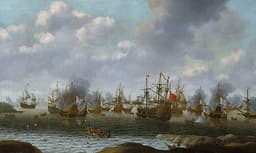
Michiel de Ruyter
General · Modern
61.0Total
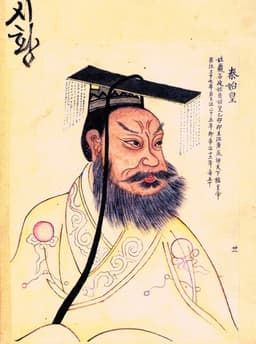
Qin Shi Huang
Emperor · Ancient
85.2Total
Basic Information
Born
1607
-259
Died
1676
-210
Era
Modern
Ancient
Nationality
Netherlands
China
Occupation
General
Emperor
Civilization
Western
Eastern
Score Comparison
Military (10%)
74.0
80.0
Political (20%)
45.0
90.0
Influence (20%)
40.0
85.0
Legacy (20%)
80.0
90.0
Leadership (15%)
62.0
78.0
Strategy (15%)
75.3
82.0
TOTAL
61.0
85.2
Michiel de Ruyter — Complete Timeline
1639 AD
Battle of the DownsWar
De Ruyter served as a captain in the Dutch fleet under Maarten Tromp at the Battle of the Downs, where the Dutch decisively defeated a Spanish fleet. This battle established Dutch naval dominance and marked de Ruyter's early combat experience.
Eighty Years' WarNaval BattleDutch Victory
Impact: regional
1661 AD
Expedition to the MediterraneanWar
De Ruyter led a Dutch fleet to the Mediterranean to protect Dutch merchant shipping from Barbary pirates and to assert Dutch naval presence. He negotiated treaties with Algiers and Tunis, securing safer passage for Dutch trade.
Barbary PiratesNaval DiplomacyTrade Protection
Impact: regionalconstructive
1667 AD
Raid on the MedwayWar
De Ruyter led a Dutch fleet up the River Medway, attacking the English navy at its Chatham Dockyard. The Dutch burned or captured several major English warships, including the flagship HMS Royal Charles, a humiliating defeat for England.
Second Anglo-Dutch WarNaval RaidEnglish Defeat
Impact: regional
1672 AD
Battle of SolebayWar◆ Major
De Ruyter attacked the Anglo-French fleet at Solebay, preventing a blockade of the Dutch coast. The battle was tactically indecisive but strategically important as it thwarted Allied plans to invade the Netherlands.
Third Anglo-Dutch WarNaval BattleStrategic Defense
Impact: regional
1673 AD
Battle of the TexelWar◆ Major
De Ruyter commanded the Dutch fleet to a tactical victory over a combined Anglo-French fleet at the Battle of the Texel. This victory prevented an invasion of the Netherlands and secured Dutch independence during the Franco-Dutch War.
Franco-Dutch WarNaval BattleDutch Victory
Impact: regional
1676 AD
Death at the Battle of AugustaWar◆ Major
De Ruyter was mortally wounded by a cannonball during the Battle of Augusta against a French fleet. He died several days later. His death was a major loss for the Dutch navy and he was given a state funeral with great honors.
Franco-Dutch WarNaval BattleDeath in Battle
Impact: nationaltragic
Qin Shi Huang — Complete Timeline
246 BC
Construction of the Mausoleum and Terracotta ArmyOther◆ Major
Qin Shi Huang commissioned a vast mausoleum complex near Xi'an, guarded by thousands of life-sized terracotta soldiers, horses, and chariots. The project employed hundreds of thousands of workers and reflected his obsession with immortality and imperial power.
Impact: global
230 BC
Conquest of the Six Warring StatesWar
From 230 to 221 BCE, Ying Zheng led the Qin state in a series of campaigns that conquered the Han, Zhao, Wei, Chu, Yan, and Qi states. This unified China under a single ruler for the first time, ending the Warring States period.
Impact: global
221 BC
Standardization of Writing, Currency, and MeasurementsReform◆ Major
Qin Shi Huang ordered the standardization of Chinese script, currency, and weights and measures across the unified empire. This facilitated administration, trade, and cultural integration, laying a foundation for future dynasties.
Impact: globalconstructive
Proclamation of the Qin DynastyPolitical Action
After conquering the last independent state, Ying Zheng declared himself Shi Huangdi (First Emperor), founding the Qin Dynasty. He adopted a new title to signify his supreme authority and initiated centralized imperial rule.
Impact: global
214 BC
Initiation of the Great Wall ConstructionOther◆ Major
Qin Shi Huang ordered the connection and extension of existing northern fortifications to create a unified defensive wall against nomadic Xiongnu raids. This project involved massive conscripted labor and became the precursor to the later Great Wall.
Impact: regional
213 BC
Burning of Books and Burying of ScholarsPolitical Action◆ Major
On the advice of Li Si, Qin Shi Huang ordered the burning of historical records and philosophical texts not aligned with Legalist doctrine. He also had 460 Confucian scholars buried alive to suppress dissent and consolidate ideological control.
Impact: nationaldestructive
Expert Analysis
michiel-de-ruyter-vs-qin-shi-huang
# The Emperor and the Admiral: Two Visions of Power
On a spring morning in 221 BC, a man in northern China declared himself the First Emperor, believing his dynasty would last ten thousand generations. Fourteen centuries later, on a gray North Sea dawn in 1667, a fisherman’s son from Vlissingen led a handful of Dutch ships up the River Medway, burning the pride of the English navy at its moorings. One built walls that still stand; the other broke through them. Both changed history. Yet their paths could not have been more different—one ruled by iron will over a continent, the other by courage alone over a fleet.
Origins
Ying Zheng was born into war. The year was 259 BC, and the seven kingdoms of China had been tearing each other apart for two centuries. His father was a king, his mother a concubine, and his childhood was spent in a foreign court as a hostage—a pawn in the brutal chess game of the Warring States. He learned early that trust was weakness and that power came from fear.
Michiel de Ruyter was born in 1607 into a world of salt and sail. His father was a beer porter; his mother died when he was young. At eleven, he went to sea as a cabin boy. The Dutch Republic was a young nation fighting for its life against Spain, and the sea was its only highway to wealth. De Ruyter learned seamanship in the holds of merchant ships, navigating storms off Greenland and fighting Barbary pirates in the Mediterranean. He rose not by birth but by reputation—a man who could handle a ship in any weather and a crew in any crisis.
The difference in their origins is not merely one of class. Qin Shi Huang grew up surrounded by walls—palace walls, city walls, the walls of a fractured civilization that needed to be conquered to be whole. De Ruyter grew up surrounded by horizons—the open sea, where no wall could hold back the wind.
Rise to Power
Ying Zheng became king of Qin at thirteen. For eight years, he ruled through regents while learning the arts of war and statecraft. Then, in 230 BC, he struck. Over nine years, his armies rolled over the six other kingdoms—Han, Zhao, Wei, Chu, Yan, and Qi—one by one. It was not a war of defense but of annihilation. By 221 BC, at the age of thirty-eight, he stood alone. He renamed himself Shi Huangdi—the First Emperor—and declared that his rule would unite "all under Heaven."
De Ruyter's rise was slower and more reluctant. He was forty-two before he accepted a command in the Dutch navy. He had made his fortune as a merchant captain and had no desire for glory. But the Dutch Republic needed him. In 1661, he led a fleet to the Mediterranean to humble the Barbary pirates. In 1667, when England and France threatened to blockade the Dutch coast, he proposed a desperate gamble: sail up the Thames and destroy the English fleet where it lay. The Raid on the Medway was not a battle—it was a humiliation. The English watched their ships burn at anchor while Dutch sailors towed away the Royal Charles, their flagship, as a trophy.
One man conquered an empire. The other saved a republic. Both rose because their eras demanded them, but the demands were different: Qin needed a destroyer of worlds; the Netherlands needed a guardian of trade.
Leadership & Governance
Qin Shi Huang governed through standardization. He imposed a single script, a single currency, a single axle length for carts so that roads could be uniform. He ordered the burning of all books not approved by his Legalist philosophy and, according to tradition, buried 460 scholars alive for dissent. He connected the northern walls into a Great Wall to keep out the Xiongnu nomads. His rule was efficient, ruthless, and absolute. The First Emperor did not ask for loyalty—he demanded obedience.
De Ruyter led through example. He never shouted; he never panicked. At the Battle of Solebay in 1672, when the Dutch fleet was caught at anchor by a larger Anglo-French force, he sailed straight into the enemy line, breaking their formation and saving his country from invasion. At the Battle of the Texel in 1673, he outmaneuvered a combined fleet of ninety ships with sixty of his own, proving that tactics could overcome numbers. His men called him "Bestevaer"—Grandfather—because he treated them with the gruff affection of an old sailor.
Qin Shi Huang's governance was a machine that crushed everything into a single shape. De Ruyter's leadership was a net that held together a republic of merchants and fishermen, each with their own pride and interest.
Triumph & Tragedy
The Emperor's greatest triumph was also his greatest tragedy. He unified China, but the cost was terror. He built his mausoleum—a vast underground palace guarded by thousands of life-sized terracotta soldiers—but the workers who built it were reportedly buried alive to keep its secrets. He sought immortality, sending expeditions for the elixir of life, but died in 210 BC at the age of forty-nine, probably from mercury poisoning from his own immortality potions. Within three years, his dynasty collapsed.
De Ruyter's tragedy came on April 22, 1676. He was sixty-eight years old, fighting the French off Sicily. A cannonball shattered his leg; he died five days later. His last words, according to legend, were "Keep the fleet together." He died in service, not in bed, and the Dutch Republic mourned him as a national hero. His body lay in state for weeks before being buried with full honors.
One man's death ended his dynasty. The other's death cemented his legend.
Character & Destiny
Qin Shi Huang was a man of terrible vision. He saw a world of chaos and believed that only absolute order could save it. He was paranoid, brilliant, and utterly alone. He trusted no one—not his ministers, not his generals, not even his own sons. His cruelty was not sadism but policy: he believed that fear was the only reliable tool of governance.
De Ruyter was a man of quiet competence. He was not a philosopher or a visionary; he was a sailor who understood wind, tide, and human nature. He fought for the Dutch Republic not because he loved power but because he loved the sea. He wrote simple letters to his wife, worried about his children, and refused titles of nobility. When the English offered him a fortune to switch sides, he refused.
Their characters shaped their fates. The Emperor's ambition built a system that could not survive him. The Admiral's humility built a reputation that outlasted his country's golden age.
Legacy
Qin Shi Huang's legacy is China itself. The script he standardized is still used; the administrative divisions he created still exist; the Great Wall, though rebuilt many times, still winds across the northern frontier. He is remembered as both a unifier and a tyrant—the man who made China possible and the man who burned its books. In 1974, farmers digging a well near Xi'an discovered his terracotta army, and the world saw the scale of his ambition: eight thousand soldiers, each with a unique face, standing guard for eternity.
De Ruyter's legacy is more diffuse. He did not build an empire or a wall. He built a moment—a few decades when a small republic of merchants and sailors could defy the great powers of Europe. The Netherlands declined after his death, but his example lived on. Nelson studied his tactics; the Royal Navy learned from his raids. In the Netherlands today, he is still "Bestevaer," the grandfather of the fleet, and his statue stands in Vlissingen, looking out to sea.
Conclusion
Standing on the deck of a Dutch ship in 1667, Michiel de Ruyter watched the English fleet burn. He had done what no admiral had done before or would do again. But he knew that fire is temporary—that walls, once broken, can be rebuilt. Perhaps he thought of the First Emperor, that distant figure who had tried to wall out the world. Perhaps he understood what Qin Shi Huang never did: that no wall is permanent, but a good captain can navigate any sea.
One man built walls that still stand. The other broke through them. Both changed history. But only one understood that the greatest power is not the strength to command, but the wisdom to serve.
Rankings
🥇
Qin Shi HuangLeader
Mil: 80.0Pol: 90.0Inf: 85.0
85.2
🥈
Michiel de Ruyter
Mil: 74.0Pol: 45.0Inf: 40.0
61.0
+24.2 behind
How This Comparison Works
Algorithm
Each figure is scored on 6 dimensions (0—100 scale) based on structured historical data: Military (10%), Political (20%), Influence (20%), Legacy (20%), Leadership (15%), Strategy (15%). The weighted total produces the final ranking.
Data Sources
Scores are computed from structured sub-indicators in the database. Scale factors adjust for era (Ancient ×0.85, Modern ×1.0) and civilization size (Eastern ×1.05, Other ×0.80) to account for differences in population and military scale.
Maximum 3 Figures
Comparisons are limited to 2—3 figures to ensure readability and statistical meaningfulness.
Error Margins
±5 points per dimension — Sub-scores are derived from historical records with inherent uncertainty. Two figures within 5 points on a dimension should be considered roughly equivalent in that area.
Total Score Accuracy
±3 points overall — The weighted combination of 6 dimensions produces a total score with approximately ±3 points of uncertainty. Differences of less than 3 points are not statistically significant— the figures are effectively tied.
Known Limitations
- Historical records are incomplete and uneven across civilizations
- Figures from oral-tradition societies may be underrepresented
- Occupation labels can misclassify multi-role figures
- Scores measure capability and impact, not moral character
- Quantitative scoring is a comparison tool, not absolute truth
Capability Radar
Military (10%) — Battles & Warfare
Battles
85
85
Win Rate
90
90
Expansion
60
90
Political (20%) — Governance & Reform
Reform
40
95
Diplomacy
70
75
Economy
55
90
Influence (20%) — Cultural & Global Reach
Cultural
75
95
Global
70
85
Legacy (20%) — Historical Impact
Historical
80
95
Longevity
75
95
Leadership (15%) — Power & Stability
Tenure
50
70
Stability
60
65
Strategy (15%) — Tactics & Innovation
Strategy
88
85
Tactics
95
80
Reform
75
95
Similar Comparisons
Comments & Discussion
MedwayBuccaneer6/17/2026
De Ruyter’s Medway raid shows raw tactical genius that Qin’s wall-building never matched. Qin unified a messy map; De Ruyter humiliated the English Empire with just 75 ships. That’s asymmetric victory through seamanship, not slave labor. One man burned a fleet while the other piled stones on peasant backs. Give me the admiral every time.
泥腿评论员6/17/2026
秦始皇是个狠人没错,但他的兵马俑再牛,能打仗吗?德鲁伊特是实打实的从水手干到海军上将,率17艘小船就敢闯泰晤士河烧英国舰队。一个靠血统登基,一个靠本事出海,您觉得谁会更有意思?
SkepticalScroll6/17/2026
De Ruyter versus Qin Shi Huang? This is oranges to battleships. One commanded fleets, not continents; the other ran a state apparatus of 20 million. The scale gap is absurd—Qin standardized writing, currency, and axle widths across China. De Ruyter’s best day burned some dockyards. Apples to oranges, and apples lose in territorial weight.
西域历史迷6/17/2026
如果是比谁更残忍,秦始皇绝对赢。他焚书坑儒,连史书都烧,几千年的文化差点断在他手上。德鲁伊特呢,打仗是狠,但从不屠城,甚至救俘虏。一个帝国靠暴力统治,一个英雄靠诚信带兵,您选哪个当祖宗?
NauticalNihao6/17/2026
Great comparison. But Qin’s Great Wall wasn’t just stones—it standardized defensive doctrine for millennia. De Ruyter’s four wars were brilliant but ephemeral: no permanent legacy beyond naval tactics. Qin built an administrative system that outlasted his dynasty. De Ruyter died in battle. Qin died plotting immortality. Both stubborn. One shaped a civilization.