Loading...
Frederick VII of Denmark vs Shah Jahan Begum
Frederick VII of Denmark leads by 4.2 pts · 2 figures compared
…
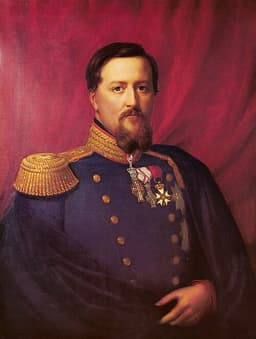
Frederick VII of Denmark
Emperor · Modern
55.4Total

Shah Jahan Begum
Emperor · Modern
51.2Total
Basic Information
Born
1808
1838
Died
1863
1901
Era
Modern
Modern
Nationality
Denmark
India
Occupation
Emperor
Emperor
Civilization
Western
Indian
Score Comparison
Military (10%)
25.0
14.9
Political (20%)
72.0
59.3
Influence (20%)
51.8
56.4
Legacy (20%)
48.3
45.8
Leadership (15%)
74.0
78.0
Strategy (15%)
60.0
35.7
TOTAL
55.4
51.2
Frederick VII of Denmark — Complete Timeline
1848 AD
First Schleswig WarWar◆ Major
Frederick VII faced a rebellion in the duchies of Schleswig and Holstein, supported by Prussia. The war ended in 1851 with the London Protocol, which confirmed Danish sovereignty over Schleswig-Holstein but required Denmark not to integrate Schleswig into the kingdom.
Schleswig-HolsteinWarNationalism
Impact: regional
1849 AD
Granted the Constitution of DenmarkPolitical Action
Frederick VII signed the Danish Constitution on June 5, 1849, transforming Denmark from an absolute monarchy into a constitutional monarchy. The constitution established a bicameral parliament (Rigsdag) and granted civil rights to citizens, ending royal absolutism.
ConstitutionConstitutional MonarchyReform
Impact: nationalprogressive
1857 AD
Abolition of the Øresund TollReform◆ Major
Frederick VII agreed to the abolition of the
TradeBaltic SeaReform
Impact: regionalconstructive
1863 AD
Promulgation of the November ConstitutionPolitical Action◆ Major
Frederick VII signed the November Constitution, which incorporated Schleswig into Denmark in violation of the London Protocol. This act provoked the Second Schleswig War with Prussia and Austria, leading to Danish defeat and loss of the duchies.
ConstitutionSchleswig-HolsteinWar
Impact: regionaldestructive
Shah Jahan Begum — Complete Timeline
1868 AD
Became Nawab Begum of BhopalPolitical Action◆ Major
Shah Jahan Begum succeeded her mother Sikandar Begum as the ruling Nawab Begum of Bhopal. She was one of the few female Muslim rulers in India, governing the princely state with authority.
BhopalFemale RulerSuccession
Impact: regional
1870 AD
Implemented Public Works ProjectsReform
Shah Jahan Begum oversaw the construction of roads, hospitals, and schools in Bhopal. These projects improved infrastructure and public health, though they strained the state's finances.
InfrastructureBhopalPublic Works
constructive
1871 AD
Constructed the Taj-ul-MasajidCultural◆ Major
Shah Jahan Begum began construction of the Taj-ul-Masajid mosque in Bhopal, one of the largest mosques in India. The project was completed after her death, becoming a major architectural landmark.
ArchitectureMosqueBhopal
Impact: regionalconstructive
1876 AD
Authored the 'Taj-ul-Iqbal' HistoryCultural
Shah Jahan Begum wrote 'Taj-ul-Iqbal', a history of Bhopal in Urdu. The work documented the state's rulers and events, contributing to historical scholarship in the region.
LiteratureHistoryUrdu
constructive
Expert Analysis
Origins
Frederick VII of Denmark was born on October 6, 1808, in Copenhagen, the son of Christian VIII and Charlotte Frederica of Mecklenburg-Schwerin. His early life was marked by a strained relationship with his father, and he received a limited education, showing little interest in state affairs. His first marriage to Princess Vilhelmine of Denmark ended in divorce, and his subsequent marriage to Caroline Mariane of Mecklenburg-Strelitz was also unhappy. Frederick's personal life was often scandalous, but his later marriage to actress Louise Rasmussen, who became Countess Danner, provided him with stability.
Shah Jahan Begum was born on July 29, 1838, in Bhopal, India, the only surviving child of Sikandar Begum and Jahangir Mohammad Khan. Her mother, Sikandar Begum, was a capable ruler who ensured Shah Jahan received a thorough education in statecraft, languages (Urdu, Persian, Arabic, and English), and Islamic studies. Growing up in the princely state of Bhopal, she was groomed for leadership from an early age. Her father died when she was young, and her mother's strong influence shaped her political acumen.
Rise to Power
Frederick VII became King of Denmark on January 20, 1848, upon his father's death. His accession coincided with the Revolutions of 1848 sweeping Europe. Facing pressure from liberal nationalists, Frederick appointed a new cabinet and agreed to establish a constitutional assembly. His key turning point came on June 5, 1849, when he signed the Danish Constitution, transforming Denmark from an absolute monarchy into a constitutional one. This move was partly driven by his desire to secure his dynasty and avoid revolution, but it also reflected his personal conviction that reform was necessary. His allies included the National Liberal Party, while his opponents were conservative absolutists.
Shah Jahan Begum became the ruling Nawab Begum of Bhopal in 1868, after her mother Sikandar Begum's death. Her ascension was smooth due to her mother's careful planning and the British recognition of her right to rule. As a female Muslim ruler, she faced challenges in a patriarchal society, but the precedent set by her grandmother Qudsia Begum and mother made it acceptable. Her rule was supported by the British colonial authorities, who valued stability in the princely states. She consolidated power by maintaining good relations with the British while asserting her autonomy in internal affairs.
Leadership & Governance
Frederick VII's leadership style was largely hands-off, delegating governance to his ministers. He is often described as a figurehead for the constitutional transition. His political score of 72.0 reflects his role in the peaceful transition to democracy, but his military score of 25.0 indicates his lack of involvement in military affairs. He supported the adoption of the June Constitution, which established a bicameral parliament and civil liberties. However, his later actions, such as signing the November Constitution in 1863, were controversial. This unilateral act incorporated Schleswig into Denmark, violating the 1852 London Protocol and triggering the Second Schleswig War. This decision showed his willingness to act against advice, leading to disaster.
Shah Jahan Begum was an active ruler, personally overseeing administration and public works. She scored 78.0 in leadership, reflecting her hands-on approach. She implemented reforms in education, establishing schools for girls, and improved infrastructure by building roads, hospitals, and water systems. She also constructed the Taj-ul-Masajid mosque, one of the largest in India, though it was completed after her death. Her governance was marked by a blend of tradition and modernization, maintaining Islamic law while adopting British administrative practices. However, her military score of 14.9 indicates that Bhopal relied on British protection, and she did not command armies.
Triumph & Tragedy
Frederick VII's greatest triumph was the peaceful transition to constitutional monarchy in 1849, which laid the foundation for modern Danish democracy. This act earned him the title "the Father of the Constitution" and is celebrated annually on June 5. His tragedy was the Second Schleswig War of 1864, provoked by his November Constitution. The war resulted in Denmark losing Schleswig, Holstein, and Lauenburg to Prussia and Austria, a devastating blow to Danish national pride. His failure to heed diplomatic warnings and his impulsive decision-making led to this catastrophe.
Shah Jahan Begum's triumphs include her successful rule as a female monarch in a male-dominated era, her contributions to education and infrastructure, and her literary work 'Taj-ul-Iqbal', a history of Bhopal. She left a legacy of progressive governance. Her tragedy lies in the fact that her construction projects, especially the Taj-ul-Masajid, drained state finances, and her later years saw declining British support. Additionally, her daughter Sultan Jahan Begum succeeded her and implemented further reforms, but Shah Jahan's rule was overshadowed by her mother's and daughter's more celebrated reigns.
Character & Destiny
Frederick VII was known for his affable and easygoing nature, but also for his indecisiveness and susceptibility to influence. His character shaped his fate: his desire to be loved led him to grant the constitution, but his later stubbornness caused the war. Historians assess him as a well-meaning but flawed monarch, whose legacy is mixed. He scored 74.0 in leadership, indicating his ability to inspire loyalty, but his strategy score of 60.0 reflects poor long-term planning.
Shah Jahan Begum was determined and pious, with a strong sense of duty. She was a patron of culture and religion, but also pragmatic in dealing with the British. Her character allowed her to overcome gender barriers, but her focus on grand projects sometimes led to financial strain. She is remembered as a capable ruler who maintained Bhopal's autonomy. Her leadership score of 78.0 is the highest among the two, but her strategy score of 35.7 suggests a lack of military or geopolitical foresight.
Legacy
Frederick VII's legacy is primarily constitutional: Denmark's transition to democracy began with his reign. The Danish Constitution of 1849 remains the foundation of Danish governance, though amended. His military failures are a cautionary tale. His influence score of 51.8 reflects his impact on Danish politics, but his legacy score of 48.3 indicates that his personal reputation is overshadowed by the constitutional achievement.
Shah Jahan Begum's legacy includes the Taj-ul-Masajid, her educational reforms, and her history book. She is remembered as one of the few female Muslim rulers in India, inspiring later generations. Her influence score of 56.4 is slightly higher than Frederick's, due to her symbolic importance. However, her legacy score of 45.8 is lower, as her achievements are less known globally. Bhopal's progressive policies continued under her daughter, but Shah Jahan's personal contributions are often overlooked.
Conclusion
Between Frederick VII of Denmark and Shah Jahan Begum, Frederick had a greater impact on his nation's political structure, scoring a total of 55.4 against Shah Jahan's 51.2. His decision to grant the constitution transformed Denmark from an absolute monarchy to a constitutional one, a change that persists today. While Shah Jahan Begum's leadership was commendable, especially as a female ruler, her influence was more localized and less transformative. Frederick's actions had direct consequences for Denmark's position in Europe, even if negative. Therefore, Frederick VII's impact is more significant in terms of political change, despite his later failures. Shah Jahan Begum's legacy is important for gender representation and regional development, but it does not match the systemic change wrought by Frederick VII.
Rankings
🥇
Frederick VII of DenmarkLeader
Mil: 25.0Pol: 72.0Inf: 51.8
55.4
🥈
Shah Jahan Begum
Mil: 14.9Pol: 59.3Inf: 56.4
51.2
+4.2 behind
How This Comparison Works
Algorithm
Each figure is scored on 6 dimensions (0—100 scale) based on structured historical data: Military (10%), Political (20%), Influence (20%), Legacy (20%), Leadership (15%), Strategy (15%). The weighted total produces the final ranking.
Data Sources
Scores are computed from structured sub-indicators in the database. Scale factors adjust for era (Ancient ×0.85, Modern ×1.0) and civilization size (Eastern ×1.05, Other ×0.80) to account for differences in population and military scale.
Maximum 3 Figures
Comparisons are limited to 2—3 figures to ensure readability and statistical meaningfulness.
Error Margins
±5 points per dimension — Sub-scores are derived from historical records with inherent uncertainty. Two figures within 5 points on a dimension should be considered roughly equivalent in that area.
Total Score Accuracy
±3 points overall — The weighted combination of 6 dimensions produces a total score with approximately ±3 points of uncertainty. Differences of less than 3 points are not statistically significant— the figures are effectively tied.
Known Limitations
- Historical records are incomplete and uneven across civilizations
- Figures from oral-tradition societies may be underrepresented
- Occupation labels can misclassify multi-role figures
- Scores measure capability and impact, not moral character
- Quantitative scoring is a comparison tool, not absolute truth
Capability Radar
Military (10%) — Battles & Warfare
Battles
37
10
Win Rate
38
10
Expansion
40
10
Political (20%) — Governance & Reform
Reform
75
75
Diplomacy
50
70
Economy
30
65
Influence (20%) — Cultural & Global Reach
Cultural
30
50
Global
20
30
Legacy (20%) — Historical Impact
Historical
50
45
Longevity
40
40
Leadership (15%) — Power & Stability
Tenure
25
70
Stability
40
70
Strategy (15%) — Tactics & Innovation
Strategy
48
15
Tactics
47
15
Reform
50
30
Similar Comparisons
Comments & Discussion
No comments yet. Be the first to share your thoughts!