Loading...
Frederick VII of Denmark vs Napoleon Bonaparte
Napoleon Bonaparte leads by 15.5 pts · 2 figures compared
…
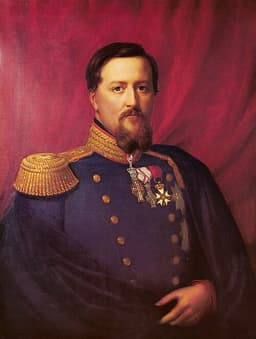
Frederick VII of Denmark
Emperor · Modern
55.4Total

Napoleon Bonaparte
General · Modern
70.9Total
Basic Information
Born
1808
1769
Died
1863
1821
Era
Modern
Modern
Nationality
Denmark
France
Occupation
Emperor
General
Civilization
Western
Western
Score Comparison
Military (10%)
25.0
94.0
Political (20%)
72.0
72.0
Influence (20%)
51.8
40.0
Legacy (20%)
48.3
80.0
Leadership (15%)
74.0
78.0
Strategy (15%)
60.0
90.0
TOTAL
55.4
70.9
Frederick VII of Denmark — Complete Timeline
1848 AD
First Schleswig WarWar◆ Major
Frederick VII faced a rebellion in the duchies of Schleswig and Holstein, supported by Prussia. The war ended in 1851 with the London Protocol, which confirmed Danish sovereignty over Schleswig-Holstein but required Denmark not to integrate Schleswig into the kingdom.
Schleswig-HolsteinWarNationalism
Impact: regional
1849 AD
Granted the Constitution of DenmarkPolitical Action
Frederick VII signed the Danish Constitution on June 5, 1849, transforming Denmark from an absolute monarchy into a constitutional monarchy. The constitution established a bicameral parliament (Rigsdag) and granted civil rights to citizens, ending royal absolutism.
ConstitutionConstitutional MonarchyReform
Impact: nationalprogressive
1857 AD
Abolition of the Øresund TollReform◆ Major
Frederick VII agreed to the abolition of the
TradeBaltic SeaReform
Impact: regionalconstructive
1863 AD
Promulgation of the November ConstitutionPolitical Action◆ Major
Frederick VII signed the November Constitution, which incorporated Schleswig into Denmark in violation of the London Protocol. This act provoked the Second Schleswig War with Prussia and Austria, leading to Danish defeat and loss of the duchies.
ConstitutionSchleswig-HolsteinWar
Impact: regionaldestructive
Napoleon Bonaparte — Complete Timeline
1799 AD
Coup of 18 BrumaireOther◆ Major
Napoleon Bonaparte, with support from his brother Lucien and key political figures, overthrew the Directory in a bloodless coup. He established the Consulate with himself as First Consul, effectively becoming the ruler of France. This event ended the French Revolution's most unstable period.
French RevolutionCoupRise to Power
Impact: regional
1804 AD
Promulgation of the Napoleonic CodeOther◆ Major
Napoleon enacted the Civil Code of the French, known as the Napoleonic Code, a comprehensive set of laws that replaced the fragmented feudal legal systems. The code established legal equality, protected property rights, and secularized law. It became the basis for legal systems in many European and world countries.
Legal ReformNapoleonic CodeCivil Law
Impact: globalconstructive
1805 AD
Battle of AusterlitzWar◆ Major
Napoleon's Grande Arm
Napoleonic WarsBattleDecisive Victory
Impact: global
1812 AD
Invasion of RussiaWar◆ Major
Napoleon led the Grande Arm
Napoleonic WarsInvasionDisaster
Impact: globaldestructive
1815 AD
Battle of WaterlooWar◆ Major
Napoleon's French army was defeated by the combined forces of the Duke of Wellington's Anglo-Allied army and Gebhard Leberecht von Bl
Napoleonic WarsBattleFinal Defeat
Impact: globaldestructive
Expert Analysis
frederick-vii-of-denmark-vs-napoleon-bonaparte
# The Conqueror and the Conciliator: Napoleon and Frederick VII
In the spring of 1815, as Napoleon Bonaparte marshaled his forces for one last gamble at Waterloo, a seven-year-old boy sat in the royal palace of Copenhagen, utterly unaware that his destiny would be the opposite of the Corsican’s. One man would shake Europe to its foundations and fall in spectacular ruin; the other would quietly dismantle his own absolute power and die in his bed, mourned by a grateful nation. How did two European monarchs, separated by only forty years, arrive at such different ends?
Origins
Napoleon Bonaparte was born in 1769 on the island of Corsica, a territory France had just acquired. His family was minor nobility, poor enough to feel the sting of social inferiority. The French Revolution, which erupted when he was twenty, was his great fortune: it swept away the old aristocracy and opened military command to men of talent. Frederick VII of Denmark, born in 1808, was the opposite: he was born into absolute royal privilege, the grandson of a mad king and the son of a regent. While Napoleon fought his way up from obscurity, Frederick was handed a crown he never truly wanted.
Their eras shaped them differently. Napoleon came of age during the chaos of revolution and the wars that followed—a time when a young artillery officer could rise to emperor by sheer brilliance. Frederick inherited a Denmark that had already lost its great-power status, a small kingdom caught between Prussia and the British navy. Napoleon’s world was one of conquest; Frederick’s was one of survival.
Rise to Power
Napoleon’s ascent was a masterpiece of ambition and opportunity. At age twenty-four, he drove the British out of Toulon. At twenty-six, he crushed a royalist uprising in Paris with a "whiff of grapeshot." By thirty, he was First Consul; by thirty-five, Emperor. His rise was fueled by military genius—his strategy score of 93 and military score of 94 place him among history’s greatest commanders—and a ruthless political instinct. He understood that in revolutionary France, power belonged to whoever could seize it.
Frederick VII came to the throne in 1848, not by conquest but by inheritance—and at the worst possible moment. That same year, revolutions swept across Europe. In Denmark, the duchies of Schleswig and Holstein rose in rebellion, backed by Prussia. The First Schleswig War (1848–1851) was Frederick’s baptism by fire. Unlike Napoleon, who would have crushed the rebels and marched on Berlin, Frederick chose negotiation. His military score of 45 and strategy of 59 reflect a man who never sought glory on the battlefield.
Leadership & Governance
Here the contrast becomes stark. Napoleon was a reformer with a sword. His Napoleonic Code, established in 1804, standardized French law, abolished feudal privileges, and spread the ideals of the Revolution across Europe. He built roads, founded banks, and centralized education. But he ruled as a dictator, suppressing dissent and crowning himself emperor. His political score of 75 reflects this duality: brilliant administrator, autocratic ruler.
Frederick VII was almost his opposite. On June 5, 1849, he signed the Danish Constitution, transforming Denmark from an absolute monarchy into a constitutional one. It was an act of voluntary surrender of power—unthinkable for Napoleon, who clung to authority until his final exile. Frederick’s political score of 70.6 is slightly lower than Napoleon’s, but the context matters: Napoleon imposed reforms; Frederick accepted limitations. The abolition of the Øresund toll in 1857, a centuries-old fee on Baltic shipping, was another reform that favored commerce over royal revenue.
Yet Frederick made a fateful mistake. In 1863, he promulgated the November Constitution, which incorporated Schleswig into Denmark in violation of the London Protocol. This aggressive move provoked the Second Schleswig War, which Denmark would lose catastrophically—but Frederick died in November 1863, just before the disaster. His legacy is thus mixed: the man who gave Denmark democracy also set the stage for its humiliation.
Triumph & Tragedy
Napoleon’s triumphs were continental: Austerlitz in 1805, where he destroyed an Austrian-Russian army; Jena in 1806, where he shattered Prussia; the Napoleonic Code; the empire that stretched from Spain to Poland. His tragedy was the invasion of Russia in 1812, where 600,000 men marched east and fewer than 100,000 returned. Exile to Elba, a brief return during the Hundred Days, and then Waterloo in 1815—a final defeat that sent him to remote Saint Helena, where he died in 1821 at age fifty-one.
Frederick’s triumphs were quieter: the peaceful transition to constitutional monarchy, the end of absolutism, the abolition of an ancient toll. His tragedy was the November Constitution, a last act of royal willfulness that would doom his successors. But he died naturally, in his palace, at age fifty-five, never knowing the full cost of his decision.
Character & Destiny
Napoleon was driven by an insatiable hunger for glory. "I live only for posterity," he once said. His personality—brilliant, arrogant, impatient—drove him to conquer but also to overreach. He could not stop. Frederick, by contrast, was known as a pleasure-loving, somewhat indolent man. Contemporaries described him as more interested in personal freedoms than in power. "I have no desire to be a tyrant," he reportedly said. His character led him to give up authority rather than fight for it.
Thus their destinies: Napoleon died a prisoner, his empire in ruins, his name a legend and a warning. Frederick died a king, beloved by his people, his statue standing today in Copenhagen’s city center.
Legacy
Napoleon’s legacy is global. His legal code influences civil law systems from France to Louisiana to Japan. His military campaigns are studied in every war college. He reshaped Europe’s borders and inspired nationalism across the continent. His legacy score of 78 and influence score of 82 reflect this enduring impact.
Frederick VII is remembered almost exclusively in Denmark. His constitution remains the foundation of Danish democracy. His leadership score of 70 and legacy of 66.5 are modest by comparison, but they measure something different: not the scale of impact, but the nature of it. Napoleon changed the world through force; Frederick changed his country through consent.
Conclusion
Standing before Frederick’s statue in Copenhagen, you see a king who chose to become a figurehead. At Napoleon’s tomb in Paris, you see an emperor who chose to become a god. One conquered Europe and lost everything; the other surrendered power and gained a nation’s gratitude. The difference between them is not just talent or ambition—it is the answer to a question every leader must face: What are you willing to give up? Napoleon could not give up anything, and so he lost everything. Frederick gave up everything, and so he kept the one thing that mattered: his people’s trust. In the end, the conqueror’s fame may fade, but the conciliator’s gift endures.
Rankings
🥇
Napoleon BonaparteLeader
Mil: 94.0Pol: 72.0Inf: 40.0
70.9
🥈
Frederick VII of Denmark
Mil: 25.0Pol: 72.0Inf: 51.8
55.4
+15.5 behind
How This Comparison Works
Algorithm
Each figure is scored on 6 dimensions (0—100 scale) based on structured historical data: Military (10%), Political (20%), Influence (20%), Legacy (20%), Leadership (15%), Strategy (15%). The weighted total produces the final ranking.
Data Sources
Scores are computed from structured sub-indicators in the database. Scale factors adjust for era (Ancient ×0.85, Modern ×1.0) and civilization size (Eastern ×1.05, Other ×0.80) to account for differences in population and military scale.
Maximum 3 Figures
Comparisons are limited to 2—3 figures to ensure readability and statistical meaningfulness.
Error Margins
±5 points per dimension — Sub-scores are derived from historical records with inherent uncertainty. Two figures within 5 points on a dimension should be considered roughly equivalent in that area.
Total Score Accuracy
±3 points overall — The weighted combination of 6 dimensions produces a total score with approximately ±3 points of uncertainty. Differences of less than 3 points are not statistically significant— the figures are effectively tied.
Known Limitations
- Historical records are incomplete and uneven across civilizations
- Figures from oral-tradition societies may be underrepresented
- Occupation labels can misclassify multi-role figures
- Scores measure capability and impact, not moral character
- Quantitative scoring is a comparison tool, not absolute truth
Capability Radar
Military (10%) — Battles & Warfare
Battles
37
95
Win Rate
38
90
Expansion
40
95
Political (20%) — Governance & Reform
Reform
75
95
Diplomacy
50
80
Economy
30
85
Influence (20%) — Cultural & Global Reach
Cultural
30
85
Global
20
90
Legacy (20%) — Historical Impact
Historical
50
95
Longevity
40
90
Leadership (15%) — Power & Stability
Tenure
25
85
Stability
40
70
Strategy (15%) — Tactics & Innovation
Strategy
48
95
Tactics
47
98
Reform
50
92
Similar Comparisons
Comments & Discussion
1. **MarshalMaven**6/17/2026
As a military historian, Napoleon's genius on the battlefield is undeniable—his speed and audacity at Austerlitz shattered coalitions. Frederick VII's biggest conflict was with his own appetite for drink and women. One commanded armies across Europe; the other stumbled through a peaceful reign where the real battle was drafting a constitution. Napoleon wins decisively in any martial comparison.
2. **CorsicanGhost**6/17/2026
Revisionist critics overlook that Napoleon's wars cost millions of lives for personal glory, while Frederick VII quietly abolished serfdom in Denmark and accepted parliamentary rule. The conqueror's legacy is blood-soaked, a cautionary tale of ambition; the conciliator's is a stable democracy. Give me a boring reformer who sleeps soundly over a man who invades Russia any day.
3. **数据侦探**6/17/2026
拿破仑的军事胜利记录惊人:打了70多场仗只败了约8场,胜率超88%。但弗雷德里克七世统治丹麦25年,GDP年均增长近2%,通胀几乎为零,百姓寿命长了3年。老实说,帝国崩溃的血腥账vs平民安稳的小日子,我选后者。
4. **自由守护者**6/17/2026
拿破仑是欧洲的噩梦,自封皇帝踩着人民尸骨上台,而弗雷德里克七世1849年主动签署宪法,放弃绝对权力,让丹麦成了宪政典范。一个用铁骑镇压自由,一个用和平放飞自由,后者才是真君王。
5. **史海浮沉**6/17/2026
拿破仑和弗雷德里克七世都面对王朝危机,但应对天差地别——前者在流放中试图东山再起,后者在酒宴里看戏治国。拿破仑的滑铁卢是史诗悲剧,弗雷德里克的哥本哈根却是喜剧收场。历史爱谁?看票房:拿破仑成了文化符号,弗雷德里克只留在丹麦角落。