Loading...
Frederick VII of Denmark vs Vasili IV of Russia
Frederick VII of Denmark leads by 17.0 pts · 2 figures compared
…
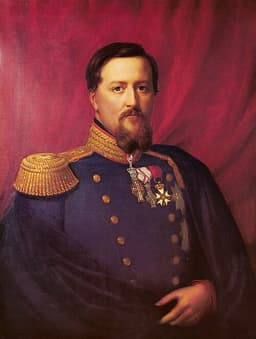
Frederick VII of Denmark
Emperor · Modern
55.4Total
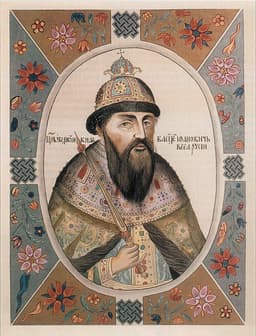
Vasili IV of Russia
Emperor · Modern
38.4Total
Basic Information
Born
1808
1552
Died
1863
1612
Era
Modern
Modern
Nationality
Denmark
Russia
Occupation
Emperor
Emperor
Civilization
Western
Western
Score Comparison
Military (10%)
25.0
25.9
Political (20%)
72.0
27.9
Influence (20%)
51.8
47.9
Legacy (20%)
48.3
36.7
Leadership (15%)
74.0
45.0
Strategy (15%)
60.0
36.8
TOTAL
55.4
38.4
Frederick VII of Denmark — Complete Timeline
1848 AD
First Schleswig WarWar◆ Major
Frederick VII faced a rebellion in the duchies of Schleswig and Holstein, supported by Prussia. The war ended in 1851 with the London Protocol, which confirmed Danish sovereignty over Schleswig-Holstein but required Denmark not to integrate Schleswig into the kingdom.
Schleswig-HolsteinWarNationalism
Impact: regional
1849 AD
Granted the Constitution of DenmarkPolitical Action
Frederick VII signed the Danish Constitution on June 5, 1849, transforming Denmark from an absolute monarchy into a constitutional monarchy. The constitution established a bicameral parliament (Rigsdag) and granted civil rights to citizens, ending royal absolutism.
ConstitutionConstitutional MonarchyReform
Impact: nationalprogressive
1857 AD
Abolition of the Øresund TollReform◆ Major
Frederick VII agreed to the abolition of the
TradeBaltic SeaReform
Impact: regionalconstructive
1863 AD
Promulgation of the November ConstitutionPolitical Action◆ Major
Frederick VII signed the November Constitution, which incorporated Schleswig into Denmark in violation of the London Protocol. This act provoked the Second Schleswig War with Prussia and Austria, leading to Danish defeat and loss of the duchies.
ConstitutionSchleswig-HolsteinWar
Impact: regionaldestructive
Vasili IV of Russia — Complete Timeline
1606 AD
Elected Tsar of RussiaPolitical Action◆ Major
Vasili IV was elected Tsar by a hastily assembled Zemsky Sobor after the overthrow and murder of False Dmitry I. His election ended the brief reign of the first pretender but failed to stabilize Russia, as the country descended into the Time of Troubles.
ElectionTsarTime of Troubles
Impact: national
1607 AD
Defeated the Bolotnikov RebellionWar◆ Major
Vasili IV's forces, led by Prince Mikhail Skopin-Shuisky, defeated the rebel army of Ivan Bolotnikov near Moscow. The rebellion, which combined Cossacks, peasants, and nobles, threatened the capital but was crushed, though it weakened the tsar's authority.
RebellionBolotnikovCivil War
Impact: nationaldestructive
1609 AD
Signed the Treaty of Vyborg with SwedenPolitical Action◆ Major
Vasili IV signed the Treaty of Vyborg, ceding the fortress of Korela to Sweden in exchange for military aid against the Polish-Lithuanian Commonwealth and False Dmitry II. The treaty brought Swedish intervention into the Time of Troubles but failed to secure his throne.
TreatySwedenTime of Troubles
Impact: regionaldestructive
1610 AD
Deposed and forcibly tonsured as a monkPolitical Action◆ Major
Vasili IV was deposed by a coalition of boyars and forced to become a monk, ending his reign. He was later handed over to the Polish-Lithuanian Commonwealth and died in captivity in 1612, the last Rurikid tsar to rule Russia.
DepositionMonkCaptivity
Impact: nationaltragic
Expert Analysis
Origins
Frederick VII of Denmark was born on October 6, 1808, in Copenhagen, as the son of Prince Frederick (later King Frederick VI) and Princess Marie of Hesse-Kassel. He received a military education and served in the army, but his early life was marked by a lack of interest in state affairs. He married three times but had no legitimate children, leading to the end of the Oldenburg dynasty. In contrast, Vasili IV of Russia was born in 1552 into the Shuisky family, one of the oldest Rurikid lines. He was a boyar who gained experience in court intrigues and military campaigns under Ivan the Terrible and Boris Godunov. His early career included serving as a governor and leading troops against Crimean Tatars.
Rise to Power
Frederick VII ascended the throne on January 20, 1848, following the death of his father, Christian VIII. His reign began during a period of political upheaval across Europe. In March 1848, a peaceful demonstration in Copenhagen demanded a constitution. Frederick, advised by his ministers, agreed to end absolute monarchy and called for a constitutional assembly. He signed the Danish Constitution on June 5, 1849, transforming Denmark into a constitutional monarchy. Vasili IV rose to power after the Time of Troubles in Russia. Following the murder of False Dmitry I in 1606, a faction of boyars proclaimed Vasili as tsar. He was elected by a hastily assembled Zemsky Sobor on May 19, 1606, but his reign was immediately contested by rebels and pretenders.
Leadership & Governance
Frederick VII's leadership style was characterized by his willingness to delegate and compromise. He allowed his ministers to govern, and his signing of the constitution established a parliamentary system. His political score of 72.0 reflects his ability to navigate the transition from absolutism. However, he lacked strategic foresight, as seen in the November Constitution of 1863, which violated the London Protocol and led to the Second Schleswig War. Vasili IV's governance was marked by constant struggle. He failed to unify the boyars or secure widespread support. His military score of 25.9 and strategy of 36.8 indicate poor decision-making, such as signing the Treaty of Vyborg with Sweden in 1609, ceding territory for military aid that ultimately did not save his throne.
Triumph & Tragedy
Frederick VII's greatest triumph was the peaceful transition to constitutional monarchy. The 1849 constitution granted civil liberties and established a two-chamber parliament. His legacy score of 48.3 reflects the enduring nature of this reform. However, his tragedy was the mishandling of the Schleswig-Holstein question. The November Constitution, pushed by national-liberal ministers, provoked the Second Schleswig War in 1864, resulting in Denmark's defeat and loss of the duchies. Vasili IV's triumph was the suppression of the Bolotnikov Rebellion in 1607, temporarily stabilizing his rule. But his tragedy was his deposition in 1610, forced tonsure as a monk, and subsequent death in Polish captivity in 1612. His total score of 38.4 reflects his inability to end the Time of Troubles.
Character & Destiny
Frederick VII was known for his amiability and lack of ambition. He enjoyed a simple life, often mingling with commoners. His character allowed him to accept the loss of absolute power, but his indecisiveness contributed to the Schleswig-Holstein crisis. Vasili IV was cunning and ambitious but lacked the charisma and military skill to lead Russia. His reliance on boyar factions and foreign aid undermined his authority. Historians note that his reign was a desperate attempt to preserve the old order against popular upheaval. Both men were shaped by their eras: Frederick by the liberal revolutions of 1848, Vasili by the chaos of the Time of Troubles.
Legacy
Frederick VII's legacy is primarily the Danish Constitution, which remains in effect today, making Denmark one of the oldest constitutional monarchies. He is remembered as a reformer who peacefully relinquished power. His influence score of 51.8 reflects the model he provided for other monarchies. Vasili IV's legacy is largely negative. As the last Rurikid tsar, his failure to stabilize Russia led to the ascension of the Romanov dynasty. His reign is a cautionary tale of the dangers of weak leadership during crises. His influence score of 47.9 is comparable to Frederick's, but his legacy score of 36.7 is lower due to his disastrous end.
Conclusion
Frederick VII of Denmark had a greater impact than Vasili IV of Russia, as evidenced by his higher total score of 55.4 versus 38.4. Frederick's constitutional reform shaped Danish governance for centuries, while Vasili's reign was a failed interlude in Russia's Time of Troubles. Frederick's political score of 72.0 and leadership of 74.0 far exceed Vasili's 27.9 and 45.0. Though both faced crises, Frederick's ability to adapt ensured his nation's stability, while Vasili's inflexibility led to collapse. Thus, Frederick VII stands as a more successful and influential monarch.
Rankings
🥇
Frederick VII of DenmarkLeader
Mil: 25.0Pol: 72.0Inf: 51.8
55.4
🥈
Vasili IV of Russia
Mil: 25.9Pol: 27.9Inf: 47.9
38.4
+17.0 behind
How This Comparison Works
Algorithm
Each figure is scored on 6 dimensions (0—100 scale) based on structured historical data: Military (10%), Political (20%), Influence (20%), Legacy (20%), Leadership (15%), Strategy (15%). The weighted total produces the final ranking.
Data Sources
Scores are computed from structured sub-indicators in the database. Scale factors adjust for era (Ancient ×0.85, Modern ×1.0) and civilization size (Eastern ×1.05, Other ×0.80) to account for differences in population and military scale.
Maximum 3 Figures
Comparisons are limited to 2—3 figures to ensure readability and statistical meaningfulness.
Error Margins
±5 points per dimension — Sub-scores are derived from historical records with inherent uncertainty. Two figures within 5 points on a dimension should be considered roughly equivalent in that area.
Total Score Accuracy
±3 points overall — The weighted combination of 6 dimensions produces a total score with approximately ±3 points of uncertainty. Differences of less than 3 points are not statistically significant— the figures are effectively tied.
Known Limitations
- Historical records are incomplete and uneven across civilizations
- Figures from oral-tradition societies may be underrepresented
- Occupation labels can misclassify multi-role figures
- Scores measure capability and impact, not moral character
- Quantitative scoring is a comparison tool, not absolute truth
Capability Radar
Military (10%) — Battles & Warfare
Battles
37
20
Win Rate
38
15
Expansion
40
5
Political (20%) — Governance & Reform
Reform
75
10
Diplomacy
50
15
Economy
30
10
Influence (20%) — Cultural & Global Reach
Cultural
30
15
Global
20
10
Legacy (20%) — Historical Impact
Historical
50
20
Longevity
40
10
Leadership (15%) — Power & Stability
Tenure
25
30
Stability
40
5
Strategy (15%) — Tactics & Innovation
Strategy
48
15
Tactics
47
20
Reform
50
10
Similar Comparisons
Comments & Discussion
No comments yet. Be the first to share your thoughts!