Loading...
Frederik IX of Denmark vs Napoleon Bonaparte
Napoleon Bonaparte leads by 19.2 pts · 2 figures compared
…
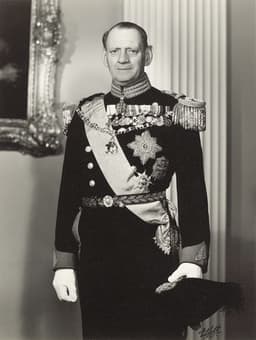
Frederik IX of Denmark
Emperor · Modern
51.7Total

Napoleon Bonaparte
General · Modern
70.9Total
Basic Information
Born
1899
1769
Died
1972
1821
Era
Modern
Modern
Nationality
Denmark
France
Occupation
Emperor
General
Civilization
Western
Western
Score Comparison
Military (10%)
25.6
94.0
Political (20%)
62.7
72.0
Influence (20%)
51.8
40.0
Legacy (20%)
40.0
80.0
Leadership (15%)
72.0
78.0
Strategy (15%)
60.0
90.0
TOTAL
51.7
70.9
Frederik IX of Denmark — Complete Timeline
1947 AD
Accession to the thronePolitical Action◆ Major
Frederik IX became King of Denmark on April 20, 1947, following the death of his father, Christian X. His reign oversaw the post-war reconstruction and modernization of Denmark.
AccessionSuccession
Impact: national
1949 AD
Support for NATO membershipPolitical Action◆ Major
Frederik IX supported Denmark's accession to NATO in 1949, aligning the country with Western powers during the Cold War. This marked a shift from Denmark's traditional neutrality.
NATOCold WarForeign Policy
Impact: regionalconstructive
1953 AD
Signing of the 1953 constitutionReform◆ Major
Frederik IX signed a new constitution in 1953 that abolished the upper house (Landsting), introduced a unicameral parliament (Folketing), and allowed female succession to the throne. This modernized the Danish political system.
Constitutional ReformUnicameralismFemale Succession
Impact: nationalprogressive
1960 AD
Modernization of the Danish welfare stateReform◆ Major
During Frederik IX's reign, Denmark expanded its welfare state, including the introduction of universal healthcare, old-age pensions, and social security. These reforms were part of the post-war social democratic consensus.
Welfare StateSocial ReformHealthcare
Impact: nationalconstructive
1972 AD
Death and succession of Margrethe IIPolitical Action◆ Major
Frederik IX died on January 14, 1972, and was succeeded by his daughter, Margrethe II, who became Denmark's first reigning queen in centuries. His death marked the end of an era of post-war reconstruction.
DeathSuccessionMargrethe II
Impact: national
Napoleon Bonaparte — Complete Timeline
1799 AD
Coup of 18 BrumaireOther◆ Major
Napoleon Bonaparte, with support from his brother Lucien and key political figures, overthrew the Directory in a bloodless coup. He established the Consulate with himself as First Consul, effectively becoming the ruler of France. This event ended the French Revolution's most unstable period.
French RevolutionCoupRise to Power
Impact: regional
1804 AD
Promulgation of the Napoleonic CodeOther◆ Major
Napoleon enacted the Civil Code of the French, known as the Napoleonic Code, a comprehensive set of laws that replaced the fragmented feudal legal systems. The code established legal equality, protected property rights, and secularized law. It became the basis for legal systems in many European and world countries.
Legal ReformNapoleonic CodeCivil Law
Impact: globalconstructive
1805 AD
Battle of AusterlitzWar◆ Major
Napoleon's Grande Arm
Napoleonic WarsBattleDecisive Victory
Impact: global
1812 AD
Invasion of RussiaWar◆ Major
Napoleon led the Grande Arm
Napoleonic WarsInvasionDisaster
Impact: globaldestructive
1815 AD
Battle of WaterlooWar◆ Major
Napoleon's French army was defeated by the combined forces of the Duke of Wellington's Anglo-Allied army and Gebhard Leberecht von Bl
Napoleonic WarsBattleFinal Defeat
Impact: globaldestructive
Expert Analysis
frederik-ix-of-denmark-vs-napoleon-bonaparte
# The Emperor and the Sailor King
On a June morning in 1815, Napoleon Bonaparte surveyed the muddy fields near Waterloo, his grand army poised for what would be the final act of a drama that had reshaped Europe. A century and a half later, on a crisp January day in 1972, King Frederik IX of Denmark died quietly in Copenhagen, his reign a gentle coda to a monarchy that had learned to step back from power. These two men, both crowned rulers of their nations, inhabited worlds so different that they might have belonged to separate ages of human history. Yet their lives pose a question that lingers: what separates the conqueror from the caretaker, and why did one burn so brightly while the other glowed so steadily?
Origins
Napoleon Bonaparte was born in 1769 on the island of Corsica, a place that had only recently become French. His family was minor nobility, but his rise depended not on birth but on the chaos of revolution. The France of his youth was a cauldron—the old order collapsing, the guillotine busy, and opportunity open to any man with talent and ambition. Napoleon absorbed the Enlightenment's faith in reason and order, but he also inherited a Corsican sense of honor and vendetta. He was, from the start, a creature of upheaval.
Frederik IX, born in 1899, entered a Denmark that had been stable for centuries. His father was King Christian X, his mother Queen Alexandrine, and his path was predetermined. But young Frederik had a passion that set him apart: the sea. He trained as a naval officer, serving on ships and learning the rhythms of command in a world where decisions were measured in knots and degrees, not in battles and blood. His education was not in the philosophy of revolution but in the practical arts of navigation and duty. Denmark was a small kingdom that had learned the hard lesson of the nineteenth century—that survival meant staying small.
Rise to Power
Napoleon’s ascent was a rocket. In 1793, at age twenty-four, he drove the British out of Toulon and was made a brigadier general. By 1796, he commanded the Army of Italy and turned it into a legend, crossing the Alps, winning battles against Austria, and sending looted art back to Paris. The Directory, France’s corrupt ruling body, saw him as a useful tool; Napoleon saw them as obstacles. In 1799, he staged a coup and made himself First Consul. By 1804, he crowned himself Emperor in Notre Dame, taking the crown from the Pope’s hands and placing it on his own head. The message was clear: he owed nothing to God or man.
Frederik IX’s rise was a slow tide. He became king in 1947 at age forty-eight, after his father’s long reign. There was no coup, no battlefield glory—just a quiet accession. But he had already lived through Denmark’s darkest hour: the Nazi occupation of 1940-1945. During those years, his father Christian X had become a symbol of resistance, riding his horse through Copenhagen each day to show the flag still flew. Frederik, as crown prince, had worked with the resistance and been imprisoned briefly by the Germans. He learned that power, in a small country, was not about conquest but about endurance.
Leadership & Governance
Napoleon governed as he fought: with speed, brilliance, and ruthlessness. He reformed French law with the Napoleonic Code, a system that enshrined equality before the law, property rights, and secular administration—but also restored slavery in the colonies and crushed women’s rights. He built roads, standardized education, and created a centralized state that France still lives with. His military genius was unmatched: at Austerlitz in 1805, he destroyed a combined Russian and Austrian army with a strategy so perfect it is still studied. But he could not stop. Victory demanded more victory, and each conquest bred new enemies.
Frederik IX ruled as a constitutional monarch, which meant he reigned but did not govern. His power was symbolic, and he used it wisely. In 1949, he supported Denmark’s entry into NATO, a quiet but crucial decision that anchored his country in the Western alliance. In 1953, he signed a new constitution that abolished the upper house and introduced a unicameral parliament, a reform that modernized Danish democracy. And throughout the 1960s, he presided over the expansion of the welfare state—universal healthcare, old-age pensions, social security. His leadership was not about personal glory but about institutional stability. He was, in essence, a manager of decline—the decline of royal power itself.
Triumph & Tragedy
Napoleon’s greatest triumph was also the seed of his tragedy. In 1812, he invaded Russia with the largest army Europe had ever seen—over 600,000 men. He won the Battle of Borodino and entered Moscow, but the city burned, and the Russian winter did what no enemy could. The Grand Army retreated in chaos, losing hundreds of thousands to cold, hunger, and guerrilla attacks. He never recovered. Exiled to Elba in 1814, he escaped and returned for one hundred days, but at Waterloo in 1815, his old magic failed. He died in 1821 on the remote island of Saint Helena, a prisoner of the British, his empire shattered.
Frederik IX’s tragedy was gentler. He was a man who loved the sea and the simple life of a sailor, but he was born to be a king. He smoked a pipe, wore casual clothes, and played jazz piano—he even conducted the Royal Danish Orchestra. His marriage to Princess Ingrid of Sweden was happy, but he had no sons, and the succession law had to be changed to allow his daughter Margrethe to inherit the throne. He died of heart failure in 1972, at age seventy-two, just after giving a New Year’s speech. The tragedy was not his failure but his irrelevance: the world he had known was passing away, and his greatest achievement was to let it go peacefully.
Character & Destiny
Napoleon was driven by an insatiable hunger. “I am the revolution,” he said, and he meant it. He saw himself as a force of nature, a man who made his own luck. His character was a paradox: brilliant and petty, generous and cruel, visionary and blind. He could inspire men to die for him, but he could also abandon them. His destiny was to be the archetype of the modern dictator—the man who remakes the world in his image and destroys himself in the process.
Frederik IX was driven by duty. “A king is a servant,” he once said, and he acted accordingly. His character was modest and warm, his passions private. He did not seek to change the world but to preserve his small corner of it. His destiny was to be the archetype of the modern constitutional monarch—the man who gives up power to keep his crown, who reigns without ruling, who symbolizes continuity in a world of change.
Legacy
Napoleon’s legacy is written in blood and stone. The Napoleonic Code influences legal systems from Europe to Latin America. His campaigns are studied in military academies worldwide. His name is synonymous with ambition, genius, and overreach. He is remembered as both a liberator and a tyrant, a man who spread the ideals of the French Revolution even as he betrayed them.
Frederik IX’s legacy is quieter but no less real. He modernized the Danish monarchy, making it a symbol of national unity rather than a relic of feudalism. His support for the welfare state helped create one of the most egalitarian societies in the world. He is remembered in Denmark as the “Sailor King,” a man who loved his country and his people. His daughter Margrethe II, who succeeded him, has reigned for over fifty years, a testament to the stability he helped build.
Conclusion
Napoleon Bonaparte and Frederik IX of Denmark stand at opposite ends of the spectrum of leadership. One conquered continents, the other sailed his own small sea. One died in exile, the other in his bed. One is remembered for his triumphs and his fall, the other for his steadiness and his service. Their differences are not just personal but historical: Napoleon lived in an age of revolution, when a man could remake the world with will and war; Frederik lived in an age of institutions, when power was measured not in conquest but in consent. Yet both were products of their time, and both shaped their nations in ways that endure. The question is not which was better—it is which kind of world we want to live in. The conqueror’s fire burns bright but consumes everything; the caretaker’s flame is low but warms the house through the long night. History, perhaps, has room for both.
Rankings
🥇
Napoleon BonaparteLeader
Mil: 94.0Pol: 72.0Inf: 40.0
70.9
🥈
Frederik IX of Denmark
Mil: 25.6Pol: 62.7Inf: 51.8
51.7
+19.2 behind
How This Comparison Works
Algorithm
Each figure is scored on 6 dimensions (0—100 scale) based on structured historical data: Military (10%), Political (20%), Influence (20%), Legacy (20%), Leadership (15%), Strategy (15%). The weighted total produces the final ranking.
Data Sources
Scores are computed from structured sub-indicators in the database. Scale factors adjust for era (Ancient ×0.85, Modern ×1.0) and civilization size (Eastern ×1.05, Other ×0.80) to account for differences in population and military scale.
Maximum 3 Figures
Comparisons are limited to 2—3 figures to ensure readability and statistical meaningfulness.
Error Margins
±5 points per dimension — Sub-scores are derived from historical records with inherent uncertainty. Two figures within 5 points on a dimension should be considered roughly equivalent in that area.
Total Score Accuracy
±3 points overall — The weighted combination of 6 dimensions produces a total score with approximately ±3 points of uncertainty. Differences of less than 3 points are not statistically significant— the figures are effectively tied.
Known Limitations
- Historical records are incomplete and uneven across civilizations
- Figures from oral-tradition societies may be underrepresented
- Occupation labels can misclassify multi-role figures
- Scores measure capability and impact, not moral character
- Quantitative scoring is a comparison tool, not absolute truth
Capability Radar
Military (10%) — Battles & Warfare
Battles
35
95
Win Rate
38
90
Expansion
42
95
Political (20%) — Governance & Reform
Reform
55
95
Diplomacy
50
80
Economy
50
85
Influence (20%) — Cultural & Global Reach
Cultural
30
85
Global
20
90
Legacy (20%) — Historical Impact
Historical
30
95
Longevity
20
90
Leadership (15%) — Power & Stability
Tenure
60
85
Stability
65
70
Strategy (15%) — Tactics & Innovation
Strategy
42
95
Tactics
49
98
Reform
51
92
Similar Comparisons
Comments & Discussion
CaptainCorsica6/17/2026
Calling this a comparison is like comparing a hurricane to a breeze. Waterloo was Napoleon’s climax—60,000 dead in one day—while Frederik IX’s biggest legacy was maybe passing some tax reforms? As a military historian, I see a man who redrew Europe’s battlelines versus a king who just sailed boats. Napoleon’s artillery tactics at Austerlitz are still studied; Frederik’s naval tours are tourist trivia.
数据国王6/17/2026
数据不会说谎:拿破仑指挥过60多场战役,统治超7000万人;腓特烈九世的丹麦只有450万人,且无一场战争。说两者同属“君主”,就像把原子弹和蜡烛都叫“光源”。拿破仑的滑铁卢失败改写了欧洲版图,而腓特烈的死不过是丹麦报纸头版而已。数据上,这根本不是同一量级的游戏。
QuoteSmusher6/17/2026
Napoleon’s “History is the version of past events that people have decided to agree upon” frames this whole mess. Frederik IX’s reign is a gentle footnote; Napoleon’s is a saga of epitaphs. Both were monarchs? Sure, but one stamped his signature across Europe with blood, the other with polite diplomacy. If Waterloo was a thunderclap, Frederik’s death was just a sigh.
复古铁粉6/17/2026
别把拿破仑神化了!“滑铁卢”后他流放圣赫勒拿岛,连个王国都保不住;腓特烈九世至少让丹麦和平走完二战中立之路。革命鬼才 vs 稳定灯塔,我选后者。拿破仑的民法典再伟大,也掩盖不了他屠戮300万人的事实。腓特烈没有国界改写,但丹麦人活得更好——这不是输赢问题,是价值选择。
SkepticalSails6/17/2026
You’re all missing the punchline: their legacy is the same—both became symbols. Napoleon’s legend fuels French identity; Frederik IX’s sailors’ king myth softens Danish monarchy. But as a skeptic, I ask: who actually cared? Waterloo’s casualties are names in a mass grave; Frederik’s reforms were just committee work. The real difference? Napoleon got epic poems; Frederik got a postage stamp. Intoxicating, isn’t it?