Loading...
Fumio Kishida vs Helmut Kohl
Helmut Kohl leads by 6.9 pts · 2 figures compared
…
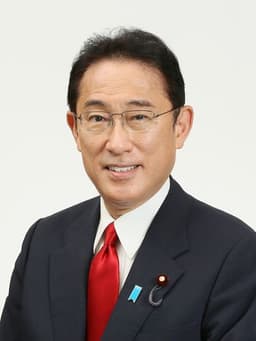
Fumio Kishida
Politician · Modern
51.8Total

Helmut Kohl
Politician · Modern
58.7Total
Basic Information
Born
1957
1930
Died
—
—
Era
Modern
Modern
Nationality
Japan
Germany
Occupation
Politician
Politician
Civilization
Eastern
Western
Score Comparison
Military (10%)
29.2
48.3
Political (20%)
68.0
70.3
Influence (20%)
53.3
68.0
Legacy (20%)
40.0
40.0
Leadership (15%)
64.0
80.0
Strategy (15%)
57.2
43.1
TOTAL
51.8
58.7
Fumio Kishida — Complete Timeline
2021 AD
Announced new capitalism policyReform◆ Major
Kishida unveiled a 'new capitalism' economic policy aiming to redistribute wealth and promote growth. The plan included raising wages, increasing investment in green technology, and addressing income inequality in Japan.
JapanEconomic PolicyNew Capitalism
Impact: nationalconstructive
Elected Prime Minister of JapanPolitical Action◆ Major
Kishida was elected as Prime Minister of Japan after winning the LDP leadership election. He succeeded Yoshihide Suga and formed a cabinet focused on economic recovery and COVID-19 response.
JapanPrime MinisterLDP
Impact: national
2022 AD
Assassination of Shinzo AbePolitical Action◆ Major
Former Prime Minister Shinzo Abe was assassinated during a campaign speech in Nara. Kishida, as sitting prime minister, led the government's response, including security reviews and a state funeral for Abe.
JapanAssassinationAbe
Impact: nationaltragic
Helmut Kohl — Complete Timeline
1982 AD
Chancellor of West GermanyPolitical Action◆ Major
Kohl became Chancellor of West Germany after a constructive vote of no confidence removed Helmut Schmidt. He led a coalition of CDU/CSU and FDP, beginning a 16-year tenure that would oversee German reunification.
ChancellorshipWest GermanyPolitical Transition
Impact: national
1990 AD
German ReunificationPolitical Action
Kohl negotiated the reunification of East and West Germany with international partners, including the Soviet Union. The Two Plus Four Treaty granted full sovereignty to a unified Germany, which formally occurred on October 3, 1990.
ReunificationCold WarEuropean Integration
Impact: globalconstructive
1999 AD
Introduction of the EuroPolitical Action◆ Major
Kohl was a key architect of the Maastricht Treaty, which established the European Union and the single currency, the euro. The euro was introduced as a virtual currency in 1999, with physical notes and coins following in 2002.
European UnionEuroMonetary Union
Impact: globalconstructive
Expert Analysis
Origins
Fumio Kishida was born on July 29, 1957, in Tokyo, Japan, into a political family. His father was a former diplomat, and his grandfather served as a member of the House of Representatives. Kishida attended Keio University, graduating with a degree in law in 1982. He briefly worked at the Long-Term Credit Bank of Japan before entering politics as a secretary for his father.
Helmut Kohl was born on April 3, 1930, in Ludwigshafen, Germany. His father was a civil servant. Kohl studied history and political science at the University of Frankfurt and the University of Heidelberg, earning a doctorate in history in 1958. He joined the Christian Democratic Union (CDU) in 1946, at age 16, and quickly rose through local party ranks.
Rise to Power
Kishida was first elected to the House of Representatives in 1993. He held various ministerial roles, including Minister of State for Okinawa and Northern Territories Affairs (2007-2008) and Minister of Foreign Affairs (2012-2017). In 2021, he won the Liberal Democratic Party (LDP) leadership election, succeeding Yoshihide Suga, and became Prime Minister on October 4, 2021. His rise was steady, relying on factional support within the LDP.
Kohl became Minister-President of Rhineland-Palatinate in 1969. In 1973, he was elected national chairman of the CDU. He became Chancellor of West Germany on October 1, 1982, after a constructive vote of no confidence removed Helmut Schmidt. Kohl's political skill and coalition management kept him in power for 16 years, until 1998.
Leadership & Governance
Kishida’s leadership style is consensus-oriented and cautious. He advocates 'new capitalism,' aiming to balance growth with wealth redistribution. Key policies include raising wages, increasing investment in green technology, and addressing Japan’s declining birthrate. However, his governance has been marked by low approval ratings and challenges in implementing reforms. He scored 64.0 in leadership and 57.2 in strategy.
Kohl was a master of coalition politics and a visionary leader. He pursued European integration and German reunification with determination. His governance involved building trust with international leaders like François Mitterrand and Mikhail Gorbachev. Kohl’s leadership score of 80.0 reflects his ability to navigate complex geopolitical landscapes. His strategy score of 43.1, however, indicates some tactical missteps, such as the handling of post-reunification economic disparities.
Triumph & Tragedy
Kishida’s greatest success was managing Japan’s response to the assassination of former Prime Minister Shinzo Abe in July 2022, maintaining stability. He also secured a historic defense budget increase to 2% of GDP by 2027, reversing decades of pacifism. However, his failure to control inflation and the yen’s decline, along with scandals within the LDP, have eroded public trust. His total score of 51.8 reflects modest achievements.
Kohl’s triumph was German reunification in 1990, a peaceful integration of East and West Germany. He also co-architected the Maastricht Treaty (1992), leading to the euro. However, his legacy is tarnished by the CDU donations scandal (1999-2000), which damaged his reputation. The economic costs of reunification also led to long-term fiscal strains. Kohl’s total score of 58.7 is higher, driven by his political and influence scores.
Character & Destiny
Kishida is known as a pragmatic and low-key leader, often described as a 'safe pair of hands.' His cautious approach has helped him survive political storms, but critics say he lacks bold vision. His destiny is tied to Japan’s demographic and economic challenges, which require more aggressive reforms.
Kohl was a larger-than-life figure, known for his stamina and political cunning. His character—determined, persuasive, and sometimes stubborn—enabled him to seize the historic opportunity of German reunification. However, his refusal to address corruption allegations stained his later years.
Legacy
Kishida’s legacy is still forming. He may be remembered for shifting Japan’s defense policy and attempting economic reform. However, unless he achieves lasting change, his impact will be limited. He scores 40.0 in legacy.
Kohl’s legacy is immense: he is the 'Chancellor of Unity,' who peacefully reunited Germany and laid the foundation for the European Union. The euro and a unified Germany are his enduring monuments. His legacy score of 40.0, however, is similar to Kishida’s due to the corruption scandal, but his influence score of 68.0 is far higher.
Conclusion
Helmut Kohl had a greater impact than Fumio Kishida. Kohl’s leadership during German reunification and European integration reshaped the continent, while Kishida’s tenure has been largely reactive. Although their legacy scores are tied at 40.0, Kohl’s higher political (70.3 vs 68.0) and influence (68.0 vs 53.3) scores demonstrate a more profound effect on history. Kishida’s total score of 51.8 is below Kohl’s 58.7, confirming the gap. Kohl’s achievements were transformative, whereas Kishida’s have been incremental.
Rankings
🥇
Helmut KohlLeader
Mil: 48.3Pol: 70.3Inf: 68.0
58.7
🥈
Fumio Kishida
Mil: 29.2Pol: 68.0Inf: 53.3
51.8
+6.9 behind
How This Comparison Works
Algorithm
Each figure is scored on 6 dimensions (0—100 scale) based on structured historical data: Military (10%), Political (20%), Influence (20%), Legacy (20%), Leadership (15%), Strategy (15%). The weighted total produces the final ranking.
Data Sources
Scores are computed from structured sub-indicators in the database. Scale factors adjust for era (Ancient ×0.85, Modern ×1.0) and civilization size (Eastern ×1.05, Other ×0.80) to account for differences in population and military scale.
Maximum 3 Figures
Comparisons are limited to 2—3 figures to ensure readability and statistical meaningfulness.
Error Margins
±5 points per dimension — Sub-scores are derived from historical records with inherent uncertainty. Two figures within 5 points on a dimension should be considered roughly equivalent in that area.
Total Score Accuracy
±3 points overall — The weighted combination of 6 dimensions produces a total score with approximately ±3 points of uncertainty. Differences of less than 3 points are not statistically significant— the figures are effectively tied.
Known Limitations
- Historical records are incomplete and uneven across civilizations
- Figures from oral-tradition societies may be underrepresented
- Occupation labels can misclassify multi-role figures
- Scores measure capability and impact, not moral character
- Quantitative scoring is a comparison tool, not absolute truth
Capability Radar
Military (10%) — Battles & Warfare
Battles
51
30
Win Rate
56
33
Expansion
57
36
Political (20%) — Governance & Reform
Reform
40
80
Diplomacy
55
85
Economy
45
75
Influence (20%) — Cultural & Global Reach
Cultural
20
60
Global
30
75
Legacy (20%) — Historical Impact
Historical
25
80
Longevity
15
65
Leadership (15%) — Power & Stability
Tenure
35
85
Stability
40
70
Strategy (15%) — Tactics & Innovation
Strategy
59
39
Tactics
63
43
Reform
69
42
Similar Comparisons
Comments & Discussion
No comments yet. Be the first to share your thoughts!