Loading...
Gaafar Nimeiry vs Ismail Khan
Gaafar Nimeiry leads by 3.7 pts · 2 figures compared
…
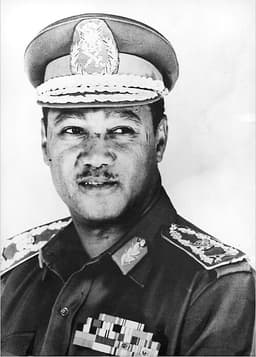
Gaafar Nimeiry
General · Modern
53.1Total

Ismail Khan
General · Modern
49.4Total
Basic Information
Born
1930
1946
Died
—
—
Era
Modern
Modern
Nationality
Sudan
Afghanistan
Occupation
General
General
Civilization
Other
Middle Eastern
Score Comparison
Military (10%)
45.0
40.0
Political (20%)
61.3
42.2
Influence (20%)
54.1
54.9
Legacy (20%)
42.5
45.0
Leadership (15%)
74.0
54.2
Strategy (15%)
41.7
60.0
TOTAL
53.1
49.4
Gaafar Nimeiry — Complete Timeline
1969 AD
1969 Sudanese coup d'étatPolitical Action◆ Major
Gaafar Nimeiry, then a colonel, led the Free Officers Movement in a bloodless coup that overthrew the civilian government of Prime Minister Mohamed Ahmed Mahgoub. Nimeiry established the Revolutionary Command Council (RCC) and declared Sudan a socialist state.
CoupMilitary RuleSocialism
Impact: national
1972 AD
Addis Ababa AgreementPolitical Action◆ Major
Nimeiry signed the Addis Ababa Agreement with the Anyanya rebel group, ending the First Sudanese Civil War (1955-1972). The agreement granted southern Sudan regional autonomy and ended 17 years of conflict, marking a major achievement in Nimeiry's early rule.
Peace AgreementCivil War EndAutonomy
Impact: nationalconstructive
1983 AD
Shift to IslamismReform◆ Major
Nimeiry abandoned his socialist policies and adopted Islamic Sharia law, imposing hudud punishments and dissolving the southern autonomy. This decision alienated the non-Muslim south and reignited civil war, leading to the formation of the Sudan People's Liberation Army (SPLA).
IslamizationShariaCivil War
Impact: nationaldestructive
1985 AD
1985 Sudanese coup d'étatPolitical Action◆ Major
Nimeiry was overthrown by a military coup led by General Abdel Rahman Swar al-Dahab while he was on a visit to the United States. The coup was triggered by widespread protests against economic hardship, corruption, and the ongoing civil war. Nimeiry went into exile in Egypt.
CoupRegime ChangeExile
Impact: national
Ismail Khan — Complete Timeline
1992 AD
Siege of Herat (1992-1995)War◆ Major
Ismail Khan's forces captured Herat from the communist government in 1992. He then established a semi-independent Islamic state in western Afghanistan, ruling Herat province until 1995 when the Taliban captured the city, forcing him to flee.
Afghan Civil WarHeratTaliban
Impact: regional
1995 AD
Capture by Taliban (1995)War◆ Major
Taliban forces captured Herat in September 1995. Ismail Khan was captured and imprisoned by the Taliban, remaining in captivity until his escape in 1999. This marked the end of his rule over western Afghanistan.
TalibanPrisonerDefeat
Impact: regionaltragic
2001 AD
Return as Governor (2001-2004)Political Action◆ Major
After the US-led invasion removed the Taliban, Ismail Khan returned to Herat and was appointed governor of Herat province. He reestablished his authority, controlling customs revenue and maintaining a private militia, leading to tensions with the central government in Kabul.
Post-TalibanGovernorWarlord
Impact: regional
2004 AD
Removal from Governorship (2004)Political Action
President Hamid Karzai removed Ismail Khan as governor of Herat in 2004, appointing him Minister of Energy and Water in Kabul. This was part of efforts to centralize power and reduce the influence of regional warlords in Afghanistan.
KarzaiCentralizationPolitical Maneuvering
Impact: national
Expert Analysis
Origins
**Gaafar Nimeiry** was born on January 1, 1930, in Wad Nubawi, Sudan, to a modest Nubian family. He attended the Sudanese Military College, graduating in 1952, and later trained in Egypt, where he was exposed to Arab nationalism and the Free Officers Movement. His early career was marked by service in the Sudanese army, rising to the rank of colonel by 1969.
**Ismail Khan** was born in 1946 in Herat, Afghanistan, into a Tajik family. He attended the Afghan Military Academy in Kabul, graduating as an artillery officer. He served in the Afghan National Army under the Soviet-backed government, but defected in 1979 to join the mujahideen resistance against the Soviet invasion. His early military experience shaped his guerrilla tactics.
Rise to Power
Nimeiry's rise came on May 25, 1969, when he led the Free Officers Movement in a bloodless coup against Prime Minister Mohamed Ahmed Mahgoub. At age 39, he became Chairman of the Revolutionary Command Council, later assuming the presidency. His early rule was characterized by socialist policies and close ties with Egypt and the Soviet Union.
Ismail Khan rose to prominence during the Soviet-Afghan War (1979-1989) as a commander of the Jamiat-e Islami party. He became known as the 'Lion of Herat' for his effective guerrilla operations. In 1992, after the fall of the communist government, his forces captured Herat, and he established a semi-independent Islamic state in western Afghanistan, ruling with a mix of Islamism and local autonomy.
Leadership & Governance
Nimeiry's leadership style was authoritarian but pragmatic. He initially pursued socialist reforms, nationalizing banks and industries, and signed the Addis Ababa Agreement in 1972, ending the First Sudanese Civil War by granting southern Sudan autonomy. However, his shift to Islamism in 1983, imposing Sharia law and dissolving southern autonomy, reversed that progress and reignited the civil war. His governance score of 74.0 reflects his ability to maintain power through strategic alliances, but his military score of 45.0 indicates poor outcomes from his policies.
Ismail Khan governed Herat as a personal fiefdom from 1992 to 1995, imposing strict Islamic law but also providing security and basic services. His leadership score of 54.2 and political score of 42.2 show he was more a military commander than a politician. He struggled with governance beyond his region, failing to build broader alliances. His strategy score of 60.0 is higher than Nimeiry's 41.7, reflecting his effective guerrilla tactics.
Triumph & Tragedy
Nimeiry's greatest triumph was the Addis Ababa Agreement, which brought peace to Sudan for a decade. However, his decision to unilaterally impose Sharia law in 1983 was a tragic failure that reignited the civil war, leading to over 2 million deaths. His overthrow in 1985 marked the end of his rule, and his legacy is tainted by the war.
Ismail Khan's triumph was his successful defense of Herat against Soviet forces and his establishment of a stable region. However, his capture by the Taliban in 1995 and subsequent imprisonment was a major setback. After returning as governor in 2001, he was removed in 2004 by President Karzai, highlighting his inability to transition from warlord to national leader.
Character & Destiny
Nimeiry was a pragmatic opportunist, shifting from socialism to Islamism to stay in power. His indecisiveness and reliance on shifting alliances ultimately led to his downfall. Historical assessments note his initial vision for a unified Sudan was undermined by his later policies.
Ismail Khan was a charismatic but rigid leader, known for his piety and local popularity. His stubbornness and refusal to compromise with the central government limited his influence. He remained a regional figure, unable to expand his power nationally.
Legacy
Nimeiry's legacy is mixed: he ended the First Civil War but triggered the second, more devastating one. His shift to Islamism set a precedent for future Sudanese governments. His influence score of 54.1 reflects his impact on Sudan's political trajectory.
Ismail Khan's legacy is primarily as a symbol of Tajik resistance and a local leader in Herat. His influence score of 54.9 is slightly higher than Nimeiry's, but his legacy score of 45.0 is lower. He is remembered as a warlord who failed to adapt to post-Taliban Afghanistan.
Conclusion
Gaafar Nimeiry had a greater overall impact than Ismail Khan, as reflected in his total score of 53.1 versus 49.4. Despite his failures, Nimeiry shaped Sudan's national identity and conflict dynamics for decades. Ismail Khan remained a regional actor with limited national influence. Nimeiry's decisions had nationwide consequences, while Khan's influence was confined to Herat. Thus, Nimeiry's impact was more significant, even if largely negative.
Rankings
🥇
Gaafar NimeiryLeader
Mil: 45.0Pol: 61.3Inf: 54.1
53.1
🥈
Ismail Khan
Mil: 40.0Pol: 42.2Inf: 54.9
49.4
+3.7 behind
How This Comparison Works
Algorithm
Each figure is scored on 6 dimensions (0—100 scale) based on structured historical data: Military (10%), Political (20%), Influence (20%), Legacy (20%), Leadership (15%), Strategy (15%). The weighted total produces the final ranking.
Data Sources
Scores are computed from structured sub-indicators in the database. Scale factors adjust for era (Ancient ×0.85, Modern ×1.0) and civilization size (Eastern ×1.05, Other ×0.80) to account for differences in population and military scale.
Maximum 3 Figures
Comparisons are limited to 2—3 figures to ensure readability and statistical meaningfulness.
Error Margins
±5 points per dimension — Sub-scores are derived from historical records with inherent uncertainty. Two figures within 5 points on a dimension should be considered roughly equivalent in that area.
Total Score Accuracy
±3 points overall — The weighted combination of 6 dimensions produces a total score with approximately ±3 points of uncertainty. Differences of less than 3 points are not statistically significant— the figures are effectively tied.
Known Limitations
- Historical records are incomplete and uneven across civilizations
- Figures from oral-tradition societies may be underrepresented
- Occupation labels can misclassify multi-role figures
- Scores measure capability and impact, not moral character
- Quantitative scoring is a comparison tool, not absolute truth
Capability Radar
Military (10%) — Battles & Warfare
Battles
25
45
Win Rate
30
50
Expansion
20
30
Political (20%) — Governance & Reform
Reform
40
20
Diplomacy
45
40
Economy
30
25
Influence (20%) — Cultural & Global Reach
Cultural
30
40
Global
25
20
Legacy (20%) — Historical Impact
Historical
35
35
Longevity
20
25
Leadership (15%) — Power & Stability
Tenure
70
35
Stability
20
20
Strategy (15%) — Tactics & Innovation
Strategy
25
50
Tactics
20
55
Reform
30
20
Similar Comparisons
Comments & Discussion
No comments yet. Be the first to share your thoughts!