Loading...
Gaafar Nimeiry vs Napoleon Bonaparte
Napoleon Bonaparte leads by 17.8 pts · 2 figures compared
…
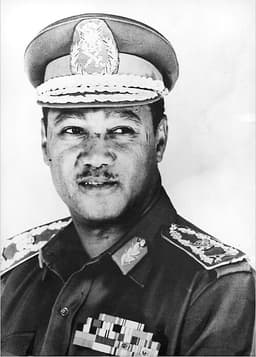
Gaafar Nimeiry
General · Modern
53.1Total

Napoleon Bonaparte
General · Modern
70.9Total
Basic Information
Born
1930
1769
Died
—
1821
Era
Modern
Modern
Nationality
Sudan
France
Occupation
General
General
Civilization
Other
Western
Score Comparison
Military (10%)
45.0
94.0
Political (20%)
61.3
72.0
Influence (20%)
54.1
40.0
Legacy (20%)
42.5
80.0
Leadership (15%)
74.0
78.0
Strategy (15%)
41.7
90.0
TOTAL
53.1
70.9
Gaafar Nimeiry — Complete Timeline
1969 AD
1969 Sudanese coup d'étatPolitical Action◆ Major
Gaafar Nimeiry, then a colonel, led the Free Officers Movement in a bloodless coup that overthrew the civilian government of Prime Minister Mohamed Ahmed Mahgoub. Nimeiry established the Revolutionary Command Council (RCC) and declared Sudan a socialist state.
CoupMilitary RuleSocialism
Impact: national
1972 AD
Addis Ababa AgreementPolitical Action◆ Major
Nimeiry signed the Addis Ababa Agreement with the Anyanya rebel group, ending the First Sudanese Civil War (1955-1972). The agreement granted southern Sudan regional autonomy and ended 17 years of conflict, marking a major achievement in Nimeiry's early rule.
Peace AgreementCivil War EndAutonomy
Impact: nationalconstructive
1983 AD
Shift to IslamismReform◆ Major
Nimeiry abandoned his socialist policies and adopted Islamic Sharia law, imposing hudud punishments and dissolving the southern autonomy. This decision alienated the non-Muslim south and reignited civil war, leading to the formation of the Sudan People's Liberation Army (SPLA).
IslamizationShariaCivil War
Impact: nationaldestructive
1985 AD
1985 Sudanese coup d'étatPolitical Action◆ Major
Nimeiry was overthrown by a military coup led by General Abdel Rahman Swar al-Dahab while he was on a visit to the United States. The coup was triggered by widespread protests against economic hardship, corruption, and the ongoing civil war. Nimeiry went into exile in Egypt.
CoupRegime ChangeExile
Impact: national
Napoleon Bonaparte — Complete Timeline
1799 AD
Coup of 18 BrumaireOther◆ Major
Napoleon Bonaparte, with support from his brother Lucien and key political figures, overthrew the Directory in a bloodless coup. He established the Consulate with himself as First Consul, effectively becoming the ruler of France. This event ended the French Revolution's most unstable period.
French RevolutionCoupRise to Power
Impact: regional
1804 AD
Promulgation of the Napoleonic CodeOther◆ Major
Napoleon enacted the Civil Code of the French, known as the Napoleonic Code, a comprehensive set of laws that replaced the fragmented feudal legal systems. The code established legal equality, protected property rights, and secularized law. It became the basis for legal systems in many European and world countries.
Legal ReformNapoleonic CodeCivil Law
Impact: globalconstructive
1805 AD
Battle of AusterlitzWar◆ Major
Napoleon's Grande Arm
Napoleonic WarsBattleDecisive Victory
Impact: global
1812 AD
Invasion of RussiaWar◆ Major
Napoleon led the Grande Arm
Napoleonic WarsInvasionDisaster
Impact: globaldestructive
1815 AD
Battle of WaterlooWar◆ Major
Napoleon's French army was defeated by the combined forces of the Duke of Wellington's Anglo-Allied army and Gebhard Leberecht von Bl
Napoleonic WarsBattleFinal Defeat
Impact: globaldestructive
Expert Analysis
gaafar-nimeiry-vs-napoleon-bonaparte
# The General and the Zealot: Why Napoleon Built an Empire While Nimeiry Lost a Nation
In the spring of 1815, Napoleon Bonaparte stood before his Grande Armée, about to face the combined forces of Europe at Waterloo. Across the Mediterranean, in a dusty barracks in Khartoum, a young Sudanese officer named Gaafar Nimeiry was not yet born. But when Nimeiry would seize power 154 years later, he would carry a similar ambition: to transform a fractured nation through military will. One would leave a legal and political legacy that still shapes Europe; the other would leave a country more divided than he found it. The question is not whether both were ambitious—they were. The question is why their paths diverged so dramatically.
Origins
Napoleon Bonaparte was born in 1769 on Corsica, an island that had only recently become French. His family was minor nobility, but his education at French military academies exposed him to Enlightenment ideals and the brutal realities of revolutionary warfare. The French Revolution had shattered the old order, and Napoleon, a young artillery officer, understood that in chaos lay opportunity. He was a product of a civilization in flux, where merit could outrank birth.
Gaafar Nimeiry, born in 1930 in the village of Wad Nubawi, Sudan, grew up under the Anglo-Egyptian Condominium, a colonial arrangement that left Sudan neither fully independent nor fully ruled. His father was a government clerk, his family devoutly Muslim. Nimeiry attended military college in Khartoum, where he absorbed the pan-Arab nationalism of Gamal Abdel Nasser and the anti-colonial fervor sweeping Africa. But unlike Napoleon, Nimeiry inherited a nation that was not a coherent state but a colonial invention—north versus south, Arab versus African, Muslim versus Christian and animist.
Rise to Power
Napoleon’s ascent was meteoric. In 1793, at age 24, he drove British forces from Toulon. By 1796, he commanded the Army of Italy, crushing Austrian armies and dictating peace terms. He was not merely a general; he was a political operator who understood that military victory required civilian support. His 1799 coup d’état, the Coup of 18 Brumaire, was a calculated gamble that made him First Consul. He did not stumble into power—he built a ladder from battlefield to throne.
Nimeiry’s rise was simpler but more fragile. On May 25, 1969, Colonel Nimeiry and his Free Officers Movement—modeled explicitly on Nasser’s 1952 Egyptian revolution—seized control in a bloodless coup. The civilian government was weak, corrupt, and paralyzed by factionalism. Nimeiry promised order, socialism, and unity. But where Napoleon had forged his authority through years of battlefield triumph, Nimeiry’s authority rested on a single morning’s work. He had not earned the loyalty of his army; he had merely borrowed it.
Leadership & Governance
Napoleon’s genius was institutional. He did not merely conquer; he codified. The Napoleonic Code of 1804 standardized French law, abolished feudal privileges, and enshrined property rights and secular governance. He reformed education, established the Bank of France, and built roads and canals. His military strategy—speed, massed artillery, and decisive engagement—was revolutionary. At Austerlitz in 1805, he destroyed a larger Russo-Austrian army with tactical brilliance. Yet his governance was autocratic; he centralized power, suppressed dissent, and crowned himself emperor in 1804.
Nimeiry governed through a shifting mix of ideologies. In 1972, he achieved his greatest success: the Addis Ababa Agreement, which granted autonomy to southern Sudan and ended the First Sudanese Civil War. It was a genuine political achievement, born of compromise and pragmatism. For a decade, Sudan enjoyed relative peace. But Nimeiry could not sustain it. In 1983, facing economic crisis and pressure from Islamist factions, he abruptly abandoned his socialist policies and imposed full Islamic sharia law, including hudud punishments like amputation. He dissolved the southern regional assembly, effectively tearing up the 1972 agreement. This was not a strategic masterstroke—it was a desperate gamble that reignited civil war.
Triumph & Tragedy
Napoleon’s greatest moment was the Battle of Austerlitz, where he outmaneuvered the emperors of Austria and Russia. His worst was the 1812 invasion of Russia, a catastrophic miscalculation of logistics and climate. He lost half a million men and never recovered. Waterloo in 1815 was the final act of a tragedy he wrote himself: hubris, overreach, and the refusal to accept limits.
Nimeiry’s triumph was the 1972 peace, a rare moment when a military ruler chose negotiation over force. His tragedy was the 1983 sharia imposition, which shattered that peace. The Second Sudanese Civil War would last 22 years and kill over two million people. Nimeiry did not start that war alone, but he lit the fuse. By 1985, while he was visiting Washington, D.C., a military coup led by General Abdel Rahman Swar al-Dahab removed him. He returned to find his country in ruins and his legacy in ashes.
Character & Destiny
Napoleon was driven by an insatiable appetite for glory and order. He believed history was made by great men, and he was determined to be the greatest. His personality—brilliant, arrogant, impatient—shaped every decision. He could not stop conquering, even when peace was possible. That same drive built an empire and destroyed it.
Nimeiry was a survivor, not a visionary. He shifted from socialism to Islamism not out of conviction but out of convenience. He lacked Napoleon’s strategic depth; his military score of 33.9 reflects a leader who never fought a major battle, only coups and counter-coups. Where Napoleon commanded armies across Europe, Nimeiry commanded a fractured state with a weak army. His personality was cautious, reactive, and ultimately self-serving. He tried to please everyone and ended up pleasing no one.
Legacy
Napoleon’s legacy is monumental. The Napoleonic Code influenced legal systems across Europe, Latin America, and even parts of Africa. His military tactics are still studied. He reshaped the map of Europe and ended feudalism in many territories. His scores—Military 94, Political 75, Influence 82—reflect a figure who changed the world, for better and worse.
Nimeiry’s legacy is cautionary. He is remembered in Sudan as the man who brought peace and then destroyed it. His sharia imposition radicalized Sudanese politics, empowered Islamist factions like the National Islamic Front, and set the stage for the genocide in Darfur. His scores—Military 33.9, Political 63, Influence 71.3, Legacy 55.6—tell the story of a leader who had potential but lacked the wisdom to use it. He is not studied as a great strategist; he is studied as a warning.
Conclusion
Napoleon and Nimeiry both rose from military backgrounds to rule nations, but they lived in different worlds. Napoleon commanded the most powerful army in Europe and inherited a revolutionary tradition that gave him tools to build. Nimeiry inherited a colony and had to invent a nation from scratch. One had the luxury of ambition; the other was trapped by circumstance. Yet both were undone by the same flaw: the belief that power alone could solve problems that required patience, wisdom, and humility. Napoleon’s empire fell in a day at Waterloo. Nimeiry’s peace fell in a year of sharia. In the end, history judges not by how high you rise, but by what you leave standing when you fall.
Rankings
🥇
Napoleon BonaparteLeader
Mil: 94.0Pol: 72.0Inf: 40.0
70.9
🥈
Gaafar Nimeiry
Mil: 45.0Pol: 61.3Inf: 54.1
53.1
+17.8 behind
How This Comparison Works
Algorithm
Each figure is scored on 6 dimensions (0—100 scale) based on structured historical data: Military (10%), Political (20%), Influence (20%), Legacy (20%), Leadership (15%), Strategy (15%). The weighted total produces the final ranking.
Data Sources
Scores are computed from structured sub-indicators in the database. Scale factors adjust for era (Ancient ×0.85, Modern ×1.0) and civilization size (Eastern ×1.05, Other ×0.80) to account for differences in population and military scale.
Maximum 3 Figures
Comparisons are limited to 2—3 figures to ensure readability and statistical meaningfulness.
Error Margins
±5 points per dimension — Sub-scores are derived from historical records with inherent uncertainty. Two figures within 5 points on a dimension should be considered roughly equivalent in that area.
Total Score Accuracy
±3 points overall — The weighted combination of 6 dimensions produces a total score with approximately ±3 points of uncertainty. Differences of less than 3 points are not statistically significant— the figures are effectively tied.
Known Limitations
- Historical records are incomplete and uneven across civilizations
- Figures from oral-tradition societies may be underrepresented
- Occupation labels can misclassify multi-role figures
- Scores measure capability and impact, not moral character
- Quantitative scoring is a comparison tool, not absolute truth
Capability Radar
Military (10%) — Battles & Warfare
Battles
25
95
Win Rate
30
90
Expansion
20
95
Political (20%) — Governance & Reform
Reform
40
95
Diplomacy
45
80
Economy
30
85
Influence (20%) — Cultural & Global Reach
Cultural
30
85
Global
25
90
Legacy (20%) — Historical Impact
Historical
35
95
Longevity
20
90
Leadership (15%) — Power & Stability
Tenure
70
85
Stability
20
70
Strategy (15%) — Tactics & Innovation
Strategy
25
95
Tactics
20
98
Reform
30
92
Similar Comparisons
Comments & Discussion
马背上的拿破仑6/17/2026
拿破仑靠的是革命后的人才选拔制,从炮兵军官一路杀到皇帝,这背后是整个法国社会的流动性。而尼迈里呢?他在1969年靠政变上台,却用"民族联盟"的幌子掩盖军事独裁。一个给世界留下了民法典,一个给苏丹留下了分裂和饥饿。两个人都穿上军装拿过枪,但拿破仑打的是改变历史的仗,尼迈里打的是争权夺利的仗。军靴踩过的地方,一个长出了法律,一个长出了荒草。
IronAgeEye6/17/2026
"The Sword of Waterloo vs. The Sinkhole of Khartoum" — Napoleon conquered Europe with the Code and a cannon; Nimeiry couldn’t even hold his own country together without losing the south. One built institutions that outlasted his exile (hello, Napoleonic Code), the other signed the Addis Ababa Agreement just to watch it burn. Ambition without a system is just a coup waiting to collapse. Nimeiry had the audacity to compare himself to Caesar, but he couldn't even keep his own economy from bartering