Loading...
This comparison has not been analyzed yet.
One-time AI generation (~1 minute). Scores and timeline are already available below.
Gaspard de Coligny vs Homma Masaharu
Gaspard de Coligny leads by 8.8 pts · 2 figures compared
…
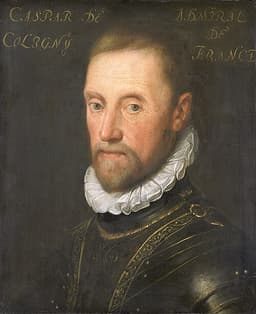
Gaspard de Coligny
General · Modern
58.3Total

Homma Masaharu
General · Modern
49.5Total
Basic Information
Born
1519
1887
Died
1572
1946
Era
Modern
Modern
Nationality
France
Japan
Occupation
General
General
Civilization
Western
Eastern
Score Comparison
Military (10%)
47.5
70.0
Political (20%)
68.0
29.3
Influence (20%)
62.0
52.5
Legacy (20%)
52.0
43.3
Leadership (15%)
65.7
54.2
Strategy (15%)
50.0
60.0
TOTAL
58.3
49.5
Gaspard de Coligny — Complete Timeline
1567 AD
Battle of Saint-DenisWar◆ Major
Gaspard de Coligny commanded Huguenot forces at the Battle of Saint-Denis against the royal army. The battle was indecisive, but the Huguenots failed to capture Paris. Coligny's leadership solidified his position as a key Huguenot military commander.
BattleWars of ReligionHuguenots
Impact: national
1570 AD
Peace of Saint-Germain-en-LayePolitical Action◆ Major
Coligny negotiated the Peace of Saint-Germain-en-Laye, which granted Huguenots limited religious freedom and control of several fortified towns. The peace allowed Coligny to return to court and gain influence over King Charles IX.
Peace TreatyReligious TolerationHuguenots
Impact: nationalconstructive
1572 AD
Assassination attempt on ColignyOther◆ Major
An assassination attempt was made on Gaspard de Coligny in Paris, allegedly ordered by Catherine de Medici and the Guise family. He was shot but survived. This attack set the stage for the St. Bartholomew's Day Massacre two days later.
Assassination AttemptSt. Bartholomew's DayHuguenots
Impact: nationaldestructive
St. Bartholomew's Day MassacreOther
Gaspard de Coligny was killed during the St. Bartholomew's Day Massacre, when Catholic mobs murdered Huguenots in Paris. His body was mutilated and thrown from a window. His death marked a turning point in the Wars of Religion.
MassacreDeathWars of Religion
Impact: nationaltragic
Homma Masaharu — Complete Timeline
1942 AD
Conquered the PhilippinesWar◆ Major
Homma Masaharu commanded the Japanese 14th Army in the invasion of the Philippines, defeating American and Filipino forces. He captured Manila in January 1942 and forced the surrender of Allied troops on Bataan in April 1942, leading to the Bataan Death March.
World War IIPhilippines CampaignBataan
Impact: regional
Oversaw Bataan Death MarchWar
After the surrender of Bataan, Homma's forces forced approximately 75,000 American and Filipino prisoners of war to march 65 miles to prison camps. The march resulted in thousands of deaths due to brutality, starvation, and disease, becoming a major war crime.
World War IIBataan Death MarchWar Crimes
Impact: globaldestructive
1946 AD
Executed for War CrimesPolitical Action◆ Major
Homma Masaharu was tried by a U.S. military commission in Manila and found guilty of war crimes for the Bataan Death March. He was sentenced to death and executed by firing squad on April 3, 1946, despite arguments that he lacked control over his troops.
War Crimes TrialExecutionBataan Death March
Impact: nationaldestructive
This comparison has not been analyzed yet.
One-time AI generation (~1 minute). Scores and timeline are already available below.
Rankings
🥇
Gaspard de ColignyLeader
Mil: 47.5Pol: 68.0Inf: 62.0
58.3
🥈
Homma Masaharu
Mil: 70.0Pol: 29.3Inf: 52.5
49.5
+8.8 behind
How This Comparison Works
Algorithm
Each figure is scored on 6 dimensions (0—100 scale) based on structured historical data: Military (10%), Political (20%), Influence (20%), Legacy (20%), Leadership (15%), Strategy (15%). The weighted total produces the final ranking.
Data Sources
Scores are computed from structured sub-indicators in the database. Scale factors adjust for era (Ancient ×0.85, Modern ×1.0) and civilization size (Eastern ×1.05, Other ×0.80) to account for differences in population and military scale.
Maximum 3 Figures
Comparisons are limited to 2—3 figures to ensure readability and statistical meaningfulness.
Error Margins
±5 points per dimension — Sub-scores are derived from historical records with inherent uncertainty. Two figures within 5 points on a dimension should be considered roughly equivalent in that area.
Total Score Accuracy
±3 points overall — The weighted combination of 6 dimensions produces a total score with approximately ±3 points of uncertainty. Differences of less than 3 points are not statistically significant— the figures are effectively tied.
Known Limitations
- Historical records are incomplete and uneven across civilizations
- Figures from oral-tradition societies may be underrepresented
- Occupation labels can misclassify multi-role figures
- Scores measure capability and impact, not moral character
- Quantitative scoring is a comparison tool, not absolute truth
Capability Radar
Military (10%) — Battles & Warfare
Battles
55
55
Win Rate
50
60
Expansion
30
50
Political (20%) — Governance & Reform
Reform
50
10
Diplomacy
55
20
Economy
30
10
Influence (20%) — Cultural & Global Reach
Cultural
45
20
Global
55
25
Legacy (20%) — Historical Impact
Historical
70
30
Longevity
60
20
Leadership (15%) — Power & Stability
Tenure
45
40
Stability
20
15
Strategy (15%) — Tactics & Innovation
Strategy
65
50
Tactics
60
55
Reform
40
20
Similar Comparisons
Comments & Discussion
No comments yet. Be the first to share your thoughts!