Loading...
George Reid vs Martin Van Buren
Martin Van Buren leads by 1.5 pts · 2 figures compared
…

George Reid
Politician · Modern
52.6Total
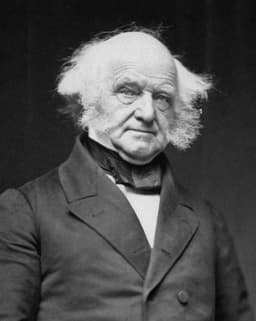
Martin Van Buren
Politician · Modern
54.1Total
Basic Information
Born
1845
1782
Died
1918
1862
Era
Modern
Modern
Nationality
Australia
United States
Occupation
Politician
Politician
Civilization
Western
Western
Score Comparison
Military (10%)
50.0
50.0
Political (20%)
62.7
45.0
Influence (20%)
52.5
59.0
Legacy (20%)
41.7
50.0
Leadership (15%)
68.0
72.0
Strategy (15%)
44.3
42.7
TOTAL
52.6
54.1
George Reid — Complete Timeline
1901 AD
Led the Free Trade PartyPolitical Action
Reid became the leader of the Free Trade Party in the first Australian federal parliament. He championed low tariffs and opposed the protectionist policies of his rivals, shaping early Australian economic policy.
Free TradeAustralian PoliticsEconomic Policy
Impact: national
1904 AD
Elected Prime Minister of AustraliaPolitical Action◆ Major
George Reid became the fourth Prime Minister of Australia on August 18, 1904, leading a Protectionist government. His tenure lasted until July 5, 1905, and was marked by his advocacy for free trade policies.
Australian PoliticsPrime MinisterFree Trade
Impact: national
1910 AD
Appointed High Commissioner to the United KingdomPolitical Action◆ Major
Reid was appointed as Australia's High Commissioner to the United Kingdom, serving from 1910 to 1916. In this role, he represented Australian interests in London during the early years of World War I.
DiplomacyWorld War IAustralia-UK Relations
Impact: national
Martin Van Buren — Complete Timeline
1828 AD
Founded the Democratic PartyPolitical Action◆ Major
Van Buren organized the coalition of Jacksonian Democrats into the Democratic Party, creating a national political organization that supported Andrew Jackson's 1828 presidential campaign. This established the modern two-party system in the United States.
Political PartyJacksonian DemocracyParty System
Impact: nationalconstructive
1836 AD
Elected President of the United StatesPolitical Action◆ Major
Van Buren won the 1836 presidential election as the Democratic candidate, defeating Whig candidates William Henry Harrison and others. He succeeded Andrew Jackson and became the eighth president.
PresidencyElection
Impact: national
1837 AD
Panic of 1837Other◆ Major
A severe financial crisis began shortly after Van Buren took office, triggered by the collapse of speculative land bubbles and bank failures. The depression lasted until the mid-1840s, causing widespread unemployment and bank closures.
Economic CrisisDepressionBanking
Impact: nationaldestructive
1840 AD
Signed the Independent Treasury ActReform◆ Major
Van Buren signed legislation establishing an independent treasury system to manage federal funds without private banks. The system separated government deposits from state banks, aiming to prevent future panics.
Economic ReformTreasuryBanking
Impact: nationalconstructive
Lost 1840 Presidential ElectionPolitical Action◆ Major
Van Buren was defeated by Whig candidate William Henry Harrison in the 1840 election. The campaign focused on the economic depression and Van Buren's perceived elitism, leading to a landslide loss.
Election DefeatWhig Victory
Impact: nationaltragic
1848 AD
Free Soil Party CandidacyPolitical Action
Van Buren ran as the Free Soil Party candidate in the 1848 presidential election, opposing the expansion of slavery into territories. He split the Democratic vote, contributing to Whig Zachary Taylor's victory.
Third PartyAnti-SlaveryElection
Impact: national
Expert Analysis
Origins
George Reid was born on February 25, 1845, in Johnstone, Scotland, and emigrated to Australia with his family in 1852. His father was a Presbyterian minister. Reid was educated at the Scotch College in Melbourne and later worked as a clerk before studying law. He was admitted to the bar in 1879 and entered politics as a free trade advocate.
Martin Van Buren was born on December 5, 1782, in Kinderhook, New York, to a family of Dutch descent. His father was a farmer and tavern keeper. Van Buren had limited formal education but studied law under a local attorney. He was admitted to the bar in 1803 and quickly became involved in New York politics as a Democratic-Republican.
Rise to Power
Reid entered the New South Wales Legislative Assembly in 1880 and became Premier of New South Wales in 1894, serving until 1899. He was a leading figure in the federation movement and became the first leader of the Free Trade Party in the federal parliament. He was elected Prime Minister on August 18, 1904, after the fall of Chris Watson's government. His tenure lasted less than a year, ending on July 5, 1905.
Van Buren rose through New York politics, serving in the state senate and as Attorney General of New York. He was elected to the U.S. Senate in 1821 and became a key ally of Andrew Jackson. Van Buren helped organize the Democratic Party and served as Jackson's Secretary of State and later Vice President. He won the presidency in 1836, defeating several Whig candidates.
Leadership & Governance
Reid's leadership was characterized by his commitment to free trade and fiscal conservatism. As Prime Minister, he focused on tariff reduction and opposed protectionist policies. His government passed the Conciliation and Arbitration Act but struggled to maintain stability due to a divided parliament. Reid's leadership score of 68.0 reflects his ability to navigate complex parliamentary dynamics, but his short tenure limited his impact.
Van Buren's leadership was defined by his role in founding the Democratic Party and his response to the Panic of 1837. He signed the Independent Treasury Act in 1840, separating government funds from private banks. However, his leadership score of 72.0 is tempered by his inability to effectively address the economic depression, which led to his defeat in 1840. His political score of 45.0 indicates his struggles with electoral success despite his organizational skills.
Triumph & Tragedy
Reid's greatest success was his role in shaping Australia's tariff policy and his service as High Commissioner to the United Kingdom from 1910 to 1916, where he represented Australian interests effectively. His greatest failure was his brief prime ministership, which ended due to his inability to form a stable coalition. His political score of 62.7 reflects his influence in Australian politics, but his legacy score of 41.7 indicates limited long-term impact.
Van Buren's triumph was founding the Democratic Party, which became a major political force. His presidency saw the establishment of the independent treasury system. However, his tragedy was the Panic of 1837, which caused widespread economic hardship and destroyed his popularity. His influence score of 59.0 reflects his party-building achievements, but his legacy score of 50.0 is average.
Character & Destiny
Reid was known for his pragmatism and oratory skills. He was a skilled debater but often seen as indecisive. His character as a free trade ideologue limited his ability to form alliances, contributing to his short prime ministership. His destiny was to be a transitional figure in Australian politics, overshadowed by more dominant leaders like Alfred Deakin.
Van Buren was a master political strategist, earning the nickname "The Little Magician." He was cautious and methodical, but his indecisiveness during the Panic of 1837 hurt his presidency. His character as a party builder ensured the Democratic Party's survival, but his inability to adapt to economic crises sealed his political fate.
Legacy
Reid's legacy lies in his advocacy for free trade and his role in the early Australian federation. He is remembered as a competent administrator but not a transformative leader. His scores: military 50.0, political 62.7, influence 52.5, legacy 41.7, leadership 68.0, strategy 44.3, total 52.6.
Van Buren's legacy is more significant as the founder of the Democratic Party and a key figure in the Second Party System. The independent treasury system influenced later fiscal policy. His scores: military 50.0, political 45.0, influence 59.0, legacy 50.0, leadership 72.0, strategy 42.7, total 54.1.
Conclusion
Martin Van Buren had a greater impact than George Reid. Despite a narrow total score gap of 1.5 points, Van Buren's founding of the Democratic Party and his role in shaping American political institutions outweigh Reid's contributions to Australian free trade policy. Van Buren's influence on the party system and fiscal policy endures, while Reid's achievements are largely confined to Australia's early federal period. Van Buren's higher influence (59.0 vs 52.5) and leadership (72.0 vs 68.0) scores support this conclusion.
Rankings
🥇
Martin Van BurenLeader
Mil: 50.0Pol: 45.0Inf: 59.0
54.1
🥈
George Reid
Mil: 50.0Pol: 62.7Inf: 52.5
52.6
+1.5 behind
How This Comparison Works
Algorithm
Each figure is scored on 6 dimensions (0—100 scale) based on structured historical data: Military (10%), Political (20%), Influence (20%), Legacy (20%), Leadership (15%), Strategy (15%). The weighted total produces the final ranking.
Data Sources
Scores are computed from structured sub-indicators in the database. Scale factors adjust for era (Ancient ×0.85, Modern ×1.0) and civilization size (Eastern ×1.05, Other ×0.80) to account for differences in population and military scale.
Maximum 3 Figures
Comparisons are limited to 2—3 figures to ensure readability and statistical meaningfulness.
Error Margins
±5 points per dimension — Sub-scores are derived from historical records with inherent uncertainty. Two figures within 5 points on a dimension should be considered roughly equivalent in that area.
Total Score Accuracy
±3 points overall — The weighted combination of 6 dimensions produces a total score with approximately ±3 points of uncertainty. Differences of less than 3 points are not statistically significant— the figures are effectively tied.
Known Limitations
- Historical records are incomplete and uneven across civilizations
- Figures from oral-tradition societies may be underrepresented
- Occupation labels can misclassify multi-role figures
- Scores measure capability and impact, not moral character
- Quantitative scoring is a comparison tool, not absolute truth
Capability Radar
Military (10%) — Battles & Warfare
Battles
29
29
Win Rate
32
30
Expansion
32
36
Political (20%) — Governance & Reform
Reform
45
55
Diplomacy
60
50
Economy
65
45
Influence (20%) — Cultural & Global Reach
Cultural
20
40
Global
35
45
Legacy (20%) — Historical Impact
Historical
30
55
Longevity
20
50
Leadership (15%) — Power & Stability
Tenure
55
65
Stability
50
40
Strategy (15%) — Tactics & Innovation
Strategy
39
39
Tactics
43
40
Reform
46
45
Similar Comparisons
Comments & Discussion
No comments yet. Be the first to share your thoughts!