Loading...
Grover Cleveland vs Martin Van Buren
Martin Van Buren leads by 0.4 pts · 2 figures compared
…
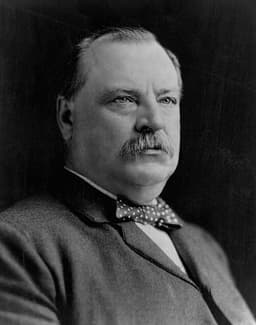
Grover Cleveland
Politician · Modern
53.7Total
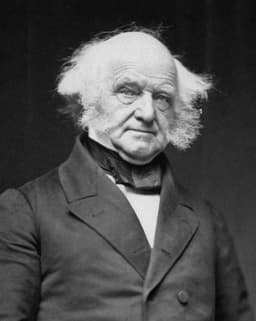
Martin Van Buren
Politician · Modern
54.1Total
Basic Information
Born
1837
1782
Died
1908
1862
Era
Modern
Modern
Nationality
United States
United States
Occupation
Politician
Politician
Civilization
Western
Western
Score Comparison
Military (10%)
50.0
50.0
Political (20%)
45.0
45.0
Influence (20%)
54.9
59.0
Legacy (20%)
48.3
50.0
Leadership (15%)
79.8
72.0
Strategy (15%)
41.8
42.7
TOTAL
53.7
54.1
Grover Cleveland — Complete Timeline
1884 AD
Election as President of the United States (First Term)Political Action◆ Major
Cleveland, a Democrat, won the 1884 presidential election against Republican James G. Blaine. The campaign was marked by personal attacks, but Cleveland's reputation as a reformer helped him win a narrow victory.
Presidential ElectionDemocratic Party
Impact: national
1887 AD
Signing of the Interstate Commerce ActReform◆ Major
Cleveland signed the Interstate Commerce Act, which created the Interstate Commerce Commission (ICC) to regulate railroad rates and practices. This was the first federal agency to regulate private industry, marking a significant expansion of federal power over commerce.
Railroad RegulationFederal Regulation
Impact: nationalconstructive
1892 AD
Election as President of the United States (Second Term)Political Action◆ Major
Cleveland won the 1892 presidential election against incumbent Benjamin Harrison, becoming the only president to serve two non-consecutive terms. His victory was a repudiation of the McKinley Tariff and Republican economic policies.
Presidential ElectionNon-Consecutive Terms
Impact: national
1894 AD
Intervention in the Pullman StrikePolitical Action◆ Major
Cleveland ordered federal troops to break the Pullman Strike, a nationwide railroad strike led by Eugene V. Debs. The intervention was controversial, as it used federal power to suppress labor unrest, and led to Debs' imprisonment.
Labor StrikeFederal Intervention
Impact: nationaldestructive
Martin Van Buren — Complete Timeline
1828 AD
Founded the Democratic PartyPolitical Action◆ Major
Van Buren organized the coalition of Jacksonian Democrats into the Democratic Party, creating a national political organization that supported Andrew Jackson's 1828 presidential campaign. This established the modern two-party system in the United States.
Political PartyJacksonian DemocracyParty System
Impact: nationalconstructive
1836 AD
Elected President of the United StatesPolitical Action◆ Major
Van Buren won the 1836 presidential election as the Democratic candidate, defeating Whig candidates William Henry Harrison and others. He succeeded Andrew Jackson and became the eighth president.
PresidencyElection
Impact: national
1837 AD
Panic of 1837Other◆ Major
A severe financial crisis began shortly after Van Buren took office, triggered by the collapse of speculative land bubbles and bank failures. The depression lasted until the mid-1840s, causing widespread unemployment and bank closures.
Economic CrisisDepressionBanking
Impact: nationaldestructive
1840 AD
Signed the Independent Treasury ActReform◆ Major
Van Buren signed legislation establishing an independent treasury system to manage federal funds without private banks. The system separated government deposits from state banks, aiming to prevent future panics.
Economic ReformTreasuryBanking
Impact: nationalconstructive
Lost 1840 Presidential ElectionPolitical Action◆ Major
Van Buren was defeated by Whig candidate William Henry Harrison in the 1840 election. The campaign focused on the economic depression and Van Buren's perceived elitism, leading to a landslide loss.
Election DefeatWhig Victory
Impact: nationaltragic
1848 AD
Free Soil Party CandidacyPolitical Action
Van Buren ran as the Free Soil Party candidate in the 1848 presidential election, opposing the expansion of slavery into territories. He split the Democratic vote, contributing to Whig Zachary Taylor's victory.
Third PartyAnti-SlaveryElection
Impact: national
Expert Analysis
Origins
Grover Cleveland was born in 1837 in Caldwell, New Jersey, the son of a Presbyterian minister. He grew up in modest circumstances and left school after his father's death to support his family. He moved to Buffalo, New York, where he studied law and was admitted to the bar in 1859. His early legal career focused on local practice, and he became known for his hard work and integrity.
Martin Van Buren was born in 1782 in Kinderhook, New York, to a family of Dutch descent. His father was a farmer and tavern keeper. Van Buren studied law at a local office and was admitted to the bar in 1803. He quickly entered politics, aligning with the Democratic-Republican Party. His early involvement in New York politics earned him the nickname "The Little Magician" for his skill in political maneuvering.
Rise to Power
Cleveland's rise began as Mayor of Buffalo in 1881, where he earned a reputation for fighting corruption. He became Governor of New York in 1883, continuing his reformist agenda. In 1884, he won the Democratic presidential nomination and narrowly defeated Republican James G. Blaine in a campaign marked by personal attacks. Cleveland's support for civil service reform and fiscal conservatism appealed to voters.
Van Buren rose through New York politics, serving as state senator, attorney general, and U.S. Senator. He was a key organizer of Andrew Jackson's 1828 presidential campaign and was rewarded with the position of Secretary of State in 1829. Van Buren later served as Vice President (1833-1837) and was elected President in 1836 as Jackson's chosen successor. He founded the Democratic Party, creating a coalition that dominated American politics for decades.
Leadership & Governance
Cleveland's leadership style was characterized by veto power—he vetoed more bills than any previous president, insisting on limited government and fiscal discipline. He signed the Interstate Commerce Act of 1887, creating the first federal regulatory agency, the Interstate Commerce Commission, scoring 79.8 in leadership. His handling of the Pullman Strike in 1894, sending federal troops, showed his commitment to federal authority over labor unrest.
Van Buren, with a leadership score of 72.0, focused on establishing the Independent Treasury system, which separated government funds from private banks. He believed in strict adherence to Jacksonian principles, including limited government and opposition to a national bank. However, his response to the Panic of 1837—a severe economic depression—was seen as inadequate; he refused to intervene in the economy, adhering to laissez-faire policies.
Triumph & Tragedy
Cleveland's greatest triumph was his non-consecutive re-election in 1892, a unique achievement in U.S. history. He also successfully reduced tariffs and preserved the gold standard. His tragedy was the Panic of 1893, a severe economic depression that began in his second term. His decision to repeal the Sherman Silver Purchase Act deepened the crisis, and his intervention in the Pullman Strike was widely criticized.
Van Buren's triumph was founding the Democratic Party, which shaped American politics for generations. He also established the Independent Treasury system, which lasted until 1913. His tragedy was the Panic of 1837, which devastated the economy and led to his defeat in 1840. Van Buren's refusal to provide federal relief or stimulate the economy contributed to his reputation as a failed president.
Character & Destiny
Cleveland was known for his honesty, stubbornness, and independence. He famously said, "A public office is a public trust." His refusal to compromise on principle often led to political isolation. His character shaped his destiny: his integrity won him respect but also made him enemies. His decision to marry Frances Folsom, his ward, caused controversy but did not derail his career.
Van Buren was a skilled political strategist, earning the nickname "The Little Magician." He was cautious and conciliatory, avoiding bold actions. His character made him an effective party builder but a weak crisis leader. His determination to follow Jackson's policies, even when they proved disastrous, sealed his fate. Historians often view Van Buren as a master manipulator whose presidency was overshadowed by economic turmoil.
Legacy
Cleveland's legacy includes his defense of limited government and fiscal conservatism. He is remembered as a reformer who fought corruption and expanded federal regulation with the Interstate Commerce Act. His two non-consecutive terms remain a historical oddity. He scored 48.3 in legacy, reflecting his impact as a principled but not transformative president.
Van Buren's legacy is as the architect of the modern Democratic Party. His Independent Treasury system influenced later banking reforms. However, his presidency is often ranked near the bottom due to his handling of the Panic of 1837. He scored 50.0 in legacy, slightly higher than Cleveland, but his long-term impact on party politics is significant.
Conclusion
Comparing Cleveland and Van Buren reveals two presidents with similar total scores (53.7 vs 54.1) but different strengths. Cleveland demonstrated stronger leadership (79.8) and decisiveness, while Van Buren showed greater political influence (59.0) in building a party. However, Cleveland's unique electoral feat and his role in establishing federal regulation give him a slight edge in impact. Van Buren's founding of the Democratic Party is enduring, but his failed presidency and economic mismanagement lower his overall standing. Thus, Grover Cleveland had a greater impact as a president who acted on principle, even when unpopular, while Van Buren's legacy is more as a party organizer than a successful leader.
Rankings
🥇
Martin Van BurenLeader
Mil: 50.0Pol: 45.0Inf: 59.0
54.1
🥈
Grover Cleveland
Mil: 50.0Pol: 45.0Inf: 54.9
53.7
+0.4 behind
How This Comparison Works
Algorithm
Each figure is scored on 6 dimensions (0—100 scale) based on structured historical data: Military (10%), Political (20%), Influence (20%), Legacy (20%), Leadership (15%), Strategy (15%). The weighted total produces the final ranking.
Data Sources
Scores are computed from structured sub-indicators in the database. Scale factors adjust for era (Ancient ×0.85, Modern ×1.0) and civilization size (Eastern ×1.05, Other ×0.80) to account for differences in population and military scale.
Maximum 3 Figures
Comparisons are limited to 2—3 figures to ensure readability and statistical meaningfulness.
Error Margins
±5 points per dimension — Sub-scores are derived from historical records with inherent uncertainty. Two figures within 5 points on a dimension should be considered roughly equivalent in that area.
Total Score Accuracy
±3 points overall — The weighted combination of 6 dimensions produces a total score with approximately ±3 points of uncertainty. Differences of less than 3 points are not statistically significant— the figures are effectively tied.
Known Limitations
- Historical records are incomplete and uneven across civilizations
- Figures from oral-tradition societies may be underrepresented
- Occupation labels can misclassify multi-role figures
- Scores measure capability and impact, not moral character
- Quantitative scoring is a comparison tool, not absolute truth
Capability Radar
Military (10%) — Battles & Warfare
Battles
29
29
Win Rate
30
30
Expansion
33
36
Political (20%) — Governance & Reform
Reform
55
55
Diplomacy
65
50
Economy
60
45
Influence (20%) — Cultural & Global Reach
Cultural
30
40
Global
40
45
Legacy (20%) — Historical Impact
Historical
50
55
Longevity
40
50
Leadership (15%) — Power & Stability
Tenure
60
65
Stability
70
40
Strategy (15%) — Tactics & Innovation
Strategy
35
39
Tactics
40
40
Reform
46
45
Similar Comparisons
Comments & Discussion
No comments yet. Be the first to share your thoughts!