Loading...
Martin Van Buren vs Pranab Mukherjee
Pranab Mukherjee leads by 3.5 pts · 2 figures compared
…
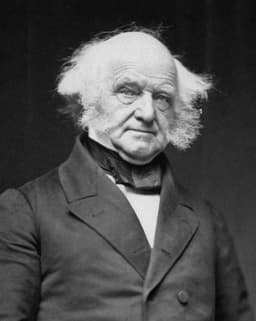
Martin Van Buren
Politician · Modern
54.1Total

Pranab Mukherjee
Politician · Modern
57.6Total
Basic Information
Born
1782
1935
Died
1862
—
Era
Modern
Modern
Nationality
United States
India
Occupation
Politician
Politician
Civilization
Western
Indian
Score Comparison
Military (10%)
50.0
41.8
Political (20%)
45.0
55.0
Influence (20%)
59.0
60.0
Legacy (20%)
50.0
50.0
Leadership (15%)
72.0
78.0
Strategy (15%)
42.7
60.0
TOTAL
54.1
57.6
Martin Van Buren — Complete Timeline
1828 AD
Founded the Democratic PartyPolitical Action◆ Major
Van Buren organized the coalition of Jacksonian Democrats into the Democratic Party, creating a national political organization that supported Andrew Jackson's 1828 presidential campaign. This established the modern two-party system in the United States.
Political PartyJacksonian DemocracyParty System
Impact: nationalconstructive
1836 AD
Elected President of the United StatesPolitical Action◆ Major
Van Buren won the 1836 presidential election as the Democratic candidate, defeating Whig candidates William Henry Harrison and others. He succeeded Andrew Jackson and became the eighth president.
PresidencyElection
Impact: national
1837 AD
Panic of 1837Other◆ Major
A severe financial crisis began shortly after Van Buren took office, triggered by the collapse of speculative land bubbles and bank failures. The depression lasted until the mid-1840s, causing widespread unemployment and bank closures.
Economic CrisisDepressionBanking
Impact: nationaldestructive
1840 AD
Signed the Independent Treasury ActReform◆ Major
Van Buren signed legislation establishing an independent treasury system to manage federal funds without private banks. The system separated government deposits from state banks, aiming to prevent future panics.
Economic ReformTreasuryBanking
Impact: nationalconstructive
Lost 1840 Presidential ElectionPolitical Action◆ Major
Van Buren was defeated by Whig candidate William Henry Harrison in the 1840 election. The campaign focused on the economic depression and Van Buren's perceived elitism, leading to a landslide loss.
Election DefeatWhig Victory
Impact: nationaltragic
1848 AD
Free Soil Party CandidacyPolitical Action
Van Buren ran as the Free Soil Party candidate in the 1848 presidential election, opposing the expansion of slavery into territories. He split the Democratic vote, contributing to Whig Zachary Taylor's victory.
Third PartyAnti-SlaveryElection
Impact: national
Pranab Mukherjee — Complete Timeline
1982 AD
Appointed Finance MinisterPolitical Action◆ Major
Pranab Mukherjee was appointed as India's Finance Minister under Prime Minister Indira Gandhi. He presented several budgets and played a key role in economic policy during the 1980s.
FinanceBudgetCongress
Impact: nationalconstructive
1995 AD
Served as External Affairs MinisterPolitical Action◆ Major
Pranab Mukherjee served as India's External Affairs Minister from 1995 to 1996 under Prime Minister P.V. Narasimha Rao. He handled India's foreign relations during a period of post-Cold War realignment.
DiplomacyForeign PolicyCongress
Impact: nationalconstructive
2009 AD
Presented Union Budget 2009-10Political Action◆ Major
As Finance Minister in the UPA government, Pranab Mukherjee presented the Union Budget for 2009-10, focusing on economic recovery from the global financial crisis. He introduced measures to boost growth and social welfare.
BudgetEconomyUPA
Impact: nationalconstructive
2012 AD
Elected President of IndiaPolitical Action◆ Major
Pranab Mukherjee was elected as the 13th President of India, securing a landslide victory. He served from 2012 to 2017, becoming a respected constitutional figure known for his statesmanship.
PresidencyElectionConstitutional
Impact: nationalconstructive
2019 AD
Awarded Bharat RatnaCultural◆ Major
Pranab Mukherjee was awarded the Bharat Ratna, India's highest civilian award, in recognition of his distinguished service to the nation as a parliamentarian and minister. The award was announced posthumously after his death in 2020.
AwardHonorCivilian
Impact: nationalconstructive
Expert Analysis
Origins
Martin Van Buren was born on December 5, 1782, in Kinderhook, New York, to a family of Dutch descent. His father was a farmer and tavern keeper. Van Buren received a basic education at a local school and later studied law, becoming a lawyer in 1803. His early career involved local politics, serving as a surrogate and state senator. He rose through the ranks of New York's Democratic-Republican Party, mastering the art of political organization.
Pranab Mukherjee was born on December 11, 1935, in Mirati, Bengal Presidency (now West Bengal, India), into a Bengali Brahmin family. His father was a freedom fighter and congressman. Mukherjee earned a degree in history and political science from the University of Calcutta and later studied law. He began his career as a teacher and journalist before entering politics in 1969, when he was elected to the Rajya Sabha as a member of the Indian National Congress.
Rise to Power
Van Buren's rise was built on his organizational skills. He became a key figure in New York's Albany Regency, a political machine that controlled state patronage. In 1821, he was elected to the U.S. Senate. He supported Andrew Jackson in the 1828 election and helped form the Democratic Party, a coalition of Jackson supporters. As a reward, Jackson appointed him Secretary of State in 1829. Van Buren served as Vice President from 1833 to 1837, then won the presidency in 1836, defeating multiple Whig candidates.
Mukherjee's rise was gradual and based on his expertise in finance and foreign affairs. He became a close aide to Prime Minister Indira Gandhi, serving as Minister of Industrial Development (1973-1974) and Finance Minister (1982-1984). He was a key figure in the Congress party during the 1980s, but after Gandhi's defeat in 1977, he remained loyal. He served as External Affairs Minister (1995-1996) under P.V. Narasimha Rao. After a brief political wilderness, he returned as Finance Minister in 2009 under Manmohan Singh, playing a crucial role in managing the global financial crisis. In 2012, he was elected President of India with a landslide victory.
Leadership & Governance
Van Buren's leadership style was cautious and consensus-oriented. As president, he faced the Panic of 1837, a severe economic depression. He responded by advocating for the Independent Treasury Act (1840), which separated government funds from private banks. However, his refusal to use federal intervention to stimulate the economy prolonged the depression. He also maintained Jackson's policy of Indian removal, enforcing the Trail of Tears. His governance was marked by a strict interpretation of federal power, limiting government action during crisis.
Mukherjee's leadership was characterized by pragmatism and institutional respect. As Finance Minister, he presented budgets that focused on fiscal discipline and economic reforms. He played a key role in the 1991 economic liberalization, though not the primary architect. As President, he acted as a constitutional figurehead, but used his moral authority to guide the government during political crises. He notably returned a bill on judicial appointments for reconsideration, asserting presidential discretion. His governance style was collaborative, earning respect across party lines.
Triumph & Tragedy
Van Buren's greatest triumph was founding the Democratic Party, which became a dominant political force. His Independent Treasury Act established a system that lasted until 1913. However, his presidency was overshadowed by the Panic of 1837, which he failed to address effectively. His decision to maintain Jackson's hard-money policies worsened the depression. He lost re-election in 1840 after a single term, his reputation tarnished by economic hardship.
Mukherjee's triumphs include serving as a successful Finance Minister during a global crisis and being awarded the Bharat Ratna. As President, he enhanced the office's dignity and gave a widely praised farewell speech. His tragedy was that his political influence waned after the Congress party's decline; he was unable to prevent the party's loss of power. He also faced criticism for his role in the 1975 Emergency, though he later expressed regret.
Character & Destiny
Van Buren was known as the "Little Magician" for his political cunning. He was a master organizer but lacked charisma and decisive action. His cautious nature led him to avoid bold economic measures during the Panic, sealing his political fate. Historians rate him as an average president, with a political score of 45.0 and leadership score of 72.0. His destiny was to be a transitional figure, overshadowed by Jackson.
Mukherjee was a scholarly and dignified figure, known for his encyclopedic memory and calm demeanor. He was a loyal party man but maintained independence as president. His character allowed him to navigate India's complex political landscape. His leadership score of 78.0 reflects his effectiveness. He died in 2020, leaving a legacy of statesmanship.
Legacy
Van Buren's legacy is mixed. He is credited with creating the modern party system, but his presidency is considered mediocre. His Independent Treasury Act was a precursor to the Federal Reserve. However, his association with the Panic of 1837 and Indian removal tarnishes his record. His influence on American politics is significant, but his total score of 54.1 reflects his limited direct impact.
Mukherjee's legacy is more positive. He is remembered as a respected president who upheld constitutional values. His contributions to India's economic reforms and foreign policy are acknowledged. He was a bridge between generations of Congress leaders. With a total score of 57.6, he slightly edges Van Buren in overall impact, particularly in political and leadership dimensions.
Conclusion
While Van Buren's creation of the Democratic Party was a foundational achievement, his presidency was a failure. Mukherjee, with a total score of 57.6 compared to Van Buren's 54.1, had a more successful career as a minister and president. He navigated crises more effectively and left a stronger legacy of institutional respect. Therefore, Pranab Mukherjee had greater impact.
Rankings
🥇
Pranab MukherjeeLeader
Mil: 41.8Pol: 55.0Inf: 60.0
57.6
🥈
Martin Van Buren
Mil: 50.0Pol: 45.0Inf: 59.0
54.1
+3.5 behind
How This Comparison Works
Algorithm
Each figure is scored on 6 dimensions (0—100 scale) based on structured historical data: Military (10%), Political (20%), Influence (20%), Legacy (20%), Leadership (15%), Strategy (15%). The weighted total produces the final ranking.
Data Sources
Scores are computed from structured sub-indicators in the database. Scale factors adjust for era (Ancient ×0.85, Modern ×1.0) and civilization size (Eastern ×1.05, Other ×0.80) to account for differences in population and military scale.
Maximum 3 Figures
Comparisons are limited to 2—3 figures to ensure readability and statistical meaningfulness.
Error Margins
±5 points per dimension — Sub-scores are derived from historical records with inherent uncertainty. Two figures within 5 points on a dimension should be considered roughly equivalent in that area.
Total Score Accuracy
±3 points overall — The weighted combination of 6 dimensions produces a total score with approximately ±3 points of uncertainty. Differences of less than 3 points are not statistically significant— the figures are effectively tied.
Known Limitations
- Historical records are incomplete and uneven across civilizations
- Figures from oral-tradition societies may be underrepresented
- Occupation labels can misclassify multi-role figures
- Scores measure capability and impact, not moral character
- Quantitative scoring is a comparison tool, not absolute truth
Capability Radar
Military (10%) — Battles & Warfare
Battles
29
41
Win Rate
30
46
Expansion
36
52
Political (20%) — Governance & Reform
Reform
55
60
Diplomacy
50
70
Economy
45
55
Influence (20%) — Cultural & Global Reach
Cultural
40
40
Global
45
50
Legacy (20%) — Historical Impact
Historical
55
50
Longevity
50
45
Leadership (15%) — Power & Stability
Tenure
65
75
Stability
40
65
Strategy (15%) — Tactics & Innovation
Strategy
39
53
Tactics
40
58
Reform
45
57
Similar Comparisons
Comments & Discussion
No comments yet. Be the first to share your thoughts!