Loading...
This comparison has not been analyzed yet.
One-time AI generation (~1 minute). Scores and timeline are already available below.
Georges Bidault vs Klaus Iohannis
Klaus Iohannis leads by 0.4 pts · 2 figures compared
…
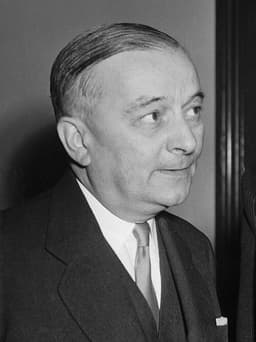
Georges Bidault
Politician · Modern
49.9Total

Klaus Iohannis
Politician · Modern
50.3Total
Basic Information
Born
1899
1959
Died
1983
—
Era
Modern
Modern
Nationality
France
Romania
Occupation
Politician
Politician
Civilization
Western
Western
Score Comparison
Military (10%)
39.9
23.2
Political (20%)
46.6
68.0
Influence (20%)
51.8
53.3
Legacy (20%)
43.3
40.0
Leadership (15%)
65.0
72.0
Strategy (15%)
54.3
36.7
TOTAL
49.9
50.3
Georges Bidault — Complete Timeline
1943 AD
Leadership of the French Resistance and CNRPolitical Action◆ Major
Bidault became president of the National Council of the Resistance (CNR) in 1943, unifying various resistance groups under de Gaulle's authority. He helped coordinate resistance activities and drafted the CNR's program for post-war social and economic reforms, which influenced the Fourth Republic.
French ResistanceWorld War IICNR
Impact: nationalconstructive
1946 AD
First Term as Prime Minister and Foreign PolicyPolitical Action
Bidault served as Prime Minister from June to December 1946, leading a tripartite government of Socialists, Communists, and MRP. He focused on foreign policy, including negotiations for the Marshall Plan and the establishment of the Fourth Republic's constitution, but faced internal coalition tensions.
Fourth RepublicGovernmentPost-War
Impact: nationalconstructive
1949 AD
Second Term as Prime Minister and the Indochina WarPolitical Action◆ Major
Bidault became Prime Minister again in 1949, overseeing France's involvement in the First Indochina War. He supported the creation of the Associated State of Vietnam under Emperor Bao Dai, but the war continued without resolution, and his government fell in 1950 due to economic and colonial issues.
Indochina WarColonial PolicyFourth Republic
Impact: globaldestructive
1958 AD
Opposition to de Gaulle and the Algerian WarPolitical Action◆ Major
Bidault opposed de Gaulle's return to power in 1958 and his policy of Algerian self-determination. He became a leader of the Organisation de l'arm
Algerian WarOASFifth Republic
Impact: nationaldestructive
Klaus Iohannis — Complete Timeline
2014 AD
Elected President of RomaniaPolitical Action◆ Major
Iohannis won the Romanian presidential election as an independent, defeating Prime Minister Victor Ponta. He was the first ethnic German to hold the office since World War II.
ElectionPresidentEthnic German
Impact: nationalconstructive
2015 AD
Anti-Corruption StancePolitical Action◆ Major
Iohannis supported anti-corruption efforts, including the work of the National Anticorruption Directorate. He called for the resignation of Prime Minister Ponta after a deadly nightclub fire, leading to a government change.
Anti-CorruptionJusticeGovernment Change
Impact: nationalconstructive
2019 AD
Re-elected President of RomaniaPolitical Action◆ Major
Iohannis won re-election in a landslide victory against former Prime Minister Viorica D
ElectionRe-electionLandslide
Impact: nationalconstructive
2022 AD
Support for Ukraine and NATOPolitical Action◆ Major
Iohannis condemned Russia's invasion of Ukraine and supported NATO's reinforcement of its eastern flank. Romania hosted allied troops and facilitated grain exports from Ukraine.
UkraineNATOSecurity
Impact: regionalconstructive
This comparison has not been analyzed yet.
One-time AI generation (~1 minute). Scores and timeline are already available below.
Rankings
🥇
Klaus IohannisLeader
Mil: 23.2Pol: 68.0Inf: 53.3
50.3
🥈
Georges Bidault
Mil: 39.9Pol: 46.6Inf: 51.8
49.9
+0.4 behind
How This Comparison Works
Algorithm
Each figure is scored on 6 dimensions (0—100 scale) based on structured historical data: Military (10%), Political (20%), Influence (20%), Legacy (20%), Leadership (15%), Strategy (15%). The weighted total produces the final ranking.
Data Sources
Scores are computed from structured sub-indicators in the database. Scale factors adjust for era (Ancient ×0.85, Modern ×1.0) and civilization size (Eastern ×1.05, Other ×0.80) to account for differences in population and military scale.
Maximum 3 Figures
Comparisons are limited to 2—3 figures to ensure readability and statistical meaningfulness.
Error Margins
±5 points per dimension — Sub-scores are derived from historical records with inherent uncertainty. Two figures within 5 points on a dimension should be considered roughly equivalent in that area.
Total Score Accuracy
±3 points overall — The weighted combination of 6 dimensions produces a total score with approximately ±3 points of uncertainty. Differences of less than 3 points are not statistically significant— the figures are effectively tied.
Known Limitations
- Historical records are incomplete and uneven across civilizations
- Figures from oral-tradition societies may be underrepresented
- Occupation labels can misclassify multi-role figures
- Scores measure capability and impact, not moral character
- Quantitative scoring is a comparison tool, not absolute truth
Capability Radar
Military (10%) — Battles & Warfare
Battles
10
24
Win Rate
10
27
Expansion
5
30
Political (20%) — Governance & Reform
Reform
40
55
Diplomacy
45
60
Economy
30
50
Influence (20%) — Cultural & Global Reach
Cultural
20
30
Global
30
30
Legacy (20%) — Historical Impact
Historical
40
30
Longevity
20
20
Leadership (15%) — Power & Stability
Tenure
55
60
Stability
25
65
Strategy (15%) — Tactics & Innovation
Strategy
20
33
Tactics
20
37
Reform
5
36
Similar Comparisons
Comments & Discussion
No comments yet. Be the first to share your thoughts!