Loading...
This comparison has not been analyzed yet.
One-time AI generation (~1 minute). Scores and timeline are already available below.
Ghulam Muhammad vs Lavrentiy Beria
Lavrentiy Beria leads by 17.0 pts · 2 figures compared
…

Ghulam Muhammad
Politician · Modern
41.6Total
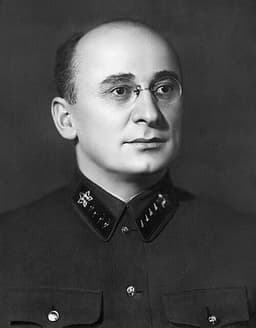
Lavrentiy Beria
Politician · Modern
58.6Total
Basic Information
Born
1895
1899
Died
1956
1953
Era
Modern
Modern
Nationality
Pakistan
Russia
Occupation
Politician
Politician
Civilization
Indian
Western
Score Comparison
Military (10%)
41.5
50.0
Political (20%)
26.4
60.0
Influence (20%)
45.5
61.0
Legacy (20%)
37.5
52.0
Leadership (15%)
45.0
79.8
Strategy (15%)
60.0
44.3
TOTAL
41.6
58.6
Ghulam Muhammad — Complete Timeline
1954 AD
Dissolution of the Constituent AssemblyPolitical Action◆ Major
As Governor-General of Pakistan, Ghulam Muhammad dissolved the Constituent Assembly on October 24, 1954, claiming it had lost the confidence of the people. This act was widely criticized as a blow to democracy and led to a constitutional crisis.
Constitutional CrisisGovernor-GeneralPakistan
Impact: nationaldestructive
1955 AD
Imposition of Governor-General's RulePolitical Action
Following the dissolution of the assembly, Ghulam Muhammad imposed Governor-General's rule, effectively taking over executive powers. He appointed a new cabinet and called for a new constituent assembly, further centralizing authority.
Governor-General's RuleAuthoritarianismPakistan
Impact: nationaldestructive
Lavrentiy Beria — Complete Timeline
1938 AD
Appointment as Head of the NKVDPolitical Action
Beria was appointed People's Commissar for Internal Affairs (NKVD) in November 1938, replacing Nikolai Yezhov. He reorganized the security apparatus, ending the Great Purge's mass executions while expanding the Gulag system and intensifying political surveillance.
NKVDSecurity ServicesStalin
Impact: nationaldestructive
1945 AD
Oversight of the Soviet Atomic Bomb ProjectInvention◆ Major
Beria was appointed to oversee the Soviet atomic bomb project in 1945, using NKVD resources to accelerate development. He managed espionage networks that obtained Western nuclear secrets and directed the construction of facilities, leading to the first Soviet atomic test in 1949.
Nuclear WeaponsCold WarEspionage
Impact: global
1953 AD
Arrest and Execution after Stalin's DeathPolitical Action◆ Major
After Stalin's death in March 1953, Beria was arrested in June 1953 by his Politburo colleagues, including Khrushchev and Malenkov, who feared his power. He was tried secretly, found guilty of treason and other crimes, and executed on December 23, 1953.
Power StruggleExecutionDe-Stalinization
Impact: nationaltragic
This comparison has not been analyzed yet.
One-time AI generation (~1 minute). Scores and timeline are already available below.
Rankings
🥇
Lavrentiy BeriaLeader
Mil: 50.0Pol: 60.0Inf: 61.0
58.6
🥈
Ghulam Muhammad
Mil: 41.5Pol: 26.4Inf: 45.5
41.6
+17.0 behind
How This Comparison Works
Algorithm
Each figure is scored on 6 dimensions (0—100 scale) based on structured historical data: Military (10%), Political (20%), Influence (20%), Legacy (20%), Leadership (15%), Strategy (15%). The weighted total produces the final ranking.
Data Sources
Scores are computed from structured sub-indicators in the database. Scale factors adjust for era (Ancient ×0.85, Modern ×1.0) and civilization size (Eastern ×1.05, Other ×0.80) to account for differences in population and military scale.
Maximum 3 Figures
Comparisons are limited to 2—3 figures to ensure readability and statistical meaningfulness.
Error Margins
±5 points per dimension — Sub-scores are derived from historical records with inherent uncertainty. Two figures within 5 points on a dimension should be considered roughly equivalent in that area.
Total Score Accuracy
±3 points overall — The weighted combination of 6 dimensions produces a total score with approximately ±3 points of uncertainty. Differences of less than 3 points are not statistically significant— the figures are effectively tied.
Known Limitations
- Historical records are incomplete and uneven across civilizations
- Figures from oral-tradition societies may be underrepresented
- Occupation labels can misclassify multi-role figures
- Scores measure capability and impact, not moral character
- Quantitative scoring is a comparison tool, not absolute truth
Capability Radar
Military (10%) — Battles & Warfare
Battles
41
28
Win Rate
48
29
Expansion
51
35
Political (20%) — Governance & Reform
Reform
10
70
Diplomacy
20
60
Economy
15
65
Influence (20%) — Cultural & Global Reach
Cultural
5
30
Global
5
65
Legacy (20%) — Historical Impact
Historical
15
70
Longevity
10
40
Leadership (15%) — Power & Stability
Tenure
30
75
Stability
5
55
Strategy (15%) — Tactics & Innovation
Strategy
50
40
Tactics
57
43
Reform
60
45
Similar Comparisons
Comments & Discussion
No comments yet. Be the first to share your thoughts!