Loading...
Lavrentiy Beria vs Napoleon Bonaparte
Napoleon Bonaparte leads by 12.3 pts · 2 figures compared
…
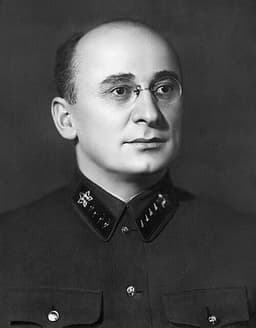
Lavrentiy Beria
Politician · Modern
58.6Total

Napoleon Bonaparte
General · Modern
70.9Total
Basic Information
Born
1899
1769
Died
1953
1821
Era
Modern
Modern
Nationality
Russia
France
Occupation
Politician
General
Civilization
Western
Western
Score Comparison
Military (10%)
50.0
94.0
Political (20%)
60.0
72.0
Influence (20%)
61.0
40.0
Legacy (20%)
52.0
80.0
Leadership (15%)
79.8
78.0
Strategy (15%)
44.3
90.0
TOTAL
58.6
70.9
Lavrentiy Beria — Complete Timeline
1938 AD
Appointment as Head of the NKVDPolitical Action
Beria was appointed People's Commissar for Internal Affairs (NKVD) in November 1938, replacing Nikolai Yezhov. He reorganized the security apparatus, ending the Great Purge's mass executions while expanding the Gulag system and intensifying political surveillance.
NKVDSecurity ServicesStalin
Impact: nationaldestructive
1945 AD
Oversight of the Soviet Atomic Bomb ProjectInvention◆ Major
Beria was appointed to oversee the Soviet atomic bomb project in 1945, using NKVD resources to accelerate development. He managed espionage networks that obtained Western nuclear secrets and directed the construction of facilities, leading to the first Soviet atomic test in 1949.
Nuclear WeaponsCold WarEspionage
Impact: global
1953 AD
Arrest and Execution after Stalin's DeathPolitical Action◆ Major
After Stalin's death in March 1953, Beria was arrested in June 1953 by his Politburo colleagues, including Khrushchev and Malenkov, who feared his power. He was tried secretly, found guilty of treason and other crimes, and executed on December 23, 1953.
Power StruggleExecutionDe-Stalinization
Impact: nationaltragic
Napoleon Bonaparte — Complete Timeline
1799 AD
Coup of 18 BrumaireOther◆ Major
Napoleon Bonaparte, with support from his brother Lucien and key political figures, overthrew the Directory in a bloodless coup. He established the Consulate with himself as First Consul, effectively becoming the ruler of France. This event ended the French Revolution's most unstable period.
French RevolutionCoupRise to Power
Impact: regional
1804 AD
Promulgation of the Napoleonic CodeOther◆ Major
Napoleon enacted the Civil Code of the French, known as the Napoleonic Code, a comprehensive set of laws that replaced the fragmented feudal legal systems. The code established legal equality, protected property rights, and secularized law. It became the basis for legal systems in many European and world countries.
Legal ReformNapoleonic CodeCivil Law
Impact: globalconstructive
1805 AD
Battle of AusterlitzWar◆ Major
Napoleon's Grande Arm
Napoleonic WarsBattleDecisive Victory
Impact: global
1812 AD
Invasion of RussiaWar◆ Major
Napoleon led the Grande Arm
Napoleonic WarsInvasionDisaster
Impact: globaldestructive
1815 AD
Battle of WaterlooWar◆ Major
Napoleon's French army was defeated by the combined forces of the Duke of Wellington's Anglo-Allied army and Gebhard Leberecht von Bl
Napoleonic WarsBattleFinal Defeat
Impact: globaldestructive
Expert Analysis
lavrentiy-beria-vs-napoleon-bonaparte
# The Architect of Power and the Master of Fear
In the winter of 1812, Napoleon Bonaparte watched his Grand Army burn the ancient walls of Moscow, only to see the flames consume his own ambitions as the Russian winter closed in. A century and a half later, in the summer of 1953, Lavrentiy Beria sat in a Kremlin meeting room, still believing he could outmaneuver his rivals, unaware that within hours he would be dragged away to face a firing squad. One man died in exile on a remote Atlantic island, the other in a basement execution chamber. Both wielded immense power over millions, yet their paths could not have diverged more sharply. What separates a conqueror who reshaped a continent from a secret policeman who terrorized a nation?
Origins
Napoleon Bonaparte was born in 1769 on the island of Corsica, a rugged Mediterranean rock that had just passed from Genoese to French control. His family was minor nobility, struggling and proud. Young Napoleon spoke Italian-accented French and carried the chip of a provincial outsider on his shoulder. The Enlightenment was in full bloom across Europe, and a young man with talent could rise—provided he found the right battlefield.
Lavrentiy Beria, born in 1899 in the village of Merkheuli in Georgia, came from a peasant family. His father was a poor farmer, his mother a devout Orthodox Christian. The Russian Empire was crumbling, and the air was thick with revolutionary fervor. Beria studied engineering but found his true calling in the Cheka, the Bolshevik secret police. If Napoleon was forged in the crucible of the French Revolution, Beria was molded in the shadows of the Soviet security apparatus.
The difference in their eras is fundamental. Napoleon came of age when a single gifted individual could still conquer kingdoms with an army and a vision. Beria emerged when modern states had perfected the machinery of surveillance, terror, and bureaucratic control. One sought glory on the battlefield; the other sought power through files and interrogations.
Rise to Power
Napoleon’s ascent was a masterpiece of audacity and timing. In 1793, at age 24, he drove the British out of Toulon with a brilliant artillery plan. By 1796, he commanded the Army of Italy and turned a ragged force into a conquering legion, winning battles like Lodi and Arcole. His Italian campaign of 1796-1797 was not just a military triumph—it was a political stage. Each victory sent dispatches to Paris that made him a national hero. By 1799, he overthrew the Directory in a coup and made himself First Consul. In 1804, he crowned himself Emperor in Notre Dame, taking the crown from Pope Pius VII’s hands and placing it on his own head.
Beria’s rise was quieter, more insidious. He joined the Bolshevik secret police in 1921 and climbed through the ranks by mastering the art of denunciation and loyalty. In 1938, Stalin appointed him head of the NKVD, replacing the bloody Yezhov. Beria’s key event was not a battle but a bureaucratic reorganization: he stopped the wild purges of the late 1930s, executed Yezhov’s men, and brought a chilling efficiency to state terror. He understood that Stalin needed not chaos but control. By 1945, he was overseeing the Soviet atomic bomb project, using NKVD slave labor and espionage to accelerate development. His power was total, but it was always derivative—he ruled through Stalin’s shadow.
Leadership & Governance
Napoleon governed with a blend of military genius and legal reform. His Napoleonic Code, enacted in 1804, standardized French law across Europe, abolishing feudalism and establishing principles of merit, property rights, and secular governance. He built roads, schools, and a central bank. On the battlefield, his strategy score of 93 reflects a mind that could read terrain and timing like a chess grandmaster. At Austerlitz in 1805, he lured the Austro-Russian army into a trap, crushing them in one of history’s greatest victories. He was a political reformer who believed in order and progress—but also in his own supremacy.
Beria’s governance was a regime of fear. He ran the NKVD like a corporate empire of coercion, with informants, torture chambers, and labor camps. His political score of 72.2 and leadership score of 83.0 suggest he was effective within his dark domain. He oversaw the deportation of entire ethnic groups, the execution of thousands, and the creation of the Gulag system that swallowed millions. Yet he also managed the atomic project with ruthless efficiency, forcing scientists to work under threat of death. He was not a builder of institutions but a master of destruction.
Triumph & Tragedy
Napoleon’s greatest triumph was the Empire at its height in 1810-1812, stretching from Spain to Poland. His greatest tragedy was the invasion of Russia in 1812. He marched 600,000 men into the vastness and returned with fewer than 100,000. The disaster broke his aura of invincibility. Exiled to Elba in 1814, he escaped in 1815 and raised another army, only to meet final defeat at Waterloo on June 18, 1815. He died in 1821 on Saint Helena, a prisoner.
Beria’s triumph was surviving Stalin’s paranoia and accumulating power that rivaled the dictator himself. His tragedy came swiftly after Stalin’s death in March 1953. He miscalculated, thinking he could control the succession. In June 1953, his Politburo colleagues, led by Khrushchev, arrested him. He was executed later that year, his name erased from Soviet history.
Character & Destiny
Napoleon was driven by ambition and a belief in his own destiny. “Impossible is a word to be found only in the dictionary of fools,” he once said. His personality—restless, brilliant, arrogant—led him to overreach. He could not stop conquering, and that need destroyed him.
Beria was cold, calculating, and utterly devoid of sentiment. He wore pince-nez glasses and spoke softly, which made him more terrifying. His character was forged in a system where trust was weakness and betrayal was survival. He died because he failed to understand that even the master of fear can become its victim.
Legacy
Napoleon left a mixed legacy. His military campaigns killed millions, but his legal reforms shaped modern Europe. The Napoleonic Code influences civil law in dozens of countries. He is remembered as a genius of war and a flawed visionary.
Beria’s legacy is almost entirely negative. He is a symbol of Stalinist terror, the face of the secret police. His name is synonymous with cruelty. His total score of 64.6 reflects a man who wielded immense power but left nothing of value.
Conclusion
One man sought to conquer the world with armies and laws; the other sought to control it with files and fear. Napoleon’s ambition was visible, his name inscribed on arches and codes. Beria’s power was invisible, his name scrubbed from history. Yet both fell from the same precipice: the illusion that power, once held, cannot be lost. In the end, the conqueror died alone on an island, and the secret policeman died in a basement—two men who mastered their eras but could not master their own fates.
Rankings
🥇
Napoleon BonaparteLeader
Mil: 94.0Pol: 72.0Inf: 40.0
70.9
🥈
Lavrentiy Beria
Mil: 50.0Pol: 60.0Inf: 61.0
58.6
+12.3 behind
How This Comparison Works
Algorithm
Each figure is scored on 6 dimensions (0—100 scale) based on structured historical data: Military (10%), Political (20%), Influence (20%), Legacy (20%), Leadership (15%), Strategy (15%). The weighted total produces the final ranking.
Data Sources
Scores are computed from structured sub-indicators in the database. Scale factors adjust for era (Ancient ×0.85, Modern ×1.0) and civilization size (Eastern ×1.05, Other ×0.80) to account for differences in population and military scale.
Maximum 3 Figures
Comparisons are limited to 2—3 figures to ensure readability and statistical meaningfulness.
Error Margins
±5 points per dimension — Sub-scores are derived from historical records with inherent uncertainty. Two figures within 5 points on a dimension should be considered roughly equivalent in that area.
Total Score Accuracy
±3 points overall — The weighted combination of 6 dimensions produces a total score with approximately ±3 points of uncertainty. Differences of less than 3 points are not statistically significant— the figures are effectively tied.
Known Limitations
- Historical records are incomplete and uneven across civilizations
- Figures from oral-tradition societies may be underrepresented
- Occupation labels can misclassify multi-role figures
- Scores measure capability and impact, not moral character
- Quantitative scoring is a comparison tool, not absolute truth
Capability Radar
Military (10%) — Battles & Warfare
Battles
28
95
Win Rate
29
90
Expansion
35
95
Political (20%) — Governance & Reform
Reform
70
95
Diplomacy
60
80
Economy
65
85
Influence (20%) — Cultural & Global Reach
Cultural
30
85
Global
65
90
Legacy (20%) — Historical Impact
Historical
70
95
Longevity
40
90
Leadership (15%) — Power & Stability
Tenure
75
85
Stability
55
70
Strategy (15%) — Tactics & Innovation
Strategy
40
95
Tactics
43
98
Reform
45
92
Similar Comparisons
Comments & Discussion
古典学苦行僧6/17/2026
把拿破仑和贝利亚并提,简直是对古典军事文明的亵渎。拿破仑再怎么承认革命政权的暴戾,他至少带着《民法典》征服欧洲,把启蒙思想钉进每个占领区的法律体系里。而贝利亚?一个内务人民委员会的刽子手,连克劳塞维茨的《战争论》都没摸过,只会用刑讯室的橡胶棍讨论“战略”。一个是立法的凯撒,一个是毁法的契卡,天壤之别。
修正主义铁锤6/17/2026
别被“革命”和“帝国”这些漂亮词骗了。拿破仑至少保留了拿破仑法典、改革了教育体系、建立了中央集权的现代法国政府;贝利亚除了把苏联变成了一个巨大的集中营,留下过什么正面的制度遗产?连他家乡格鲁吉亚的公路都是古拉格囚犯修的。一个用文明当外衣搞暴政,一个连外衣都懒得穿。高下立判。
Historian3056/17/2026
Comparing Napoleon to Beria is like comparing a lion to a rat. Napoleon dreamed of conquering India and redrew the map of Europe; Beria dreamed of bugging every apartment in Moscow. Give me the man who died on St. Helena with his memoirs over the one who shrieked for mercy in Lubyanka basement. One had vision—even if it was mad—the other just had a bloated fear of his own shadow.
Historian1816/17/2026
Let's be brutally honest: Beria oversaw the deaths of perhaps 50,000-100,000 during the Great Purge (depending on who's counting), while Napoleon's wars killed 3-6 million Europeans. In body count per year, Bonaparte wins by a factor of 10-20. But Beria's victims were often killed one by one, name by name, not en masse in battle. That's the difference between a slaughterhouse and a battlefield—both bloody, but the butchery feels different when it's personal.
Historian5146/17/2026
Calling Beria a "master strategist" is like calling a sewage worker a sanitation artist—technically true but missing the point. Napoleon rewrote the book on warfare with corps organization and artillery tactics that armies still study. Beria’s "achievements" were writing names in ledgers and perfecting the art of the midnight knock. One built an empire of laws and codes; the other built an empire of fear and filing cabinets. Different leagues, different sports entirely.