Loading...
This comparison has not been analyzed yet.
One-time AI generation (~1 minute). Scores and timeline are already available below.
Golda Meir vs Mokhtar Ould Daddah
Golda Meir leads by 0.2 pts · 2 figures compared
…
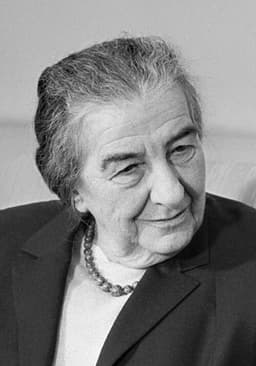
Golda Meir
Politician · Modern
55.8Total

Mokhtar Ould Daddah
Politician · Modern
55.6Total
Basic Information
Born
1898
1924
Died
1978
—
Era
Modern
Modern
Nationality
Israel
Mauritania
Occupation
Politician
Politician
Civilization
Middle Eastern
Other
Score Comparison
Military (10%)
45.0
41.8
Political (20%)
72.0
68.0
Influence (20%)
55.0
55.7
Legacy (20%)
54.0
47.5
Leadership (15%)
72.0
74.0
Strategy (15%)
25.0
43.2
TOTAL
55.8
55.6
Golda Meir — Complete Timeline
1969 AD
Appointment as Prime Minister of IsraelPolitical Action◆ Major
Golda Meir became Prime Minister of Israel after the death of Levi Eshkol. She was the first and only woman to hold the office, leading the country during a period of significant tension and conflict in the Middle East.
Prime MinisterFirst womanLeadership
Impact: national
1973 AD
Yom Kippur WarWar
Meir led Israel during the Yom Kippur War, when Egypt and Syria launched a surprise attack on the holiest day of the Jewish calendar. Israel initially suffered heavy losses but eventually repelled the attacks, though the war exposed intelligence failures.
WarSurprise attackIntelligence failure
Impact: regionaltragic
1974 AD
Resignation after the Agranat CommissionPolitical Action◆ Major
Following the Yom Kippur War, the Agranat Commission criticized the government's handling of the conflict. Meir resigned as Prime Minister in 1974, taking responsibility for the failures, though she remained a respected figure in Israeli politics.
ResignationAccountabilityWar aftermath
Impact: nationaltragic
Mokhtar Ould Daddah — Complete Timeline
1960 AD
Independence of MauritaniaPolitical Action
Mokhtar Ould Daddah led Mauritania to independence from France on November 28, 1960. He became the country's first president, establishing the political framework of the new nation.
IndependenceNation-building
Impact: nationalconstructive
1964 AD
Adoption of One-Party ConstitutionReform◆ Major
Ould Daddah amended the constitution to establish a one-party state under the Mauritanian People's Party. This move consolidated his power and eliminated political opposition.
AuthoritarianismConstitutional Change
Impact: nationaldestructive
1975 AD
Western Sahara War InvolvementWar◆ Major
Mauritania annexed the southern third of Western Sahara after Spain withdrew, leading to conflict with the Polisario Front. The war drained Mauritania's resources and caused economic hardship.
Western Sahara WarTerritorial Expansion
Impact: regionaldestructive
1978 AD
Overthrow in Military CoupPolitical Action
Ould Daddah was overthrown in a bloodless military coup led by Colonel Mustafa Ould Salek on July 10, 1978. The coup ended his 18-year rule, triggered by failures in the Western Sahara war and economic decline.
CoupEnd of Rule
Impact: nationaltragic
This comparison has not been analyzed yet.
One-time AI generation (~1 minute). Scores and timeline are already available below.
Rankings
🥇
Golda MeirLeader
Mil: 45.0Pol: 72.0Inf: 55.0
55.8
🥈
Mokhtar Ould Daddah
Mil: 41.8Pol: 68.0Inf: 55.7
55.6
+0.2 behind
How This Comparison Works
Algorithm
Each figure is scored on 6 dimensions (0—100 scale) based on structured historical data: Military (10%), Political (20%), Influence (20%), Legacy (20%), Leadership (15%), Strategy (15%). The weighted total produces the final ranking.
Data Sources
Scores are computed from structured sub-indicators in the database. Scale factors adjust for era (Ancient ×0.85, Modern ×1.0) and civilization size (Eastern ×1.05, Other ×0.80) to account for differences in population and military scale.
Maximum 3 Figures
Comparisons are limited to 2—3 figures to ensure readability and statistical meaningfulness.
Error Margins
±5 points per dimension — Sub-scores are derived from historical records with inherent uncertainty. Two figures within 5 points on a dimension should be considered roughly equivalent in that area.
Total Score Accuracy
±3 points overall — The weighted combination of 6 dimensions produces a total score with approximately ±3 points of uncertainty. Differences of less than 3 points are not statistically significant— the figures are effectively tied.
Known Limitations
- Historical records are incomplete and uneven across civilizations
- Figures from oral-tradition societies may be underrepresented
- Occupation labels can misclassify multi-role figures
- Scores measure capability and impact, not moral character
- Quantitative scoring is a comparison tool, not absolute truth
Capability Radar
Military (10%) — Battles & Warfare
Battles
0
20
Win Rate
0
27
Expansion
15
26
Political (20%) — Governance & Reform
Reform
55
55
Diplomacy
70
50
Economy
60
30
Influence (20%) — Cultural & Global Reach
Cultural
55
40
Global
60
25
Legacy (20%) — Historical Impact
Historical
65
45
Longevity
50
30
Leadership (15%) — Power & Stability
Tenure
60
60
Stability
50
25
Strategy (15%) — Tactics & Innovation
Strategy
10
28
Tactics
0
35
Reform
20
38
Similar Comparisons
Comments & Discussion
No comments yet. Be the first to share your thoughts!