Loading...
Goodluck Jonathan vs Jalal Talabani
Jalal Talabani leads by 1.4 pts · 2 figures compared
…
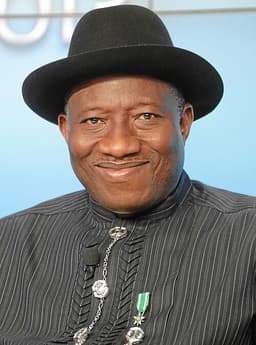
Goodluck Jonathan
Politician · Modern
54.1Total

Jalal Talabani
Politician · Modern
55.5Total
Basic Information
Born
1957
1933
Died
—
—
Era
Modern
Modern
Nationality
Nigeria
Iraq
Occupation
Politician
Politician
Civilization
Other
Middle Eastern
Score Comparison
Military (10%)
26.9
23.4
Political (20%)
68.0
68.0
Influence (20%)
56.4
61.0
Legacy (20%)
49.2
49.2
Leadership (15%)
72.0
72.0
Strategy (15%)
40.5
46.3
TOTAL
54.1
55.5
Goodluck Jonathan — Complete Timeline
2010 AD
Election as President of NigeriaPolitical Action◆ Major
Goodluck Jonathan became president following the death of President Umaru Yar'Adua. He was later elected in his own right in the 2011 presidential election, winning a majority of votes.
ElectionSuccessionPresidency
Impact: national
2012 AD
Subsidy removal protestsPolitical Action◆ Major
Jonathan's government attempted to remove fuel subsidies, leading to nationwide protests known as the 'Occupy Nigeria' movement. The protests forced the government to partially reverse the policy, highlighting public discontent.
ProtestsSubsidyEconomic Policy
Impact: nationaldestructive
2015 AD
2015 presidential election defeatPolitical Action
Jonathan lost the 2015 presidential election to Muhammadu Buhari. In a historic move, he conceded defeat before the official results were announced, preventing post-election violence and setting a precedent for peaceful democratic transitions in Nigeria.
ElectionConcessionDemocracy
Impact: nationalconstructive
Jalal Talabani — Complete Timeline
2005 AD
Elected President of IraqPolitical Action
Jalal Talabani was elected President of Iraq by the National Assembly, becoming the first Kurdish head of state in the country's history. His election was a landmark for Kurdish representation in post-Saddam Iraq.
PresidencyKurdish RightsPost-Saddam
Impact: nationalconstructive
Negotiated Iraqi ConstitutionPolitical Action◆ Major
As president, Talabani played a key role in negotiating the new Iraqi constitution, which established a federal system and recognized Kurdish autonomy. The constitution was approved by referendum in October 2005.
ConstitutionFederalismKurdistan
Impact: nationalconstructive
2009 AD
Re-elected for Second TermPolitical Action
Talabani was re-elected for a second term as president, reflecting his continued role as a unifying figure in Iraq's fragile political landscape. His tenure saw ongoing sectarian tensions and the withdrawal of US troops.
Re-electionPolitical Stability
Impact: national
Expert Analysis
Origins
Goodluck Jonathan was born on November 20, 1957, in Ogbia, Bayelsa State, Nigeria, into a canoe-making family. He earned a PhD in zoology from the University of Port Harcourt and worked as a lecturer before entering politics. Jalal Talabani was born on November 12, 1933, in Kelkan, Iraqi Kurdistan, into a prominent Kurdish family. He studied law at the University of Baghdad and became a Kurdish nationalist activist early in life, founding the Patriotic Union of Kurdistan (PUK) in 1975.
Rise to Power
Jonathan rose through Nigerian state politics, serving as deputy governor and then governor of Bayelsa. He became vice president in 2007 under Umaru Yar'Adua and assumed the presidency in 2010 after Yar'Adua's death. He won the 2011 election but lost the 2015 election to Muhammadu Buhari. Talabani spent decades leading Kurdish guerrilla movements against the Iraqi government. After the 2003 US invasion, he became a key figure in the new Iraqi government, serving as President of Iraq from 2005 to 2014. He was the first non-Arab president of an Arab country.
Leadership & Governance
Jonathan's leadership was marked by attempts at economic reform, such as the removal of fuel subsidies in 2012, which sparked the 'Occupy Nigeria' protests and forced a partial reversal. He focused on infrastructure and education but struggled with corruption and Boko Haram insurgency. Talabani, as president, was a unifying figure in Iraq's sectarian divide. He helped negotiate the 2005 constitution that established a federal system and recognized Kurdish autonomy. His political score of 68.0 matches Jonathan's, but his influence score of 61.0 is higher than Jonathan's 56.4, reflecting his role in shaping Iraq's post-war order.
Triumph & Tragedy
Jonathan's greatest triumph was his peaceful concession in 2015, a rare act in African politics that strengthened democratic norms. His score of 72.0 in leadership reflects this. His tragedy was the Boko Haram insurgency, which escalated under his watch, and the corruption scandals that plagued his administration. Talabani's triumph was becoming the first Kurdish president of Iraq and securing Kurdish rights in the constitution. His tragedy was the ongoing instability in Iraq, including the rise of ISIS and the failure to fully integrate Kurdish regions into a stable federal state. His legacy score of 49.2 is identical to Jonathan's, indicating mixed long-term impact.
Character & Destiny
Jonathan was known for his calm demeanor and willingness to compromise, which helped him concede defeat but also made him appear weak in handling crises. Talabani was a shrewd negotiator and charismatic leader, able to bridge divides between Kurds, Shia, and Sunnis. His character as a consensus-builder was crucial in Iraq's fragile democracy. Both men scored 72.0 in leadership, but their contexts differ: Jonathan led a relatively stable democracy, while Talabani navigated a post-conflict state.
Legacy
Jonathan's legacy is defined by his peaceful transfer of power, which has become a model for African leaders. However, his tenure is also remembered for economic mismanagement and insecurity. Talabani's legacy is tied to the Kurdish federalism and his role as a symbol of pluralism in Iraq. His total score of 55.5 edges Jonathan's 54.1, reflecting slightly greater influence and political impact.
Conclusion
While both leaders demonstrated democratic principles, Jalal Talabani had a greater impact due to his role in reshaping Iraq's political structure and securing Kurdish autonomy. His influence score of 61.0 surpasses Jonathan's 56.4, and his political maneuvering in a volatile region required more strategic skill, despite a lower strategy score of 46.3 vs Jonathan's 40.5. Jonathan's concession was historic, but Talabani's statecraft in a multi-ethnic, war-torn country leaves a deeper mark on history.
Rankings
🥇
Jalal TalabaniLeader
Mil: 23.4Pol: 68.0Inf: 61.0
55.5
🥈
Goodluck Jonathan
Mil: 26.9Pol: 68.0Inf: 56.4
54.1
+1.4 behind
How This Comparison Works
Algorithm
Each figure is scored on 6 dimensions (0—100 scale) based on structured historical data: Military (10%), Political (20%), Influence (20%), Legacy (20%), Leadership (15%), Strategy (15%). The weighted total produces the final ranking.
Data Sources
Scores are computed from structured sub-indicators in the database. Scale factors adjust for era (Ancient ×0.85, Modern ×1.0) and civilization size (Eastern ×1.05, Other ×0.80) to account for differences in population and military scale.
Maximum 3 Figures
Comparisons are limited to 2—3 figures to ensure readability and statistical meaningfulness.
Error Margins
±5 points per dimension — Sub-scores are derived from historical records with inherent uncertainty. Two figures within 5 points on a dimension should be considered roughly equivalent in that area.
Total Score Accuracy
±3 points overall — The weighted combination of 6 dimensions produces a total score with approximately ±3 points of uncertainty. Differences of less than 3 points are not statistically significant— the figures are effectively tied.
Known Limitations
- Historical records are incomplete and uneven across civilizations
- Figures from oral-tradition societies may be underrepresented
- Occupation labels can misclassify multi-role figures
- Scores measure capability and impact, not moral character
- Quantitative scoring is a comparison tool, not absolute truth
Capability Radar
Military (10%) — Battles & Warfare
Battles
19
25
Win Rate
24
26
Expansion
27
30
Political (20%) — Governance & Reform
Reform
40
55
Diplomacy
65
70
Economy
45
40
Influence (20%) — Cultural & Global Reach
Cultural
30
50
Global
50
45
Legacy (20%) — Historical Impact
Historical
55
55
Longevity
40
40
Leadership (15%) — Power & Stability
Tenure
60
65
Stability
50
45
Strategy (15%) — Tactics & Innovation
Strategy
31
36
Tactics
35
37
Reform
36
41
Similar Comparisons
Comments & Discussion
No comments yet. Be the first to share your thoughts!