Loading...
Grimoald I vs Julius Caesar
Julius Caesar leads by 34.0 pts · 2 figures compared
…
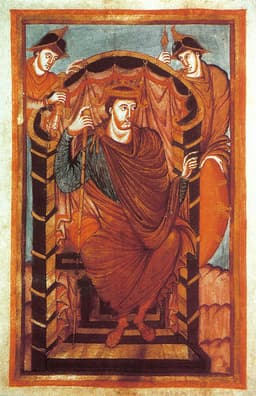
Grimoald I
Emperor · Medieval
48.8Total

Julius Caesar
General · Ancient
82.8Total
Basic Information
Born
610
-100
Died
671
-44
Era
Medieval
Ancient
Nationality
Lombards
Roman Republic
Occupation
Emperor
General
Civilization
Western
Western
Score Comparison
Military (10%)
65.0
88.0
Political (20%)
35.1
78.0
Influence (20%)
51.8
85.0
Legacy (20%)
44.2
82.0
Leadership (15%)
51.9
80.0
Strategy (15%)
52.5
85.0
TOTAL
48.8
82.8
Grimoald I — Complete Timeline
662 AD
Usurpation of the Lombard ThronePolitical Action◆ Major
Grimoald I seized the Lombard throne by assassinating King Godepert and exiling his brother Perctarit. This coup established Grimoald as king, marking a period of strong military rule and territorial expansion.
UsurpationCoupLombard Kingdom
Impact: nationaldestructive
663 AD
Battle of FornovoWar◆ Major
Grimoald defeated a Byzantine invasion force at Fornovo, securing Lombard control over Italy. The victory repelled the Byzantine attempt to reconquer the peninsula, solidifying Lombard dominance.
BattleByzantine-Lombard WarDefense
Impact: regionalconstructive
665 AD
Conquest of BeneventoWar◆ Major
Grimoald conquered the Duchy of Benevento, expanding Lombard territory into southern Italy. This campaign brought the entire Italian peninsula under Lombard influence, except for Byzantine coastal enclaves.
ConquestTerritorial ExpansionSouthern Italy
Impact: regionaldestructive
668 AD
Reform of Lombard LawReform
Grimoald issued a legal code that standardized Lombard customary law, incorporating Roman legal principles. This reform strengthened royal authority and provided a unified legal framework for the kingdom.
Legal ReformLaw CodeLombard Kingdom
Impact: nationalconstructive
Julius Caesar — Complete Timeline
58 BC
Gallic WarsWar◆ Major
Caesar, as proconsul of Gaul, launched a series of campaigns that conquered all of Gaul (modern France, Belgium, and parts of Switzerland). He fought numerous battles, including against the Helvetii, the Belgae, and the Gallic chieftain Vercingetorix. The wars brought immense wealth and a loyal army to Caesar.
Gallic WarsConquestRoman Expansion
Impact: regional
49 BC
Crossing the RubiconPolitical Action◆ Major
Caesar led Legio XIII across the Rubicon River into Italy, defying the Roman Senate's order to disband his army. This act triggered a civil war against Pompey and the Optimates, ultimately leading to Caesar's dictatorship and the end of the Roman Republic.
Roman Civil WarEnd of RepublicPower Struggle
Impact: global
48 BC
Battle of PharsalusWar◆ Major
Caesar's outnumbered army defeated the larger forces of Pompey the Great at Pharsalus in Greece. Caesar's tactical use of a reserve line to counter Pompey's cavalry charge proved decisive. Pompey fled to Egypt, where he was assassinated, leaving Caesar as the undisputed master of the Roman world.
Roman Civil WarBattleDecisive Victory
Impact: regional
44 BC
Appointment as Dictator for LifePolitical Action◆ Major
The Roman Senate appointed Caesar dictator perpetuo (dictator for life), granting him unprecedented personal power. This move concentrated military, legislative, and judicial authority in one person, effectively ending the Roman Republic's traditional system of checks and balances and alarming many senators.
DictatorshipEnd of RepublicPower Consolidation
Impact: regionaldestructive
Assassination on the Ides of MarchPolitical Action◆ Major
A group of Roman senators, led by Marcus Junius Brutus and Gaius Cassius Longinus, stabbed Caesar to death at a meeting of the Senate in the Theatre of Pompey. The assassination was intended to restore the Republic, but instead triggered another civil war that led to the rise of the Roman Empire.
AssassinationRoman PoliticsEnd of Republic
Impact: globaldestructive
Expert Analysis
grimoald-i-vs-julius-caesar
# The Ides of March and the Lombard Crown
On a morning in March of 44 BCE, Julius Caesar walked into the Senate chamber at Rome, dismissing a bodyguard who had warned him of danger. Within hours, he lay bleeding on the marble floor, stabbed twenty-three times by men he had called friends. Six centuries later, in the northern Italian city of Pavia, another ruler—Grimoald I of the Lombards—sat securely on a throne he had won through murder, having dispatched his rival with a blade in the palace itself. One assassination ended an era; the other began one. Why did these two men, both usurpers in their own way, meet such different fates—one immortalized as the founder of empire, the other remembered only by specialists?
Origins
Julius Caesar was born into the twilight of the Roman Republic, a world of crumbling aristocratic norms and rising military strongmen. His family, the Julii, claimed descent from the goddess Venus, but they were politically marginal in the cutthroat world of Roman oligarchy. Young Caesar learned early that in a system where prestige meant power, he would need to borrow, gamble, and seduce his way upward. The Republic itself was already dying—its institutions unable to govern an empire stretching from Spain to Syria.
Grimoald’s world was far different. Born around 610, he emerged from the Lombards, a Germanic people who had invaded Italy two centuries earlier, carving out a kingdom amidst the ruins of Roman civilization. The Lombards were warriors first, farmers second, and their kings ruled not by divine right but by the sword’s edge. Grimoald was a duke of Benevento before he became king, and his upbringing taught him that in a kingdom without stable succession, a man took what he could hold. Where Caesar inherited a civilization in decay, Grimoald inherited a world still being built.
Rise to Power
Caesar’s path was long and calculated. He climbed the Roman political ladder—quaestor, aedile, praetor—borrowing fortunes to fund games and bribes. His real breakthrough came in Gaul, where between 58 and 50 BCE he conquered a vast territory, built a loyal army, and amassed wealth that made him a threat to his rivals. When the Senate ordered him to disband his legions, he crossed the Rubicon River in 49 BCE, a declaration of civil war. Within four years, he had defeated his enemies, been made dictator for life, and begun reshaping Rome.
Grimoald’s rise was swifter and bloodier. In 662, he simply murdered King Godepert during a supposed peace meeting and forced Godepert’s brother Perctarit into exile. This was not a revolution but a palace coup—a knife in the dark rather than a march on a capital. Where Caesar needed years of political maneuvering and military campaigns to seize power, Grimoald needed only a moment of ruthlessness. The difference reflected their worlds: Caesar operated within a sophisticated state where legitimacy mattered; Grimoald ruled a warrior kingdom where the strongest arm made the law.
Leadership & Governance
Caesar governed as a reformer and a conqueror. He centralized administration, reformed the calendar, extended citizenship to provincials, and launched ambitious public works. His military genius was breathtaking—at Alesia in 52 BCE, he besieged a Gallic stronghold while simultaneously defeating a relief army twice his size. Yet his political wisdom faltered. He pardoned enemies who later killed him, and he showed contempt for the Senate’s traditions, accepting honors that smelled of kingship. He was a master of war but a poor reader of aristocratic resentment.
Grimoald ruled with the heavy hand of a warrior king. In 663, when a Byzantine army invaded Italy, he crushed them at Fornovo, securing Lombard independence. Two years later, he conquered the Duchy of Benevento, uniting most of Italy under Lombard rule. His greatest achievement was legal: in 668, he issued a code that blended Lombard custom with Roman law, creating a system that would influence Italian jurisprudence for centuries. Unlike Caesar, Grimoald did not try to transform his society—he simply made it more orderly. He was a consolidator, not a revolutionary.
Triumph & Tragedy
Caesar’s triumph was his conquest of Gaul, a feat that doubled Rome’s territory and made him the most famous man in the Mediterranean. His tragedy was the Ides of March—a death that came not from foreign enemies but from the very senators he had spared. He died believing he was restoring order, but his murder plunged Rome into another civil war that ultimately destroyed the Republic he had tried to save.
Grimoald’s triumph was his defense of Italy against the Byzantines, a victory that allowed Lombard power to flourish for another century. His tragedy was more subtle: he founded no lasting dynasty. After his death in 671, his son soon lost the throne to Perctarit, the brother he had exiled. His conquests were temporary, his legal code eventually superseded. Where Caesar’s death marked the birth of empire, Grimoald’s death marked the end of an ambitious line.
Character & Destiny
Caesar was charismatic, brilliant, and reckless. He gambled everything on his own genius, and for a time it paid off. But his arrogance blinded him to the hatred he inspired. He once said, “It is easier to find men who will volunteer to die than to find those who are willing to endure pain with patience.” He could not endure the patience required to let the Republic die slowly; he forced its death, and it killed him.
Grimoald was pragmatic and ruthless, but not visionary. He seized power because he could, not because he had a grand plan. His reforms were practical, his wars defensive. He understood that in a world of shifting loyalties, a king’s first duty was survival. He died in his bed, which for a Lombard king was no small achievement.
Legacy
Caesar’s legacy is incalculable. His name became synonymous with imperial power—the German “Kaiser” and Russian “Tsar” derive from it. His writings, especially his *Commentaries on the Gallic War*, are still studied as models of clarity and propaganda. He did not found the Roman Empire, but he made it inevitable.
Grimoald’s legacy is modest. He is remembered by historians of the Lombard period as a capable king who briefly united Italy under barbarian rule. His legal code survives in fragments. His name appears in no language as a title. He was a great king of a small kingdom in a dark age—competent, but not transformative.
Conclusion
Standing back, the contrast between these two figures reveals something about the nature of historical greatness. Caesar operated on a stage that spanned the Mediterranean; Grimoald’s world was Italy alone. Caesar wrote his own history; Grimoald’s story was written by monks who saw him as a barbarian. But perhaps the deepest difference is this: Caesar’s ambition was to change the world, and he succeeded, though it cost him his life. Grimoald’s ambition was to hold what he had, and he succeeded, though nothing he built outlasted him. In the end, the greatest leaders are not those who seize power most efficiently, but those who bend the arc of history—for better or worse—in a direction that cannot be reversed. Caesar bent it. Grimoald simply held it steady. And that, perhaps, is why one name echoes through the ages while the other gathers dust.
Rankings
🥇
Julius CaesarLeader
Mil: 88.0Pol: 78.0Inf: 85.0
82.8
🥈
Grimoald I
Mil: 65.0Pol: 35.1Inf: 51.8
48.8
+34.0 behind
How This Comparison Works
Algorithm
Each figure is scored on 6 dimensions (0—100 scale) based on structured historical data: Military (10%), Political (20%), Influence (20%), Legacy (20%), Leadership (15%), Strategy (15%). The weighted total produces the final ranking.
Data Sources
Scores are computed from structured sub-indicators in the database. Scale factors adjust for era (Ancient ×0.85, Modern ×1.0) and civilization size (Eastern ×1.05, Other ×0.80) to account for differences in population and military scale.
Maximum 3 Figures
Comparisons are limited to 2—3 figures to ensure readability and statistical meaningfulness.
Error Margins
±5 points per dimension — Sub-scores are derived from historical records with inherent uncertainty. Two figures within 5 points on a dimension should be considered roughly equivalent in that area.
Total Score Accuracy
±3 points overall — The weighted combination of 6 dimensions produces a total score with approximately ±3 points of uncertainty. Differences of less than 3 points are not statistically significant— the figures are effectively tied.
Known Limitations
- Historical records are incomplete and uneven across civilizations
- Figures from oral-tradition societies may be underrepresented
- Occupation labels can misclassify multi-role figures
- Scores measure capability and impact, not moral character
- Quantitative scoring is a comparison tool, not absolute truth
Capability Radar
Military (10%) — Battles & Warfare
Battles
65
95
Win Rate
70
92
Expansion
60
97
Political (20%) — Governance & Reform
Reform
30
90
Diplomacy
35
85
Economy
25
82
Influence (20%) — Cultural & Global Reach
Cultural
30
88
Global
20
94
Legacy (20%) — Historical Impact
Historical
40
95
Longevity
25
96
Leadership (15%) — Power & Stability
Tenure
45
75
Stability
20
60
Strategy (15%) — Tactics & Innovation
Strategy
55
94
Tactics
60
96
Reform
40
88
Similar Comparisons
Comments & Discussion
No comments yet. Be the first to share your thoughts!