Loading...
Guan Zhong vs Qin Shi Huang
Qin Shi Huang leads by 11.0 pts · 2 figures compared
…

Guan Zhong
Politician · Ancient
74.2Total
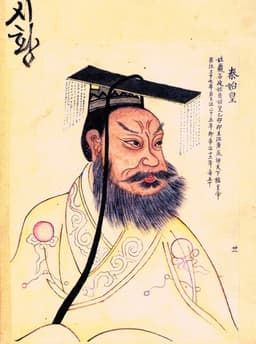
Qin Shi Huang
Emperor · Ancient
85.2Total
Basic Information
Born
-720
-259
Died
-645
-210
Era
Ancient
Ancient
Nationality
Qi
China
Occupation
Politician
Emperor
Civilization
Eastern
Eastern
Score Comparison
Military (10%)
45.0
80.0
Political (20%)
85.0
90.0
Influence (20%)
88.0
85.0
Legacy (20%)
75.0
90.0
Leadership (15%)
85.0
78.0
Strategy (15%)
35.0
82.0
TOTAL
74.2
85.2
Guan Zhong — Complete Timeline
685 BC
Guan Zhong's economic reforms in QiReform◆ Major
As prime minister of Qi, Guan Zhong implemented state monopolies on salt and iron, standardized currency, and established a system of taxation based on land quality. These reforms made Qi the wealthiest state in China and funded Duke Huan's hegemony.
QiEconomic ReformState Monopoly
Impact: nationalconstructive
667 BC
Alliance of feudal lords at JuanchengPolitical Action◆ Major
Guan Zhong organized a meeting of feudal lords at Juancheng where Duke Huan of Qi was recognized as the first official hegemon (ba) of the Spring and Autumn period. This established the hegemonic system that maintained order among the states.
QiHegemonyAlliance
Impact: nationalconstructive
664 BC
Expedition against the Northern Di tribesWar
Guan Zhong led Qi forces to repel the Di (Xianyun) nomads who were raiding the northern states of Xing and Wey. The campaign restored order and demonstrated Qi's role as protector of the Chinese states against barbarian incursions.
QiNorthern CampaignBarbarian
Impact: regionalconstructive
Qin Shi Huang — Complete Timeline
246 BC
Construction of the Mausoleum and Terracotta ArmyOther◆ Major
Qin Shi Huang commissioned a vast mausoleum complex near Xi'an, guarded by thousands of life-sized terracotta soldiers, horses, and chariots. The project employed hundreds of thousands of workers and reflected his obsession with immortality and imperial power.
Impact: global
230 BC
Conquest of the Six Warring StatesWar
From 230 to 221 BCE, Ying Zheng led the Qin state in a series of campaigns that conquered the Han, Zhao, Wei, Chu, Yan, and Qi states. This unified China under a single ruler for the first time, ending the Warring States period.
Impact: global
221 BC
Standardization of Writing, Currency, and MeasurementsReform◆ Major
Qin Shi Huang ordered the standardization of Chinese script, currency, and weights and measures across the unified empire. This facilitated administration, trade, and cultural integration, laying a foundation for future dynasties.
Impact: globalconstructive
Proclamation of the Qin DynastyPolitical Action
After conquering the last independent state, Ying Zheng declared himself Shi Huangdi (First Emperor), founding the Qin Dynasty. He adopted a new title to signify his supreme authority and initiated centralized imperial rule.
Impact: global
214 BC
Initiation of the Great Wall ConstructionOther◆ Major
Qin Shi Huang ordered the connection and extension of existing northern fortifications to create a unified defensive wall against nomadic Xiongnu raids. This project involved massive conscripted labor and became the precursor to the later Great Wall.
Impact: regional
213 BC
Burning of Books and Burying of ScholarsPolitical Action◆ Major
On the advice of Li Si, Qin Shi Huang ordered the burning of historical records and philosophical texts not aligned with Legalist doctrine. He also had 460 Confucian scholars buried alive to suppress dissent and consolidate ideological control.
Impact: nationaldestructive
Expert Analysis
guan-zhong-vs-qin-shi-huang
# The Two Architects of China: Qin Shi Huang and Guan Zhong
On a winter morning in 221 BC, Ying Zheng stood before his assembled generals in the captured palace of the last independent kingdom. He was thirty-eight years old, and in nine years of relentless warfare, he had accomplished what no ruler before him had even dared to dream: the complete unification of the Chinese world. He declared himself *Shi Huangdi*—the First Emperor—and set about remaking civilization itself. Four hundred years earlier, another man had stood before a duke in the state of Qi, armed not with armies but with ledgers and trade policies. Guan Zhong had no crown, no imperial ambition. He was merely a minister, but he would become the architect of a political order that kept China together for centuries, long before Qin Shi Huang ever forged it by fire.
Origins
Guan Zhong was born around 720 BC, into the Spring and Autumn period—a time when the Zhou royal house had lost its grip, and dozens of feudal states competed for supremacy. He was a merchant’s son, educated in the practical arts of commerce and administration. His world was one of shifting alliances, where a clever minister could shape the fate of a kingdom. He understood power not as something seized but as something built, stone by stone, through policy and persuasion.
Qin Shi Huang entered the world in 259 BC, during the Warring States period—a far more brutal era. The seven remaining great powers had been fighting for two centuries, and the stakes were total annihilation. He was born a prince of Qin, a semi-barbarian state on the western frontier, hardened by constant warfare. His father was a hostage in another kingdom; his mother was a concubine. From childhood, he learned that trust was a weakness and power the only truth.
Rise to Power
Guan Zhong’s path was indirect and nearly tragic. He first served a prince named Jiu, who lost a civil war to his brother, the future Duke Huan of Qi. Guan Zhong had actually shot an arrow at Duke Huan during the conflict—hitting his belt buckle. When captured, he expected execution. But Duke Huan, advised by his mentor Bao Shuya, saw genius in his enemy. "If you want to rule Qi," Bao Shuya said, "you need Guan Zhong." The duke pardoned him and made him prime minister in 685 BC. It was an act of extraordinary political wisdom, and it defined Guan Zhong’s entire career: power achieved through persuasion, not force.
Qin Shi Huang’s rise was the opposite. He became king of Qin at thirteen, in 246 BC. His early reign was dominated by his mother’s lover, the eunuch Lao Ai, and the chancellor Lü Buwei. At twenty-two, he discovered Lao Ai’s plot to overthrow him. He crushed it with savage efficiency: Lao Ai was torn apart by horses, his entire clan executed. Lü Buwei was forced to drink poison. From then on, Ying Zheng trusted no one. His path to power was paved with blood, and he never forgot the lesson.
Leadership & Governance
The contrast in their governing styles could not be starker. Guan Zhong believed in alignment: aligning the interests of the ruler, the merchants, the farmers, and the feudal lords. His reforms were economic masterpieces. He established state monopolies on salt and iron—essential resources—so that the government could generate revenue without crushing the people with taxes. He standardized currency and weights, making trade flow across Qi like a river. He created a system of state granaries to stabilize food prices. When the northern Di tribes raided the states of Xing and Wey in 664 BC, Guan Zhong did not simply send an army; he led one, repelling the nomads and then organizing a relief effort to rebuild the devastated cities.
Qin Shi Huang governed through standardization and terror. After conquering the six kingdoms from 230 to 221 BC, he imposed a single script, a single currency, and a single system of measurements across his empire. These reforms were brilliant—they created a unified China that could communicate and trade—but they were enforced by decree. He abolished the feudal system entirely, dividing China into commanderies administered by appointed officials. He built a network of roads and canals. He also ordered the Burning of Books in 213 BC, destroying historical records and philosophical texts that challenged his ideology, and buried alive scholars who resisted. His Great Wall, begun in 214 BC, was a massive defensive project, but it consumed countless lives.
Triumph & Tragedy
Guan Zhong’s greatest triumph came in 667 BC, when he organized the alliance of feudal lords at Juancheng. There, Duke Huan of Qi was recognized as the first official hegemon—the protector of the Zhou order. Guan Zhong had achieved what no minister before him had: a stable coalition of states that maintained peace for decades. His tragedy was that he knew his system depended on the character of the ruler. After Duke Huan’s death, Qi descended into chaos. Guan Zhong had built a house of cards, and the wind eventually blew.
Qin Shi Huang’s triumph was absolute: he created the first unified Chinese empire, a structure that would last, in some form, for over two thousand years. His tragedy was that he could not see beyond his own mortality. Obsessed with immortality, he consumed mercury pills and sent expeditions for the elixir of life. He died in 210 BC, at age forty-nine, probably from mercury poisoning. His empire crumbled within four years of his death, destroyed by the very harshness he had designed to preserve it.
Character & Destiny
Guan Zhong was a pragmatist. He once said, "When the year is bountiful, the people are generous; when the year is poor, they are stingy." He understood human nature as a set of material conditions to be managed. He was flexible, diplomatic, and patient. His destiny was to be the great minister, not the great king.
Qin Shi Huang was a visionary consumed by paranoia. He believed that history began with him—hence his title "First Emperor." He erased the past to control the future. He was brilliant, ruthless, and ultimately self-destructive. His destiny was to be the first, but also the last of his dynasty.
Legacy
Guan Zhong is remembered as the father of Chinese statecraft. His economic policies influenced generations of reformers. Confucius himself admired him, saying, "Were it not for Guan Zhong, we would be wearing our hair loose and buttoning our clothes on the left"—a reference to barbarian customs. In China today, he is a symbol of wise governance and economic management.
Qin Shi Huang’s legacy is more complex. He is both the unifier of China and the archetypal tyrant. His Great Wall became a national symbol, his Terracotta Army a global wonder. The administrative system he created—centralized, bureaucratic, standardized—became the template for every Chinese dynasty that followed. But his name is also synonymous with cruelty and the suppression of thought.
Conclusion
Standing at the crossroads of Chinese history, we see two men who answered the same question in opposite ways: How do you hold a civilization together? Guan Zhong said, through persuasion, economics, and alliance. Qin Shi Huang said, through force, standardization, and fear. Both succeeded. Both failed. Guan Zhong’s China was stable but temporary; Qin Shi Huang’s was brutal but enduring. Perhaps the deepest truth is that China needed both—the minister who taught it how to govern, and the emperor who taught it how to be one. Their ghosts still walk the land, arguing their cases, as the Middle Kingdom continues to build itself between their visions.
Rankings
🥇
Qin Shi HuangLeader
Mil: 80.0Pol: 90.0Inf: 85.0
85.2
🥈
Guan Zhong
Mil: 45.0Pol: 85.0Inf: 88.0
74.2
+11.0 behind
How This Comparison Works
Algorithm
Each figure is scored on 6 dimensions (0—100 scale) based on structured historical data: Military (10%), Political (20%), Influence (20%), Legacy (20%), Leadership (15%), Strategy (15%). The weighted total produces the final ranking.
Data Sources
Scores are computed from structured sub-indicators in the database. Scale factors adjust for era (Ancient ×0.85, Modern ×1.0) and civilization size (Eastern ×1.05, Other ×0.80) to account for differences in population and military scale.
Maximum 3 Figures
Comparisons are limited to 2—3 figures to ensure readability and statistical meaningfulness.
Error Margins
±5 points per dimension — Sub-scores are derived from historical records with inherent uncertainty. Two figures within 5 points on a dimension should be considered roughly equivalent in that area.
Total Score Accuracy
±3 points overall — The weighted combination of 6 dimensions produces a total score with approximately ±3 points of uncertainty. Differences of less than 3 points are not statistically significant— the figures are effectively tied.
Known Limitations
- Historical records are incomplete and uneven across civilizations
- Figures from oral-tradition societies may be underrepresented
- Occupation labels can misclassify multi-role figures
- Scores measure capability and impact, not moral character
- Quantitative scoring is a comparison tool, not absolute truth
Capability Radar
Military (10%) — Battles & Warfare
Battles
20
85
Win Rate
25
90
Expansion
50
90
Political (20%) — Governance & Reform
Reform
95
95
Diplomacy
90
75
Economy
95
90
Influence (20%) — Cultural & Global Reach
Cultural
85
95
Global
70
85
Legacy (20%) — Historical Impact
Historical
90
95
Longevity
85
95
Leadership (15%) — Power & Stability
Tenure
80
70
Stability
85
65
Strategy (15%) — Tactics & Innovation
Strategy
40
85
Tactics
30
80
Reform
60
95
Similar Comparisons
Comments & Discussion
QinSkeptic6/17/2026
Qin Shi Huang was a brilliant destroyer, not a real unifier. His standardization of script and axle widths only lasted because later Han bureaucrats, building on Guan Zhong’s legal codes, had the sense to maintain them. Guan Zhong’s state monopolies on salt and iron gave Qi stability for generations—Qin’s First Emperor just copied that playbook then burned it. Check the records: Guan Zhong died in 645 BC; Qi didn’t collapse until 386 BC. Qin’s empire lasted fifteen years. Talk about execution.
铁血史官6/17/2026
秦始皇统一天下靠的是武力,但治国靠的是他压根没学会的平衡术。他焚书坑儒、强征民夫修长城,结果修完十五年帝国就碎了。反观管仲,他搞“官山海”盐铁专营,轻徭薄赋,齐国富了四百年。你告诉我哪个是真统一者?一个让国祚延续,一个加速崩盘,高下立判。
DataGeekGuan6/17/2026
The numbers don’t lie: Qin Shi Huang’s population dropped from roughly 25 million to 20 million during his reign due to wars and mega-projects (historian Ban Gu’s Han Shu estimates). Meanwhile, Guan Zhong doubled Qi’s grain output via irrigation reforms without a single draft notice. The First Emperor’s metrics are empire size vs. royal lifespan—Guan Zhong’s are GDP and tax revenue. Who’s the real economic architect? The merchant’s son.
管仲遗风6/17/2026
别拿“统一”压人。周朝分封制持续八百年,靠的是管仲式的地方自治和贸易纽带。秦始皇硬拧成一块铁板,结果三世而亡。管仲提出的“尊王攘夷”就是最早的联邦制雏形,能让诸侯共存不内战。秦朝呢?高压统治、苛政猛虎。历史证明:真正的统一不是压榨百姓,而是让各方有饭吃。管仲的算法才是正道。
ClassicsScholar6/17/2026
Guan Zhong’s political philosophy in the Guanzi anticipated everything Qin Shi Huang botched. The First Emperor wanted to erase local histories—Guan Zhong compiled them for state use. Qin banned private academies; Guan founded one of the first at Jixia. Emperor standardized laws; Guan harmonized them with local customs. One believed in fear, the other in incentives. Sun Tzu said win whole wars; Guan won whole alliances. Qin’s legacy is a museum; Guan’s is a method.
改革者之声6/17/2026
秦始皇是史书里的暴君,管仲才是华夏的真开山祖。秦朝搞“书同文车同轨”看着威风,但管仲早在公元前七世纪就用统一度量衡、开放沿海经济,让齐国