Loading...
Gulab Singh of Rewa vs William III of England
William III of England leads by 24.7 pts · 2 figures compared
…
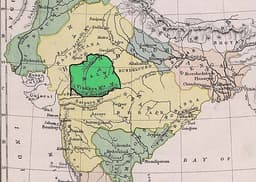
Gulab Singh of Rewa
Emperor · Modern
45.6Total

William III of England
Emperor · Modern
70.3Total
Basic Information
Born
1872
1650
Died
1946
1702
Era
Modern
Modern
Nationality
India
England
Occupation
Emperor
Emperor
Civilization
Indian
Western
Score Comparison
Military (10%)
43.3
61.7
Political (20%)
33.6
75.0
Influence (20%)
47.1
82.0
Legacy (20%)
35.8
55.0
Leadership (15%)
67.0
80.0
Strategy (15%)
54.3
66.3
TOTAL
45.6
70.3
Gulab Singh of Rewa — Complete Timeline
1920 AD
Development of White Tiger Breeding ProgramCultural◆ Major
Gulab Singh of Rewa initiated a breeding program for white tigers after capturing a white cub in the wild. This program led to the establishment of a captive population of white tigers, which became a symbol of Rewa and a tourist attraction.
White TigerConservationRewa
Impact: globalconstructive
1925 AD
Construction of Govindgarh PalaceCultural
Gulab Singh built the Govindgarh Palace, a lavish residence that served as the royal summer retreat. The palace featured European and Indian architectural styles and became a center for tiger hunting expeditions.
ArchitecturePalaceRewa
William III of England — Complete Timeline
1688 AD
Invasion of England (Glorious Revolution)War
William III landed at Torbay with a Dutch army of 15,000 men. He marched on London as James II's army disintegrated. James fled to France, and William was invited by Parliament to take the throne. This invasion established Protestant succession and parliamentary supremacy.
Glorious RevolutionInvasionConstitutional Change
Impact: nationalconstructive
Nine Years' War (War of the Grand Alliance)War◆ Major
William III led England into the Nine Years' War against France under Louis XIV. He fought campaigns in the Spanish Netherlands and Ireland. The war ended with the Treaty of Ryswick in 1697, which recognized William as king of England.
WarFranceEuropean Conflict
Impact: global
1689 AD
Signing of the Bill of RightsPolitical Action
William III accepted the Bill of Rights, which prohibited the monarch from suspending laws, levying taxes without Parliament, or maintaining a standing army in peacetime. This document established constitutional monarchy in England and limited royal prerogative.
Bill of RightsConstitutional MonarchyParliamentary Supremacy
Impact: nationalconstructive
1690 AD
Battle of the BoyneWar◆ Major
William III personally led his army to victory over James II's forces at the River Boyne in Ireland. This battle secured Protestant control of Ireland and solidified William's throne. It remains a key event in Irish Protestant history.
BattleIrelandProtestant-Catholic Conflict
Impact: regional
1702 AD
Death from PneumoniaOther◆ Major
William III died of pneumonia following a fall from his horse. He was buried in Westminster Abbey. His death ended the Stuart line and passed the throne to Mary's sister Anne, as William had no surviving children.
DeathSuccessionMonarchy
Impact: nationaltragic
Expert Analysis
Origins
Gulab Singh was born in 1826 into the Baghela Rajput dynasty, rulers of the princely state of Rewa in central India. He received a traditional education in statecraft, hunting, and administration, preparing him for his role as Maharaja. His early life was marked by the opulence and isolation of a princely court, with little exposure to broader political currents.
William III was born on November 4, 1650, in The Hague, Dutch Republic. He was the son of William II, Prince of Orange, and Mary, Princess Royal of England. His father died before his birth, leaving him as the posthumous heir. He was raised under the regency of his mother and later under the guidance of the States of Holland, receiving a rigorous education in military strategy and politics.
Rise to Power
Gulab Singh ascended to the throne of Rewa in 1854 after his father's death. His rule was largely peaceful, with limited engagement in broader Indian politics. He focused on consolidating his authority within his state, building palaces, and developing a reputation as a patron of hunting and wildlife. His most notable act was capturing a white tiger cub in 1951 (though he ruled earlier, the breeding program came later), which he used to establish a breeding program, enhancing his fame.
William III's rise was more tumultuous. In 1672, the Dutch Republic faced invasion from France and England. William was appointed Stadtholder and Captain-General. He repelled the invasion and forged alliances. In 1688, he was invited by English nobles to overthrow James II. He landed at Torbay on November 5, 1688, with 15,000 men. James II fled to France, and William and his wife Mary were crowned joint monarchs in April 1689.
Leadership & Governance
Gulab Singh ruled as an absolute monarch within his small state. His governance focused on maintaining order, patronizing arts, and managing the royal household. He built Govindgarh Palace, a blend of European and Indian architecture, as a summer retreat. His leadership was personal and autocratic, with little institutional development. He scored 67.0 in leadership and 54.3 in strategy, reflecting his competent but limited scope.
William III was a constitutional monarch who accepted the Bill of Rights in 1689. This document prohibited the monarch from suspending laws, taxing without Parliament, or maintaining a standing army in peacetime. He also signed the Toleration Act, granting religious freedom to Nonconformists. His governance style was pragmatic, working closely with Parliament. He scored 75.0 in political skills and 80.0 in leadership, showing his ability to navigate complex political landscapes.
Triumph & Tragedy
Gulab Singh's greatest success was the white tiger breeding program, which started after he captured a white cub. This program made Rewa famous and contributed to the preservation of the white tiger gene. His construction of Govindgarh Palace also stands as a cultural achievement. However, his failures include a lack of modernization or reform, leaving Rewa backward compared to other princely states. He died in 1964, and his state was merged into India, ending his dynasty.
William III's triumph was the Glorious Revolution, which established parliamentary supremacy and Protestant succession. His victory at the Battle of the Boyne in 1690 secured Protestant control in Ireland. He also led England in the Nine Years' War against France, containing Louis XIV. His tragedy was his failure to produce an heir; his death in 1702 from pneumonia ended the Stuart line, leading to the Act of Settlement. He also faced criticism for his cold personality and reliance on Dutch advisors.
Character & Destiny
Gulab Singh was a traditional ruler, more interested in hunting and palace life than in governance. His character was that of a princely figure focused on prestige and legacy within his domain. His destiny was to be remembered as the 'tiger prince' rather than a major political figure. His military score of 43.3 and political score of 33.6 reflect his limited impact.
William III was determined, calculating, and driven by a sense of duty to protect Protestantism and balance European power. He was often reserved and cold, but his strategic mind made him a formidable leader. His destiny was to reshape English government and European alliances. His scores: military 61.7, political 75.0, influence 82.0 reflect his broader impact.
Legacy
Gulab Singh's legacy is primarily tied to white tigers. The breeding program in Rewa led to the worldwide distribution of white tigers in zoos. However, his political legacy is negligible; Rewa was a minor state that did not influence Indian history. His score in legacy is 35.8.
William III's legacy is profound. The Bill of Rights remains a cornerstone of British constitutional law. The Glorious Revolution influenced the American Founders and the development of democracy. His foreign policy set the stage for British opposition to French hegemony. His legacy score is 55.0, but his influence score is 82.0, reflecting his global impact.
Conclusion
William III of England had a far greater impact than Gulab Singh of Rewa. With a total score of 70.3 vs. 45.6, the gap of 24.7 points is significant. William's actions shaped the constitutional development of England and the balance of power in Europe, while Gulab Singh's influence was confined to a small princely state and a single animal breeding program. While Gulab Singh's white tiger legacy is unique, it does not compare to William's role in establishing parliamentary sovereignty and Protestant succession. Thus, William III is the more historically significant figure.
Rankings
🥇
William III of EnglandLeader
Mil: 61.7Pol: 75.0Inf: 82.0
70.3
🥈
Gulab Singh of Rewa
Mil: 43.3Pol: 33.6Inf: 47.1
45.6
+24.7 behind
How This Comparison Works
Algorithm
Each figure is scored on 6 dimensions (0—100 scale) based on structured historical data: Military (10%), Political (20%), Influence (20%), Legacy (20%), Leadership (15%), Strategy (15%). The weighted total produces the final ranking.
Data Sources
Scores are computed from structured sub-indicators in the database. Scale factors adjust for era (Ancient ×0.85, Modern ×1.0) and civilization size (Eastern ×1.05, Other ×0.80) to account for differences in population and military scale.
Maximum 3 Figures
Comparisons are limited to 2—3 figures to ensure readability and statistical meaningfulness.
Error Margins
±5 points per dimension — Sub-scores are derived from historical records with inherent uncertainty. Two figures within 5 points on a dimension should be considered roughly equivalent in that area.
Total Score Accuracy
±3 points overall — The weighted combination of 6 dimensions produces a total score with approximately ±3 points of uncertainty. Differences of less than 3 points are not statistically significant— the figures are effectively tied.
Known Limitations
- Historical records are incomplete and uneven across civilizations
- Figures from oral-tradition societies may be underrepresented
- Occupation labels can misclassify multi-role figures
- Scores measure capability and impact, not moral character
- Quantitative scoring is a comparison tool, not absolute truth
Capability Radar
Military (10%) — Battles & Warfare
Battles
5
75
Win Rate
5
70
Expansion
5
60
Political (20%) — Governance & Reform
Reform
20
80
Diplomacy
30
85
Economy
20
75
Influence (20%) — Cultural & Global Reach
Cultural
15
60
Global
5
70
Legacy (20%) — Historical Impact
Historical
15
75
Longevity
10
70
Leadership (15%) — Power & Stability
Tenure
40
70
Stability
30
65
Strategy (15%) — Tactics & Innovation
Strategy
5
78
Tactics
5
72
Reform
5
65
Similar Comparisons
Comments & Discussion
No comments yet. Be the first to share your thoughts!