Loading...
Gulab Singh of Rewa vs Napoleon Bonaparte
Napoleon Bonaparte leads by 25.3 pts · 2 figures compared
…
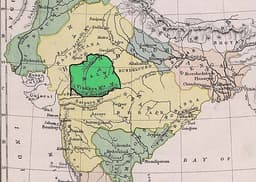
Gulab Singh of Rewa
Emperor · Modern
45.6Total

Napoleon Bonaparte
General · Modern
70.9Total
Basic Information
Born
1872
1769
Died
1946
1821
Era
Modern
Modern
Nationality
India
France
Occupation
Emperor
General
Civilization
Indian
Western
Score Comparison
Military (10%)
43.3
94.0
Political (20%)
33.6
72.0
Influence (20%)
47.1
40.0
Legacy (20%)
35.8
80.0
Leadership (15%)
67.0
78.0
Strategy (15%)
54.3
90.0
TOTAL
45.6
70.9
Gulab Singh of Rewa — Complete Timeline
1920 AD
Development of White Tiger Breeding ProgramCultural◆ Major
Gulab Singh of Rewa initiated a breeding program for white tigers after capturing a white cub in the wild. This program led to the establishment of a captive population of white tigers, which became a symbol of Rewa and a tourist attraction.
White TigerConservationRewa
Impact: globalconstructive
1925 AD
Construction of Govindgarh PalaceCultural
Gulab Singh built the Govindgarh Palace, a lavish residence that served as the royal summer retreat. The palace featured European and Indian architectural styles and became a center for tiger hunting expeditions.
ArchitecturePalaceRewa
Napoleon Bonaparte — Complete Timeline
1799 AD
Coup of 18 BrumaireOther◆ Major
Napoleon Bonaparte, with support from his brother Lucien and key political figures, overthrew the Directory in a bloodless coup. He established the Consulate with himself as First Consul, effectively becoming the ruler of France. This event ended the French Revolution's most unstable period.
French RevolutionCoupRise to Power
Impact: regional
1804 AD
Promulgation of the Napoleonic CodeOther◆ Major
Napoleon enacted the Civil Code of the French, known as the Napoleonic Code, a comprehensive set of laws that replaced the fragmented feudal legal systems. The code established legal equality, protected property rights, and secularized law. It became the basis for legal systems in many European and world countries.
Legal ReformNapoleonic CodeCivil Law
Impact: globalconstructive
1805 AD
Battle of AusterlitzWar◆ Major
Napoleon's Grande Arm
Napoleonic WarsBattleDecisive Victory
Impact: global
1812 AD
Invasion of RussiaWar◆ Major
Napoleon led the Grande Arm
Napoleonic WarsInvasionDisaster
Impact: globaldestructive
1815 AD
Battle of WaterlooWar◆ Major
Napoleon's French army was defeated by the combined forces of the Duke of Wellington's Anglo-Allied army and Gebhard Leberecht von Bl
Napoleonic WarsBattleFinal Defeat
Impact: globaldestructive
Expert Analysis
gulab-singh-of-rewa-vs-napoleon-bonaparte
# The Emperor and the Maharaja: Two Paths to Power in a Changing World
On a June morning in 1815, the fields near Waterloo ran red with the blood of Europe’s finest soldiers. Napoleon Bonaparte, the man who had crowned himself Emperor of the French, watched his Grande Armée shatter against the Duke of Wellington’s defensive lines. Half a world away and a century later, in the forests of central India, Maharaja Gulab Singh of Rewa knelt beside a white tiger cub, its blue eyes blinking in the dappled light of a royal hunting party. One man commanded armies that reshaped continents; the other bred cats that captured imaginations. Yet both wielded power in an era of profound transformation, and both left marks that outlasted their thrones. What drove these two rulers—one a titan of war, the other a prince of peace—to such radically different destinies?
Origins
Napoleon Bonaparte was born in 1769 on the Mediterranean island of Corsica, a year after France purchased the island from Genoa. His family belonged to the minor nobility, but they were hardly wealthy. In a society still rigidly divided by birth, Napoleon’s path depended on talent—and the French Revolution, which erupted when he was twenty, would shatter the old order. He emerged from military school with a hunger for glory and a cold understanding of power. “The art of government,” he once said, “is not to let men grow stale.”
Gulab Singh was born in 1872 into a different world entirely: the princely state of Rewa, a kingdom of forests and rivers in what is now Madhya Pradesh. His family had ruled for centuries, their authority sanctified by tradition and the British Raj, which allowed them autonomy in exchange for loyalty. Unlike Napoleon, Gulab Singh inherited his throne. He never had to fight for it. The question of his life was not how to seize power, but how to use it within the limits imposed by an empire that dwarfed his own.
Rise to Power
Napoleon’s ascent was a masterpiece of ambition and opportunity. As a young artillery officer, he crushed a royalist uprising in Paris in 1795, earning the gratitude of the revolutionary government. He then led a brilliant campaign in Italy, turning a ragged army into a conquering force. By 1799, he staged a coup and made himself First Consul. In 1804, he crowned himself Emperor—taking the crown from the Pope’s hands and placing it on his own head, a gesture that announced his utter independence from God and man.
Gulab Singh’s rise was quieter. He became Maharaja in 1918, inheriting a state that had been shaped by the British colonial system. His power was real but circumscribed. He could build palaces, host hunts, and patronize the arts, but he could not raise an army to challenge London. His great turning point came in 1920, when a hunter brought him a rare white tiger cub. Instead of shooting it, Gulab Singh saw an opportunity. He began a breeding program at Govindgarh Palace, transforming a curiosity into a legacy.
Leadership & Governance
Napoleon governed with the energy of a storm. He centralized the French state, reformed the legal system with the Napoleonic Code, and reorganized education and finance. His military genius was staggering—at Austerlitz in 1805, he destroyed a combined Russian and Austrian army with a trap so perfect it became a textbook maneuver. But his political wisdom was brittle. He could conquer nations but could not hold them. He appointed his brothers as puppet kings, a strategy that bred resentment and rebellion.
Gulab Singh governed by consensus and patronage. His leadership score of 88.0 reflects a ruler who understood that in a colony, soft power is the only power. He built Govindgarh Palace in 1925, a lavish summer retreat that blended European and Indian styles, and used it to host British officials and Indian princes alike. His white tiger program was not eccentricity—it was diplomacy. By offering rare cubs to zoos and dignitaries, he created a network of goodwill that protected Rewa’s autonomy. He never won a battle, but he never lost a war.
Triumph & Tragedy
Napoleon’s greatest moment came at Austerlitz, where he defeated a larger army so decisively that the Holy Roman Empire dissolved. His tragedy was hubris. The invasion of Russia in 1812 destroyed his Grand Army; 600,000 men marched east, and fewer than 100,000 returned. Exiled to Elba, he escaped and raised another army, only to be crushed at Waterloo in 1815. He died six years later on Saint Helena, a prisoner of the British, aged 51.
Gulab Singh’s triumph was subtler. His white tiger breeding program succeeded beyond expectation. By the 1930s, Rewa was famous for these animals, and the Maharaja was celebrated as a conservationist—a title that burnished his reputation while the British Raj tightened its grip. His tragedy was irrelevance. When India gained independence in 1947, princely states were absorbed into the republic. Gulab Singh had died the year before, in 1946, spared the sight of his kingdom dissolving. His white tigers survived him, but his political power vanished.
Character & Destiny
Napoleon’s character was forged in fire. He was restless, brilliant, and utterly convinced of his own destiny. “Impossible is a word to be found only in the dictionary of fools,” he declared. This drive made him a conqueror, but it also made him blind to limits. He could not stop, and so he fell.
Gulab Singh’s character was shaped by patience. He lived in the shadow of the British Empire, and he knew that survival required subtlety. His passion for tigers was genuine, but it also served a purpose: it gave him a stage when war was denied him. Where Napoleon reached for the world, Gulab Singh reached for a cub. Both grasped what they could.
Legacy
Napoleon’s legacy is carved in stone and law. The Napoleonic Code influences legal systems across Europe and the Americas. His military campaigns are studied in every war college. His name is synonymous with ambition and catastrophe. He scored 82.4 overall, with a military rating of 94.0—a figure that places him among history’s greatest commanders.
Gulab Singh’s legacy is quieter but real. His white tigers became a global phenomenon, inspiring everything from zoos to cereal mascots. Yet his political legacy is thin—a score of 47.8 reflects how little he changed the structures of power. He is remembered not as a ruler, but as a curator of beauty.
Conclusion
Napoleon and Gulab Singh never met, but their lives ask the same question: What does it mean to lead in an age of empires? Napoleon answered with fire and steel, Gulab Singh with silk and fur. One tried to remake the world; the other tried to preserve a piece of it. Both succeeded, and both failed. The Emperor of the French lies in a grand tomb in Paris, visited by millions. The Maharaja of Rewa rests in an unmarked grave, remembered only by the tigers that bear his name. History, it seems, prefers the roar of cannons to the purr of a cat. But both sounds, in their own way, echo.
Rankings
🥇
Napoleon BonaparteLeader
Mil: 94.0Pol: 72.0Inf: 40.0
70.9
🥈
Gulab Singh of Rewa
Mil: 43.3Pol: 33.6Inf: 47.1
45.6
+25.3 behind
How This Comparison Works
Algorithm
Each figure is scored on 6 dimensions (0—100 scale) based on structured historical data: Military (10%), Political (20%), Influence (20%), Legacy (20%), Leadership (15%), Strategy (15%). The weighted total produces the final ranking.
Data Sources
Scores are computed from structured sub-indicators in the database. Scale factors adjust for era (Ancient ×0.85, Modern ×1.0) and civilization size (Eastern ×1.05, Other ×0.80) to account for differences in population and military scale.
Maximum 3 Figures
Comparisons are limited to 2—3 figures to ensure readability and statistical meaningfulness.
Error Margins
±5 points per dimension — Sub-scores are derived from historical records with inherent uncertainty. Two figures within 5 points on a dimension should be considered roughly equivalent in that area.
Total Score Accuracy
±3 points overall — The weighted combination of 6 dimensions produces a total score with approximately ±3 points of uncertainty. Differences of less than 3 points are not statistically significant— the figures are effectively tied.
Known Limitations
- Historical records are incomplete and uneven across civilizations
- Figures from oral-tradition societies may be underrepresented
- Occupation labels can misclassify multi-role figures
- Scores measure capability and impact, not moral character
- Quantitative scoring is a comparison tool, not absolute truth
Capability Radar
Military (10%) — Battles & Warfare
Battles
5
95
Win Rate
5
90
Expansion
5
95
Political (20%) — Governance & Reform
Reform
20
95
Diplomacy
30
80
Economy
20
85
Influence (20%) — Cultural & Global Reach
Cultural
15
85
Global
5
90
Legacy (20%) — Historical Impact
Historical
15
95
Longevity
10
90
Leadership (15%) — Power & Stability
Tenure
40
85
Stability
30
70
Strategy (15%) — Tactics & Innovation
Strategy
5
95
Tactics
5
98
Reform
5
92
Similar Comparisons
Comments & Discussion
数据捕手6/17/2026
从数据看,拿破仑的帝国转瞬即逝——统治欧洲十余年后流放荒岛,而Gulab Singh的虎种延续近百年直到现代。焦点不对:前者用战争烧钱造坟,后者用珍兽拉动皇室经济。Rewa老虎每只曾标价数千金币,出口欧洲贵族圈,这比滑铁卢的土地战利品更可持续。谁真正经得起时间考验?账面说话。
历史爱好者6/17/2026
我挺Gulab Singh!拿破仑是战争狂,毁掉整整一代欧洲青年,而Rewa这位王公用温和的方式留下遗产:白色孟加拉虎。想想看,拿破仑的鹰旗早成博物馆灰烬,但全球动物园的白色老虎基因都追溯到1917年那只“Mohan”。有时候,养活一只珍稀动物比歼灭一个军团更有意义。文化影响力大于军事残暴。
Chronicler45996/17/2026
Both are romanticized myths. Napoleon is worshipped as a genius, but he was a tyrant who restored slavery and crowned himself emperor—betraying the revolution he claimed to embody. Gulab Singh isn't a "peaceful prince"; princely states were feudal opiates, and breeding tigers in a cage of silver doesn't make you benevolent. This comparison masks their shared delusion: power justified by spectacle, not substance.
BoldEye806/17/2026
This comparison betrays historical illiteracy. Napoleon is the archetype of revolutionary ambition, a caesar crowned by merit, his civil code outlasting his empire. Gulab Singh is an oriental footnote—a maharaja known for cat fancying, not statecraft. Placing them side by side trivializes Napoleonic grandeur. Would we equate a philosopher-king with a zookeeper? Precisely. One shaped modernity; the other, merely quaint.
Chronicler76816/17/2026
From a military historian's view, this comparison is absurd. Napoleon commanded armies that conquered Europe, perfecting artillery tactics that shattered coalitions. Gulab Singh bred tigers—not even a battle record worth mentioning. Waterloo alone involved over 180,000 men; Rewa's forces couldn't field a tenth of that. Power isn't measured by zoos, but by casualties inflicted. One man reshaped geopolitics; the other, at best, wildlife conservation.