Loading...
This comparison has not been analyzed yet.
One-time AI generation (~1 minute). Scores and timeline are already available below.
Gustavo Diaz Ordaz vs Vijaya Lakshmi Pandit
Vijaya Lakshmi Pandit leads by 9.6 pts · 2 figures compared
…
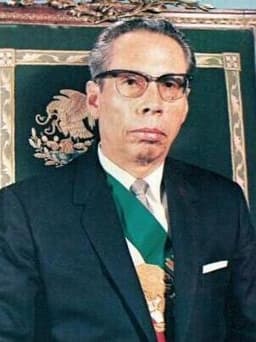
Gustavo Diaz Ordaz
Politician · Modern
48.8Total

Vijaya Lakshmi Pandit
Politician · Modern
58.4Total
Basic Information
Born
1911
1900
Died
1979
1990
Era
Modern
Modern
Nationality
Mexico
India
Occupation
Politician
Politician
Civilization
Western
Indian
Score Comparison
Military (10%)
49.2
32.8
Political (20%)
39.4
68.0
Influence (20%)
51.8
58.3
Legacy (20%)
43.3
54.0
Leadership (15%)
67.0
72.0
Strategy (15%)
41.8
60.0
TOTAL
48.8
58.4
Gustavo Diaz Ordaz — Complete Timeline
1968 AD
Tlatelolco MassacrePolitical Action
On October 2, 1968, Mexican security forces opened fire on student protesters in the Plaza de las Tres Culturas in Tlatelolco, Mexico City. Hundreds were killed. President Gustavo D
MassacreRepressionStudent Movement
Impact: nationaltragic
1970 AD
Enactment of the 1970 Federal Labor LawReform◆ Major
Díaz Ordaz signed a new Federal Labor Law that expanded workers' rights, including profit-sharing, overtime pay, and job security. This was a progressive reform that strengthened the labor code, though critics noted it also increased state control over unions.
Labor LawWorkers' RightsReform
Impact: nationalconstructive
1971 AD
Corpus Christi Massacre (El Halconazo)Political Action◆ Major
On June 10, 1971, a paramilitary group known as Los Halcones attacked student demonstrators in Mexico City, killing dozens. While D
MassacreParamilitaryRepression
Impact: nationaltragic
Vijaya Lakshmi Pandit — Complete Timeline
1942 AD
Imprisoned for Quit India MovementPolitical Action
Pandit was arrested and imprisoned by British authorities for her participation in the Quit India Movement. She spent several months in jail, continuing her activism for Indian independence.
Quit IndiaImprisonment
Impact: nationalconstructive
1946 AD
Led Indian delegation to UNPolitical Action◆ Major
Pandit led the Indian delegation to the United Nations, where she advocated for the rights of colonized peoples and against apartheid. Her speeches brought international attention to India's positions.
UNDiplomacyDecolonization
Impact: globalconstructive
1953 AD
Elected President of the United Nations General AssemblyPolitical Action
Vijaya Lakshmi Pandit was elected President of the UN General Assembly, becoming the first woman to hold this position. She presided over the eighth session, addressing global issues including decolonization and peace.
UNWomen's LeadershipDiplomacy
Impact: globalprogressive
1954 AD
Appointed High Commissioner to the United KingdomPolitical Action◆ Major
Pandit was appointed as India's High Commissioner to the United Kingdom, one of the highest diplomatic posts. She served until 1961, strengthening India-UK relations.
DiplomacyIndia-UK Relations
Impact: nationalconstructive
This comparison has not been analyzed yet.
One-time AI generation (~1 minute). Scores and timeline are already available below.
Rankings
🥇
Vijaya Lakshmi PanditLeader
Mil: 32.8Pol: 68.0Inf: 58.3
58.4
🥈
Gustavo Diaz Ordaz
Mil: 49.2Pol: 39.4Inf: 51.8
48.8
+9.6 behind
How This Comparison Works
Algorithm
Each figure is scored on 6 dimensions (0—100 scale) based on structured historical data: Military (10%), Political (20%), Influence (20%), Legacy (20%), Leadership (15%), Strategy (15%). The weighted total produces the final ranking.
Data Sources
Scores are computed from structured sub-indicators in the database. Scale factors adjust for era (Ancient ×0.85, Modern ×1.0) and civilization size (Eastern ×1.05, Other ×0.80) to account for differences in population and military scale.
Maximum 3 Figures
Comparisons are limited to 2—3 figures to ensure readability and statistical meaningfulness.
Error Margins
±5 points per dimension — Sub-scores are derived from historical records with inherent uncertainty. Two figures within 5 points on a dimension should be considered roughly equivalent in that area.
Total Score Accuracy
±3 points overall — The weighted combination of 6 dimensions produces a total score with approximately ±3 points of uncertainty. Differences of less than 3 points are not statistically significant— the figures are effectively tied.
Known Limitations
- Historical records are incomplete and uneven across civilizations
- Figures from oral-tradition societies may be underrepresented
- Occupation labels can misclassify multi-role figures
- Scores measure capability and impact, not moral character
- Quantitative scoring is a comparison tool, not absolute truth
Capability Radar
Military (10%) — Battles & Warfare
Battles
31
45
Win Rate
30
49
Expansion
35
49
Political (20%) — Governance & Reform
Reform
20
55
Diplomacy
30
80
Economy
40
30
Influence (20%) — Cultural & Global Reach
Cultural
20
55
Global
30
65
Legacy (20%) — Historical Impact
Historical
40
65
Longevity
30
50
Leadership (15%) — Power & Stability
Tenure
60
60
Stability
10
50
Strategy (15%) — Tactics & Innovation
Strategy
39
54
Tactics
39
53
Reform
43
59
Similar Comparisons
Comments & Discussion
No comments yet. Be the first to share your thoughts!