Loading...
Gustavo Diaz Ordaz vs Napoleon Bonaparte
Napoleon Bonaparte leads by 22.1 pts · 2 figures compared
…
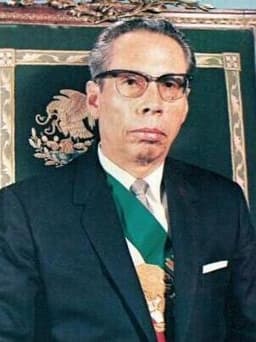
Gustavo Diaz Ordaz
Politician · Modern
48.8Total

Napoleon Bonaparte
General · Modern
70.9Total
Basic Information
Born
1911
1769
Died
1979
1821
Era
Modern
Modern
Nationality
Mexico
France
Occupation
Politician
General
Civilization
Western
Western
Score Comparison
Military (10%)
49.2
94.0
Political (20%)
39.4
72.0
Influence (20%)
51.8
40.0
Legacy (20%)
43.3
80.0
Leadership (15%)
67.0
78.0
Strategy (15%)
41.8
90.0
TOTAL
48.8
70.9
Gustavo Diaz Ordaz — Complete Timeline
1968 AD
Tlatelolco MassacrePolitical Action
On October 2, 1968, Mexican security forces opened fire on student protesters in the Plaza de las Tres Culturas in Tlatelolco, Mexico City. Hundreds were killed. President Gustavo D
MassacreRepressionStudent Movement
Impact: nationaltragic
1970 AD
Enactment of the 1970 Federal Labor LawReform◆ Major
Díaz Ordaz signed a new Federal Labor Law that expanded workers' rights, including profit-sharing, overtime pay, and job security. This was a progressive reform that strengthened the labor code, though critics noted it also increased state control over unions.
Labor LawWorkers' RightsReform
Impact: nationalconstructive
1971 AD
Corpus Christi Massacre (El Halconazo)Political Action◆ Major
On June 10, 1971, a paramilitary group known as Los Halcones attacked student demonstrators in Mexico City, killing dozens. While D
MassacreParamilitaryRepression
Impact: nationaltragic
Napoleon Bonaparte — Complete Timeline
1799 AD
Coup of 18 BrumaireOther◆ Major
Napoleon Bonaparte, with support from his brother Lucien and key political figures, overthrew the Directory in a bloodless coup. He established the Consulate with himself as First Consul, effectively becoming the ruler of France. This event ended the French Revolution's most unstable period.
French RevolutionCoupRise to Power
Impact: regional
1804 AD
Promulgation of the Napoleonic CodeOther◆ Major
Napoleon enacted the Civil Code of the French, known as the Napoleonic Code, a comprehensive set of laws that replaced the fragmented feudal legal systems. The code established legal equality, protected property rights, and secularized law. It became the basis for legal systems in many European and world countries.
Legal ReformNapoleonic CodeCivil Law
Impact: globalconstructive
1805 AD
Battle of AusterlitzWar◆ Major
Napoleon's Grande Arm
Napoleonic WarsBattleDecisive Victory
Impact: global
1812 AD
Invasion of RussiaWar◆ Major
Napoleon led the Grande Arm
Napoleonic WarsInvasionDisaster
Impact: globaldestructive
1815 AD
Battle of WaterlooWar◆ Major
Napoleon's French army was defeated by the combined forces of the Duke of Wellington's Anglo-Allied army and Gebhard Leberecht von Bl
Napoleonic WarsBattleFinal Defeat
Impact: globaldestructive
Expert Analysis
gustavo-diaz-ordaz-vs-napoleon-bonaparte
# The Emperor and the President: Two Faces of Power in an Age of Upheaval
On a June morning in 1815, Napoleon Bonaparte stood on a muddy field near Waterloo, watching his Imperial Guard march into cannon fire. On an October evening in 1968, Gustavo Díaz Ordaz sat in the National Palace in Mexico City, receiving reports of gunfire in the Plaza de las Tres Culturas. Both men commanded the machinery of state; both faced crises that would define their legacies. One would be remembered as a titan of history, the other as a symbol of state violence. But what separates a conqueror from a repressor? The answer lies not in their ambitions, but in the worlds they inherited and the choices they made within them.
**Origins**
Napoleon was born in 1769 on the island of Corsica, a year after it passed from Genoa to French control. His family was minor nobility, impoverished and resentful of French rule. He spoke Italian before French, and his accent would mark him as an outsider in Paris. The French Revolution erupted when he was twenty, shattering the old order and creating a ladder for talent. Napoleon climbed that ladder with ferocious energy, a product of revolutionary chaos who would eventually become its master.
Gustavo Díaz Ordaz was born in 1911 in San Andrés Chalchicomula, a small town in Puebla, Mexico. His father was a lawyer and government official in the twilight of the Porfiriato, the long dictatorship of Porfirio Díaz. The Mexican Revolution erupted that same year, and young Gustavo grew up in a country convulsed by civil war, land reform, and institutional collapse. Where Napoleon’s revolution created opportunity, Mexico’s revolution created a one-party state—the Institutional Revolutionary Party (PRI)—that would channel all ambition through its ranks. Díaz Ordaz joined that channel and rose through it, a bureaucrat rather than a warrior.
The difference in their eras is profound. Napoleon lived in an age when military glory could rewrite the map of Europe. Díaz Ordaz lived in an age when power meant controlling institutions, not armies. One man could still conquer; the other could only administer.
**Rise to Power**
Napoleon’s ascent was meteoric. At twenty-four, he drove the British out of Toulon and was promoted to brigadier general. At twenty-six, he crushed a royalist uprising in Paris with a “whiff of grapeshot.” At twenty-seven, he led a disastrous but brilliant campaign in Egypt, and by thirty he was First Consul of France. His path was forged in gunpowder and audacity. Every victory opened a new door; every defeat was redeemed by the next battle.
Díaz Ordaz rose through the PRI’s labyrinthine bureaucracy. He served as a federal deputy, then senator, then Secretary of Government under President Adolfo López Mateos. His reputation was built on loyalty, efficiency, and a willingness to enforce order. When López Mateos chose him as the party’s presidential candidate in 1963, the decision was made in smoke-filled rooms, not on battlefields. Díaz Ordaz won the 1964 election with 88% of the vote—a figure that reflected the PRI’s iron grip on the electoral system.
Their paths reveal the difference between revolutionary and institutional power. Napoleon seized his moment; Díaz Ordaz waited for his turn.
**Leadership & Governance**
As First Consul and later Emperor, Napoleon transformed France. He centralized the government, established the Bank of France, and reformed education. His greatest achievement was the Napoleonic Code of 1804, which abolished feudal privileges, established legal equality, and protected property rights. It remains the foundation of civil law across Europe and Latin America. On the battlefield, his strategic genius was unmatched: he won sixty battles and lost only seven, with a military score of 94.0 and a strategy score of 93.0. He moved armies with speed and deception, striking at enemy flanks and exploiting breakthroughs.
Díaz Ordaz governed a different kind of empire—a one-party state that had brought stability to Mexico after decades of revolution. He continued land reform, expanded infrastructure, and in 1970 signed a new Federal Labor Law that expanded workers’ rights, including profit-sharing and overtime pay. His leadership score of 84.3 reflects his effectiveness within the system. But his political score of 72.0 and strategy score of 35.3 reveal the limits of his vision. He saw opposition not as a challenge to be outmaneuvered, but as a threat to be crushed.
**Triumph & Tragedy**
Napoleon’s greatest moment was Austerlitz in 1805, where he destroyed the combined armies of Russia and Austria. His empire stretched from Spain to Poland, and his coronation as Emperor in 1804 seemed to fulfill the revolution’s promise of glory. But his tragedy was hubris. The 1812 invasion of Russia cost him half a million men. Exiled to Elba, he returned for a Hundred Days, only to meet final defeat at Waterloo in 1815. He died in exile on Saint Helena in 1821, at age fifty-one.
Díaz Ordaz’s triumph was the 1968 Mexico City Olympics—a showcase of Mexican modernity to the world. But his tragedy came ten days before the opening ceremony. On October 2, 1968, security forces opened fire on student protesters in the Plaza de las Tres Culturas in Tlatelolco. Hundreds were killed, though the exact number remains unknown. The Tlatelolco massacre shattered Mexico’s image of stability and exposed the PRI’s willingness to kill its own citizens. Three years later, in 1971, a paramilitary group known as Los Halcones attacked student demonstrators again in the Corpus Christi Massacre, killing dozens. Díaz Ordaz’s presidency ended in 1970, but the bloodstains never washed away.
**Character & Destiny**
Napoleon was restless, brilliant, and insatiable. “I live only for posterity,” he once said, and he believed that power was the only reality. His personality drove him to conquer, but also to overreach. He could not stop because he did not know how. His character was his destiny: a man who rose through talent and fell through ambition.
Díaz Ordaz was rigid, secretive, and suspicious. He saw dissent as conspiracy and order as the highest good. His leadership score of 84.3 suggests competence, but his military score of 37.5 and strategy score of 35.3 reveal a man who relied on force rather than cunning. He did not create the system of repression; he inherited it and used it without hesitation. His character was also his destiny: a man who maintained stability by crushing those who questioned it.
**Legacy**
Napoleon’s legacy is colossal. The Napoleonic Code reshaped law. His military tactics are still studied. He inspired nationalism across Europe and Latin America. His total score of 82.4 reflects a figure who changed the world, for good and ill. He is remembered as both liberator and tyrant, genius and warmonger.
Díaz Ordaz’s legacy is a warning. His total score of 62.3 places him far below Napoleon, but the comparison is not about numbers. It is about the nature of power. Díaz Ordaz is remembered primarily for the Tlatelolco massacre, a stain that no reform could erase. The 1970 Federal Labor Law is a footnote; the blood is the headline. In Mexico, his name is synonymous with authoritarianism and state violence.
**Conclusion**
Napoleon and Díaz Ordaz governed through fear, but they used it differently. Napoleon’s fear was the terror of invasion, the thrill of defeat, the awe of his genius. Díaz Ordaz’s fear was the cold dread of a state that would kill its own children. One man conquered nations; the other suppressed his own people. The difference is not in their scores, but in their choices. Napoleon chose glory; Díaz Ordaz chose order. History remembers both, but it judges them differently. The emperor’s shadow stretches across continents; the president’s shadow falls on a single square in Mexico City, where on a quiet October evening, the state became the enemy.
Rankings
🥇
Napoleon BonaparteLeader
Mil: 94.0Pol: 72.0Inf: 40.0
70.9
🥈
Gustavo Diaz Ordaz
Mil: 49.2Pol: 39.4Inf: 51.8
48.8
+22.1 behind
How This Comparison Works
Algorithm
Each figure is scored on 6 dimensions (0—100 scale) based on structured historical data: Military (10%), Political (20%), Influence (20%), Legacy (20%), Leadership (15%), Strategy (15%). The weighted total produces the final ranking.
Data Sources
Scores are computed from structured sub-indicators in the database. Scale factors adjust for era (Ancient ×0.85, Modern ×1.0) and civilization size (Eastern ×1.05, Other ×0.80) to account for differences in population and military scale.
Maximum 3 Figures
Comparisons are limited to 2—3 figures to ensure readability and statistical meaningfulness.
Error Margins
±5 points per dimension — Sub-scores are derived from historical records with inherent uncertainty. Two figures within 5 points on a dimension should be considered roughly equivalent in that area.
Total Score Accuracy
±3 points overall — The weighted combination of 6 dimensions produces a total score with approximately ±3 points of uncertainty. Differences of less than 3 points are not statistically significant— the figures are effectively tied.
Known Limitations
- Historical records are incomplete and uneven across civilizations
- Figures from oral-tradition societies may be underrepresented
- Occupation labels can misclassify multi-role figures
- Scores measure capability and impact, not moral character
- Quantitative scoring is a comparison tool, not absolute truth
Capability Radar
Military (10%) — Battles & Warfare
Battles
31
95
Win Rate
30
90
Expansion
35
95
Political (20%) — Governance & Reform
Reform
20
95
Diplomacy
30
80
Economy
40
85
Influence (20%) — Cultural & Global Reach
Cultural
20
85
Global
30
90
Legacy (20%) — Historical Impact
Historical
40
95
Longevity
30
90
Leadership (15%) — Power & Stability
Tenure
60
85
Stability
10
70
Strategy (15%) — Tactics & Innovation
Strategy
39
95
Tactics
39
98
Reform
43
92
Similar Comparisons
Comments & Discussion
General's Shadow6/17/2026
Comparing Napoleon to Díaz Ordaz is like comparing a forest fire to a cigarette burn. Bonaparte transformed Europe's legal systems with the Napoleonic Code and inspired nationalist movements across the continent. Díaz Ordaz ordered military snipers to fire on student protesters in Tlatelolco, leaving hundreds dead. One built lasting institutions; the other destroyed innocent lives. Let's not pretend they're in the same category of historical weight. Napoleon's legacy includes the metric system a
数据考古者6/17/2026
从纯数据角度看,拿破仑打了约60场战役,只有7场战败,胜率接近90%;而迪亚斯·奥尔达斯在1968年奥运会前夕下令镇压学生,造成官方宣称的26人死亡,实际估计超过300人。拿破仑每场战役平均调动20万士兵,管理着一个横跨欧洲的帝国;奥尔达斯只须控制一个中等国家,却连基本民意都搞不定。简单说,一个征服了大陆,一个只征服了自己的良心,而且显然失败了。
Classics Scholar6/17/2026
The comparison of Díaz Ordaz to Napoleon reveals a fundamental category error. Napoleon studied Caesar's Gallic Wars obsessively and modeled his military campaigns after classical tactics. He understood that power required both martial prowess and institutional framework. Díaz Ordaz, by contrast, lacked any such intellectual foundation. His entire political philosophy amounted to maintaining PRI's control through authoritarian means. You cannot compare a man who read Machiavelli in French to one
历史老兵6/17/2026
说句实话,拿一个把宪法当厕纸的民粹总统跟拿破仑比,本身就是对历史的侮辱。拿破仑至少懂得政策需要持续性和稳定性,所以他搞了民法典、改革了教育系统。而迪亚斯·奥尔达斯呢?他的"成就"就是把一个奥运盛典变成了屠杀现场,之后还厚着脸皮说"一切都正常"。我父亲参加过二战,他说真正的领袖是在危机中建设,而不是在建设中制造危机。拿破仑建了凯旋门,奥尔达斯只建了血墙。
Revisionist's Quill6/17/2026
I'd argue this comparison isn't as absurd as it seems. Díaz Ordaz also faced a revolutionary moment—the global 1968 protests—and his response mirrors Napoleon's Thermidorian reaction. Both men consolidated power after popular uprisings. Napoleon's 18 Brumaire coup replaced the Directory with his consulship; Díaz Ordaz's Tlatelolco massacre crushed the student movement. The difference is aesthetics and scale, not essence. Napoleon was simply better at PR—he had St. Helena to write his memoirs, Dí