Loading...
Haakon VII of Norway vs William II of Wurttemberg
Haakon VII of Norway leads by 14.4 pts · 2 figures compared
…
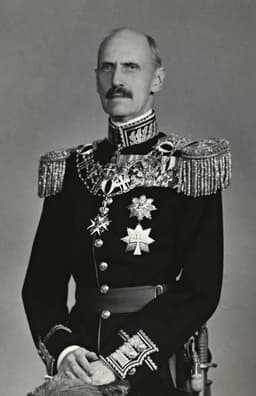
Haakon VII of Norway
Emperor · Modern
56.4Total

William II of Wurttemberg
Emperor · Modern
42.0Total
Basic Information
Born
1872
1848
Died
1957
1921
Era
Modern
Modern
Nationality
Norway
Wurttemberg
Occupation
Emperor
Emperor
Civilization
Western
Western
Score Comparison
Military (10%)
17.8
14.0
Political (20%)
70.0
39.4
Influence (20%)
58.3
47.9
Legacy (20%)
52.0
35.8
Leadership (15%)
72.0
51.9
Strategy (15%)
57.5
60.0
TOTAL
56.4
42.0
Haakon VII of Norway — Complete Timeline
1905 AD
Election as King of NorwayPolitical Action
Following the dissolution of the union with Sweden, the Norwegian parliament elected Prince Carl of Denmark as King Haakon VII. He accepted the throne after a referendum confirmed the monarchy. This established the modern, independent Kingdom of Norway with a constitutional monarch.
NorwayIndependenceMonarchyReferendum
Impact: nationalconstructive
1940 AD
Refusal to appoint Quisling as Prime MinisterPolitical Action
After the German invasion of Norway, Nazi Germany demanded that Haakon VII appoint Vidkun Quisling as prime minister. Haakon VII refused, stating he would abdicate rather than accept a government led by Quisling. This act of defiance made him a symbol of Norwegian resistance.
NorwayWorld War IIResistanceQuisling
Impact: nationalconstructive
Leadership of the Norwegian government-in-exilePolitical Action◆ Major
Haakon VII fled Norway after the German invasion and established a government-in-exile in London. He became a central figure in the Allied war effort, broadcasting radio messages to occupied Norway and maintaining the legitimacy of the Norwegian state throughout World War II.
NorwayWorld War IIExileGovernment
Impact: globalconstructive
1945 AD
Return to Norway after World War IIPolitical Action◆ Major
Haakon VII returned to Norway on June 7, 1945, exactly five years after he had fled. His return was a moment of national celebration and unity. He was greeted by massive crowds, symbolizing the restoration of Norwegian sovereignty and the end of the Nazi occupation.
NorwayWorld War IILiberationMonarchy
Impact: nationalconstructive
William II of Wurttemberg — Complete Timeline
1918 AD
Abdication as King of WürttembergPolitical Action
Following the German Revolution and the collapse of the German Empire, William II abdicated the throne of W
German RevolutionEnd of MonarchyAbdication
Impact: regionaltragic
Expert Analysis
Origins
Haakon VII of Norway was born Prince Carl of Denmark on August 3, 1872, the second son of Crown Prince Frederick of Denmark and Princess Louise of Sweden. He was raised in the Danish royal court and received military training, serving as a naval officer. In 1896, he married Princess Maud of Wales, daughter of the future British King Edward VII, strengthening ties with the United Kingdom. His early life was marked by a stable upbringing in a constitutional monarchy, with little expectation of becoming a king.
William II of Württemberg was born on February 25, 1848, the son of Prince Frederick of Württemberg and Princess Catherine of Württemberg. He was educated at the University of Tübingen and served in the Prussian army. Unlike Haakon, William was born into a ruling house and was heir presumptive to the throne of Württemberg. He ascended to the throne in 1891 after the death of his uncle, King Charles I. His upbringing was steeped in the traditions of the German Confederation and later the German Empire.
Rise to Power
Haakon VII's rise was unconventional. In 1905, Norway dissolved its union with Sweden and sought a new monarch. After negotiations, the Norwegian parliament elected Prince Carl as king, contingent on a referendum. With 79% approval, he accepted the throne and took the name Haakon VII, linking himself to the medieval Norwegian kings. He was crowned on June 22, 1906, becoming the first independent Norwegian king in over 500 years.
William II became King of Württemberg on October 6, 1891, inheriting a stable kingdom within the German Empire. His reign was largely uneventful, focusing on administrative matters and cultural patronage. He was a constitutional monarch but held limited political power, as Württemberg was part of a federal empire dominated by Prussia.
Leadership & Governance
Haakon VII's leadership was tested during World War II. When Germany invaded Norway in April 1940, he refused to capitulate to Nazi demands, including appointing Vidkun Quisling as prime minister. His famous response, 'I cannot appoint a government that the people do not trust,' solidified his role as a symbol of resistance. He led the government-in-exile from London, coordinating with the Allies and maintaining Norwegian sovereignty. His political score of 70.0 reflects his ability to unite the nation under duress.
William II governed as a constitutional monarch in a time of peace. He focused on cultural development, supporting the arts and universities. However, his political influence was minimal, scoring 39.4. During World War I, Württemberg suffered under the German war effort, and William's role was largely ceremonial. He failed to assert any independent stance, unlike Haakon.
Triumph & Tragedy
Haakon VII's greatest triumph was his steadfast resistance during WWII, which preserved Norway's democratic institutions and earned him immense respect. His return on June 7, 1945, was a moment of national unity. However, his tragedy lay in the loss of life and occupation that Norway endured despite his efforts. His military score of 17.8 indicates he was not a commander, but his moral leadership was crucial.
William II's reign saw no major triumphs. His greatest failure was the abdication in 1918, forced by the German Revolution, ending the Württemberg monarchy. He died in 1921 in relative obscurity. His legacy score of 35.8 reflects how quickly he was forgotten.
Character & Destiny
Haakon VII was principled and resolute, willing to risk his life and throne for democratic values. His decision to refuse Quisling defined his reign. He was a unifying figure, and his character shaped Norway's post-war identity.
William II was a conservative, cautious monarch who prioritized stability. He lacked the vision or courage to navigate the turbulent end of the German Empire. His abdication was inevitable, but he offered no resistance.
Legacy
Haakon VII's legacy endures as a symbol of Norwegian independence and resistance. He scored 52.0 in legacy, with his image on currency and statues nationwide. Norway remains a constitutional monarchy largely due to his example.
William II is a footnote in history. Württemberg was dissolved into the state of Baden-Württemberg in 1952, and his reign is barely remembered. His legacy score of 35.8 is among the lowest of modern monarchs.
Conclusion
Haakon VII had a significantly greater impact than William II. His leadership during WWII (score 72.0) preserved Norway's sovereignty and democratic institutions. William II, with a total score of 42.0, was a passive monarch in a dying empire. Haakon's refusal to capitulate to Nazism stands as a defining moment of moral courage, while William's abdication was a quiet surrender. The score gap of 14.4 points reflects this disparity. Haakon VII is a model of constitutional monarchy in crisis; William II is a lesson in irrelevance.
Rankings
🥇
Haakon VII of NorwayLeader
Mil: 17.8Pol: 70.0Inf: 58.3
56.4
🥈
William II of Wurttemberg
Mil: 14.0Pol: 39.4Inf: 47.9
42.0
+14.4 behind
How This Comparison Works
Algorithm
Each figure is scored on 6 dimensions (0—100 scale) based on structured historical data: Military (10%), Political (20%), Influence (20%), Legacy (20%), Leadership (15%), Strategy (15%). The weighted total produces the final ranking.
Data Sources
Scores are computed from structured sub-indicators in the database. Scale factors adjust for era (Ancient ×0.85, Modern ×1.0) and civilization size (Eastern ×1.05, Other ×0.80) to account for differences in population and military scale.
Maximum 3 Figures
Comparisons are limited to 2—3 figures to ensure readability and statistical meaningfulness.
Error Margins
±5 points per dimension — Sub-scores are derived from historical records with inherent uncertainty. Two figures within 5 points on a dimension should be considered roughly equivalent in that area.
Total Score Accuracy
±3 points overall — The weighted combination of 6 dimensions produces a total score with approximately ±3 points of uncertainty. Differences of less than 3 points are not statistically significant— the figures are effectively tied.
Known Limitations
- Historical records are incomplete and uneven across civilizations
- Figures from oral-tradition societies may be underrepresented
- Occupation labels can misclassify multi-role figures
- Scores measure capability and impact, not moral character
- Quantitative scoring is a comparison tool, not absolute truth
Capability Radar
Military (10%) — Battles & Warfare
Battles
38
36
Win Rate
39
41
Expansion
40
45
Political (20%) — Governance & Reform
Reform
65
20
Diplomacy
75
30
Economy
60
25
Influence (20%) — Cultural & Global Reach
Cultural
65
15
Global
55
10
Legacy (20%) — Historical Impact
Historical
70
15
Longevity
60
10
Leadership (15%) — Power & Stability
Tenure
70
25
Stability
80
20
Strategy (15%) — Tactics & Innovation
Strategy
45
44
Tactics
51
48
Reform
49
52
Similar Comparisons
Comments & Discussion
No comments yet. Be the first to share your thoughts!