Loading...
Haakon VII of Norway vs Napoleon Bonaparte
Napoleon Bonaparte leads by 14.5 pts · 2 figures compared
…
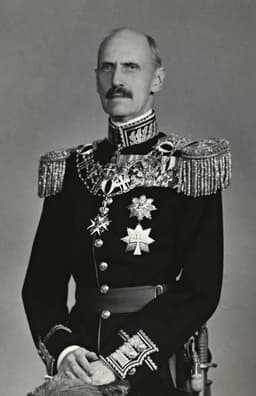
Haakon VII of Norway
Emperor · Modern
56.4Total

Napoleon Bonaparte
General · Modern
70.9Total
Basic Information
Born
1872
1769
Died
1957
1821
Era
Modern
Modern
Nationality
Norway
France
Occupation
Emperor
General
Civilization
Western
Western
Score Comparison
Military (10%)
17.8
94.0
Political (20%)
70.0
72.0
Influence (20%)
58.3
40.0
Legacy (20%)
52.0
80.0
Leadership (15%)
72.0
78.0
Strategy (15%)
57.5
90.0
TOTAL
56.4
70.9
Haakon VII of Norway — Complete Timeline
1905 AD
Election as King of NorwayPolitical Action
Following the dissolution of the union with Sweden, the Norwegian parliament elected Prince Carl of Denmark as King Haakon VII. He accepted the throne after a referendum confirmed the monarchy. This established the modern, independent Kingdom of Norway with a constitutional monarch.
NorwayIndependenceMonarchyReferendum
Impact: nationalconstructive
1940 AD
Refusal to appoint Quisling as Prime MinisterPolitical Action
After the German invasion of Norway, Nazi Germany demanded that Haakon VII appoint Vidkun Quisling as prime minister. Haakon VII refused, stating he would abdicate rather than accept a government led by Quisling. This act of defiance made him a symbol of Norwegian resistance.
NorwayWorld War IIResistanceQuisling
Impact: nationalconstructive
Leadership of the Norwegian government-in-exilePolitical Action◆ Major
Haakon VII fled Norway after the German invasion and established a government-in-exile in London. He became a central figure in the Allied war effort, broadcasting radio messages to occupied Norway and maintaining the legitimacy of the Norwegian state throughout World War II.
NorwayWorld War IIExileGovernment
Impact: globalconstructive
1945 AD
Return to Norway after World War IIPolitical Action◆ Major
Haakon VII returned to Norway on June 7, 1945, exactly five years after he had fled. His return was a moment of national celebration and unity. He was greeted by massive crowds, symbolizing the restoration of Norwegian sovereignty and the end of the Nazi occupation.
NorwayWorld War IILiberationMonarchy
Impact: nationalconstructive
Napoleon Bonaparte — Complete Timeline
1799 AD
Coup of 18 BrumaireOther◆ Major
Napoleon Bonaparte, with support from his brother Lucien and key political figures, overthrew the Directory in a bloodless coup. He established the Consulate with himself as First Consul, effectively becoming the ruler of France. This event ended the French Revolution's most unstable period.
French RevolutionCoupRise to Power
Impact: regional
1804 AD
Promulgation of the Napoleonic CodeOther◆ Major
Napoleon enacted the Civil Code of the French, known as the Napoleonic Code, a comprehensive set of laws that replaced the fragmented feudal legal systems. The code established legal equality, protected property rights, and secularized law. It became the basis for legal systems in many European and world countries.
Legal ReformNapoleonic CodeCivil Law
Impact: globalconstructive
1805 AD
Battle of AusterlitzWar◆ Major
Napoleon's Grande Arm
Napoleonic WarsBattleDecisive Victory
Impact: global
1812 AD
Invasion of RussiaWar◆ Major
Napoleon led the Grande Arm
Napoleonic WarsInvasionDisaster
Impact: globaldestructive
1815 AD
Battle of WaterlooWar◆ Major
Napoleon's French army was defeated by the combined forces of the Duke of Wellington's Anglo-Allied army and Gebhard Leberecht von Bl
Napoleonic WarsBattleFinal Defeat
Impact: globaldestructive
Expert Analysis
haakon-vii-of-norway-vs-napoleon-bonaparte
# The Conqueror and the King
On a June morning in 1815, Napoleon Bonaparte watched his Imperial Guard march toward the ridge at Waterloo, their bearskin caps silhouetted against the Belgian sky. One hundred and thirty years later, in the spring of 1945, an aging king in a worn uniform stepped off a British warship onto the docks of Oslo, his people weeping with joy. Both men had faced the same enemy—the overwhelming military might of a German-speaking power. One chose to fight to the last cannon shot; the other chose to surrender his sword and save his nation’s soul. The difference between Napoleon and Haakon VII is not merely one of scale, but of the very definition of greatness.
Origins
Napoleon Bonaparte was born in 1769 on the island of Corsica, a place that had only recently become French. His family was minor nobility, poor and resentful of the mainland. He spoke Italian before he learned French, and carried throughout his life the chip of a provincial outsider. The French Revolution, which erupted when he was twenty, shattered the old order and created a ladder for ambitious young men of talent. Napoleon climbed it with ferocious speed, his mind a machine of calculation and his ambition a furnace that never cooled.
Haakon VII was born Prince Carl of Denmark in 1872, a second son of the Danish royal family. His upbringing was one of quiet duty in a Europe where monarchs were becoming ornaments. He served as a naval officer, learning discipline and patience rather than conquest. When Norway dissolved its union with Sweden in 1905, the newly independent nation needed a king. The Norwegian parliament, in a remarkable act of democratic choice, offered the throne to this Danish prince. He accepted on one condition: that a referendum confirm the people’s will. He understood from the start that his crown rested on consent, not conquest.
Rise to Power
Napoleon’s rise was a whirlwind. At twenty-four, he cleared the streets of Paris of royalist rioters with a “whiff of grapeshot.” At twenty-seven, he commanded the Army of Italy and turned a ragged force into a conquering legion. By thirty, he had seized power as First Consul. By thirty-five, he crowned himself Emperor in Notre Dame, taking the crown from the Pope’s hands and placing it on his own head. His path was paved with battles—Arcole, Rivoli, the Pyramids, Marengo, Austerlitz—each victory a stepping stone to greater power.
Haakon’s rise was an election. In 1905, the Norwegian parliament, the Storting, offered him the throne. He sailed to Norway as a foreign prince and arrived as a constitutional monarch, bound by law and limited by parliament. His power was not taken but given. Where Napoleon seized his crown, Haakon accepted his. This single difference would define everything that followed.
Leadership & Governance
Napoleon ruled as a military genius and a reformer. His Napoleonic Code swept away feudal privileges and established legal equality, secular administration, and merit-based advancement. He built roads, standardized education, and centralized the French state. But his governance was a dictatorship wrapped in republican language. He appointed his brothers as kings, silenced opposition, and treated Europe as a chessboard for his ambition. His military score of 94 reflects his brilliance on the battlefield—he won sixty of seventy battles—but his political score of 75 shows the limits of his wisdom. He could conquer but could not consolidate.
Haakon ruled as a symbol. He had no army, no treasury, no real power. His political score of 72 is modest by Napoleon’s standards, but it misses the point. Haakon’s leadership was moral. During the German invasion of Norway in 1940, the Nazis demanded that he appoint Vidkun Quisling as prime minister. Haakon refused, telling his government that he would abdicate rather than betray the constitution. His military score of 45 is irrelevant; he never fired a shot. But his leadership score of 79 reflects something Napoleon never understood: that a king’s greatest weapon can be his willingness to lose his throne.
Triumph & Tragedy
Napoleon’s greatest triumph was Austerlitz in 1805, where he destroyed a combined Russian and Austrian army and redrew the map of Europe. His greatest tragedy was the invasion of Russia in 1812, a catastrophe of hubris that cost half a million lives and destroyed his Grand Army. He ended his days on Saint Helena, dictating his memoirs and blaming everyone but himself.
Haakon’s greatest triumph was his refusal to capitulate. In 1940, as German bombers pounded Norwegian towns, he stood firm. He led a government-in-exile from London, broadcasting radio speeches that gave his people hope. His greatest tragedy was the occupation itself—five years of suffering for Norway. But when he returned on June 7, 1945, exactly five years after he fled, the tragedy became a triumph. He had preserved not a territory but a principle.
Character & Destiny
Napoleon was a man of restless energy, consuming ambition, and a belief that he was the agent of history. “I am not a man,” he once said. “I am a thing.” He saw himself as an instrument of destiny, and destiny treated him as such—raising him to dizzying heights before casting him down. His personality drove him to overreach, to trust his star beyond all reason, to believe that he could conquer even the Russian winter.
Haakon was a man of quiet stubbornness. He was not charismatic in the Napoleonic sense; he was dignified. He understood that a constitutional monarch’s power lies in limitation, not expansion. His personality was shaped by the sea—patient, steady, enduring. He did not seek glory; he sought duty. Where Napoleon’s destiny was written in blood, Haakon’s was written in ink, on a constitution that outlasted both the Nazis and the emperor.
Legacy
Napoleon left a divided legacy. His Civil Code remains the foundation of European law, and his military innovations are still studied. But his wars killed millions and left France exhausted. His total score of 82.4 reflects a man of immense talent and immense failure.
Haakon left a unified legacy. He is remembered as the king who stood against tyranny, who proved that democracy could be defended by a single man’s refusal. His legacy score of 69.6 is lower than Napoleon’s, but it is cleaner. He did not conquer; he inspired.
Conclusion
Napoleon and Haakon both faced the German war machine. Napoleon met it at Waterloo, fought, and lost everything. Haakon met it in his palace, refused, and saved everything that mattered. The difference is not in their scores—Napoleon’s 94 in military genius against Haakon’s 45—but in their definition of victory. Napoleon believed victory meant conquest. Haakon believed victory meant survival. One built an empire that crumbled. The other built a legacy that endured. In the end, the king who surrendered his power kept it, and the emperor who seized it lost it. That is the deepest lesson history offers: sometimes the greatest strength is the willingness to be weak.
Rankings
🥇
Napoleon BonaparteLeader
Mil: 94.0Pol: 72.0Inf: 40.0
70.9
🥈
Haakon VII of Norway
Mil: 17.8Pol: 70.0Inf: 58.3
56.4
+14.5 behind
How This Comparison Works
Algorithm
Each figure is scored on 6 dimensions (0—100 scale) based on structured historical data: Military (10%), Political (20%), Influence (20%), Legacy (20%), Leadership (15%), Strategy (15%). The weighted total produces the final ranking.
Data Sources
Scores are computed from structured sub-indicators in the database. Scale factors adjust for era (Ancient ×0.85, Modern ×1.0) and civilization size (Eastern ×1.05, Other ×0.80) to account for differences in population and military scale.
Maximum 3 Figures
Comparisons are limited to 2—3 figures to ensure readability and statistical meaningfulness.
Error Margins
±5 points per dimension — Sub-scores are derived from historical records with inherent uncertainty. Two figures within 5 points on a dimension should be considered roughly equivalent in that area.
Total Score Accuracy
±3 points overall — The weighted combination of 6 dimensions produces a total score with approximately ±3 points of uncertainty. Differences of less than 3 points are not statistically significant— the figures are effectively tied.
Known Limitations
- Historical records are incomplete and uneven across civilizations
- Figures from oral-tradition societies may be underrepresented
- Occupation labels can misclassify multi-role figures
- Scores measure capability and impact, not moral character
- Quantitative scoring is a comparison tool, not absolute truth
Capability Radar
Military (10%) — Battles & Warfare
Battles
38
95
Win Rate
39
90
Expansion
40
95
Political (20%) — Governance & Reform
Reform
65
95
Diplomacy
75
80
Economy
60
85
Influence (20%) — Cultural & Global Reach
Cultural
65
85
Global
55
90
Legacy (20%) — Historical Impact
Historical
70
95
Longevity
60
90
Leadership (15%) — Power & Stability
Tenure
70
85
Stability
80
70
Strategy (15%) — Tactics & Innovation
Strategy
45
95
Tactics
51
98
Reform
49
92
Similar Comparisons
Comments & Discussion
斯巴达的步兵6/17/2026
拿破仑在1815年让85000名法军士兵为他的个人野心倒在滑铁卢,而哈康七世在1940年只下达了一个命令:"抵抗。"这本质上不是军事家与君主的对比,而是暴君与真正领袖的对照。拿破仑的每一次战役都让法兰西失去一代青年;哈康的选择却让挪威在战后保留了完整的一代人。真正的伟大不是征服了多少领土,而是保护了多少生命。
The Iron Archivist6/17/2026
Data doesn't care about romantic narratives. Napoleon's campaigns cost France 900,000 to 1.2 million military deaths, plus countless civilian casualties, all for temporary territorial gains that were reversed within a decade. Haakon VII's Norway suffered 10,262 total war deaths while maintaining a government-in-exile and a resistance movement that never capitulated. That's a 100:1 ratio in casualties alone. Napoleon calls himself "Emperor" but his legacy is a graveyard; Haakon calls himself "Kin
折扇下的理性6/17/2026
拿历史事实说话:拿破仑虽然在军事史上有很多教材可写,但他的侵略战争激发了德意志民族主义觉醒—这直接导致了普鲁士的崛起和1870年法国的惨败。他的帝国只活了16年。而哈康七世领导了完整的挪威流亡政府,与自由世界合作,不仅让本国重返独立,还成为北约创始成员国。拿破仑充其量是个昙花一现的战术家;哈康才是真正治国安邦的战略家。
Historian7966/17/2026
Waterloo was a gamble, Oslo was a guarantee. Napoleon staked everything on one battle and lost everything. Haakon VII staked nothing because he understood that a king's power isn't in his army but in his people's will to resist. The Norwegian monarchy returned precisely because he chose exile over futile bloodshed. Napoleon's "greatness" is just a euphemism for catastrophic ambition. Numbers don't lie: Napoleon left France smaller and weaker than he found it; Haakon left Norway stronger and unit