Loading...
This comparison has not been analyzed yet.
One-time AI generation (~1 minute). Scores and timeline are already available below.
Haile Selassie Gugsa vs Liu Mingchuan
Liu Mingchuan leads by 18.3 pts · 2 figures compared
…
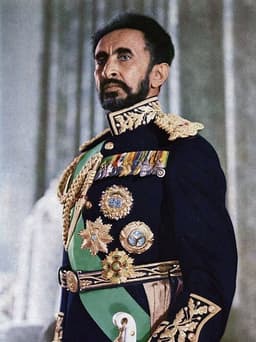
Haile Selassie Gugsa
General · Modern
36.2Total

Liu Mingchuan
General · Modern
54.5Total
Basic Information
Born
1880
1836
Died
1947
1896
Era
Modern
Modern
Nationality
Ethiopia
China
Occupation
General
General
Civilization
Other
Eastern
Score Comparison
Military (10%)
10.2
20.0
Political (20%)
26.4
59.3
Influence (20%)
50.2
57.2
Legacy (20%)
37.5
50.0
Leadership (15%)
35.4
68.0
Strategy (15%)
39.6
66.3
TOTAL
36.2
54.5
Haile Selassie Gugsa — Complete Timeline
1936 AD
Defected to Italian Forces during Second Italo-Ethiopian WarWar◆ Major
Haile Selassie Gugsa, a son-in-law of Emperor Haile Selassie, defected to the Italian invaders. He provided intelligence and support, which contributed to the Italian victory at the Battle of Maychew.
DefectionSecond Italo-Ethiopian WarBetrayal
Impact: regionaldestructive
Appointed Governor of Tigray by ItaliansPolitical Action◆ Major
After his defection, the Italian colonial administration appointed Gugsa as Governor of Tigray. He administered the region under Italian rule until the end of the occupation.
Italian OccupationGovernorCollaboration
Impact: regionaldestructive
Liu Mingchuan — Complete Timeline
1884 AD
Resistance to French InvasionWar◆ Major
Liu Mingchuan organized the defense of northern Taiwan against French forces during the Sino-French War. He successfully defended Keelung and prevented the French from capturing Taipei, preserving Qing control over the island.
DefenseSino-French WarKeelung
Impact: regional
1885 AD
Appointment as First Governor of TaiwanPolitical Action◆ Major
Liu Mingchuan was appointed the first Governor of Taiwan after the island was elevated to a province of the Qing Empire. This appointment gave him authority to implement major reforms and modernization projects.
GovernorshipTaiwan ProvinceQing Reform
Impact: regionalconstructive
1886 AD
Establishment of the Taiwan ArsenalReform
Liu Mingchuan established a modern arsenal in Taipei to produce weapons and ammunition for Taiwan's defense. The arsenal reduced dependence on imports and strengthened the island's military capability.
ArsenalMilitary ReformDefense
Impact: regionalconstructive
1887 AD
Modernization of Taiwan's InfrastructureReform◆ Major
Liu Mingchuan initiated the construction of Taiwan's first railway, telegraph lines, and modern ports. These projects improved transportation and communication on the island, facilitating economic development and administrative control.
InfrastructureRailwayTelegraph
Impact: regionalconstructive
This comparison has not been analyzed yet.
One-time AI generation (~1 minute). Scores and timeline are already available below.
Rankings
🥇
Liu MingchuanLeader
Mil: 20.0Pol: 59.3Inf: 57.2
54.5
🥈
Haile Selassie Gugsa
Mil: 10.2Pol: 26.4Inf: 50.2
36.2
+18.3 behind
How This Comparison Works
Algorithm
Each figure is scored on 6 dimensions (0—100 scale) based on structured historical data: Military (10%), Political (20%), Influence (20%), Legacy (20%), Leadership (15%), Strategy (15%). The weighted total produces the final ranking.
Data Sources
Scores are computed from structured sub-indicators in the database. Scale factors adjust for era (Ancient ×0.85, Modern ×1.0) and civilization size (Eastern ×1.05, Other ×0.80) to account for differences in population and military scale.
Maximum 3 Figures
Comparisons are limited to 2—3 figures to ensure readability and statistical meaningfulness.
Error Margins
±5 points per dimension — Sub-scores are derived from historical records with inherent uncertainty. Two figures within 5 points on a dimension should be considered roughly equivalent in that area.
Total Score Accuracy
±3 points overall — The weighted combination of 6 dimensions produces a total score with approximately ±3 points of uncertainty. Differences of less than 3 points are not statistically significant— the figures are effectively tied.
Known Limitations
- Historical records are incomplete and uneven across civilizations
- Figures from oral-tradition societies may be underrepresented
- Occupation labels can misclassify multi-role figures
- Scores measure capability and impact, not moral character
- Quantitative scoring is a comparison tool, not absolute truth
Capability Radar
Military (10%) — Battles & Warfare
Battles
5
45
Win Rate
5
40
Expansion
5
30
Political (20%) — Governance & Reform
Reform
5
75
Diplomacy
10
55
Economy
5
65
Influence (20%) — Cultural & Global Reach
Cultural
5
40
Global
5
35
Legacy (20%) — Historical Impact
Historical
10
50
Longevity
5
45
Leadership (15%) — Power & Stability
Tenure
10
60
Stability
5
60
Strategy (15%) — Tactics & Innovation
Strategy
10
55
Tactics
10
50
Reform
5
70
Similar Comparisons
Comments & Discussion
No comments yet. Be the first to share your thoughts!