Loading...
Harald Bluetooth vs Julius Caesar
Julius Caesar leads by 23.5 pts · 2 figures compared
…
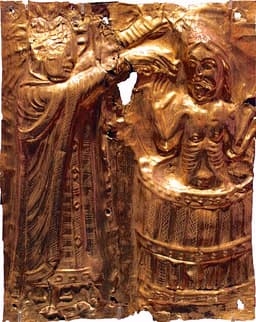
Harald Bluetooth
Emperor · Medieval
59.3Total

Julius Caesar
General · Ancient
82.8Total
Basic Information
Born
911
-100
Died
985
-44
Era
Medieval
Ancient
Nationality
Denmark
Roman Republic
Occupation
Emperor
General
Civilization
Western
Western
Score Comparison
Military (10%)
40.0
88.0
Political (20%)
72.0
78.0
Influence (20%)
62.0
85.0
Legacy (20%)
56.0
82.0
Leadership (15%)
70.0
80.0
Strategy (15%)
45.0
85.0
TOTAL
59.3
82.8
Harald Bluetooth — Complete Timeline
958 AD
Unified DenmarkPolitical Action◆ Major
Harald Bluetooth unified the Danish tribes into a single kingdom, consolidating power over Jutland, Zealand, and surrounding islands. This unification laid the foundation for the medieval Danish state and established the Gorm dynasty's rule.
UnificationDenmarkMedieval Kingdom
Impact: regionalconstructive
965 AD
Introduced Christianity to DenmarkCultural◆ Major
Harald Bluetooth converted to Christianity and mandated the conversion of Denmark. He erected the larger Jelling rune stone, which proclaims that he 'made the Danes Christian'. This event marked Denmark's entry into Christian Europe and aligned it with Latin Christendom.
ChristianizationReligionJelling Stones
Impact: regionalconstructive
Built the Jelling monumentsCultural◆ Major
Harald Bluetooth commissioned the Jelling rune stones and burial mounds in memory of his parents. The larger stone, often called 'Denmark's birth certificate', features a depiction of Christ and a runic inscription celebrating his unification of Denmark and Norway.
Jelling StonesMonumentsCultural Heritage
Impact: regionalconstructive
970 AD
Conquered NorwayWar◆ Major
Harald Bluetooth conquered Norway after defeating Earl Hakon Sigurdsson, bringing Norway under Danish rule. This expansion created a short-lived North Sea empire and demonstrated Danish military power in Scandinavia.
ConquestNorwayDanish Empire
Impact: regional
985 AD
Rebelled against by his son Sweyn ForkbeardPolitical Action◆ Major
Harald Bluetooth faced a rebellion led by his son Sweyn Forkbeard, who opposed his father's rule and Christianization policies. The rebellion forced Harald into exile, where he died shortly after, ending his reign and leading to Sweyn's ascension.
RebellionDynastic ConflictExile
Impact: regionaldestructive
Julius Caesar — Complete Timeline
58 BC
Gallic WarsWar◆ Major
Caesar, as proconsul of Gaul, launched a series of campaigns that conquered all of Gaul (modern France, Belgium, and parts of Switzerland). He fought numerous battles, including against the Helvetii, the Belgae, and the Gallic chieftain Vercingetorix. The wars brought immense wealth and a loyal army to Caesar.
Gallic WarsConquestRoman Expansion
Impact: regional
49 BC
Crossing the RubiconPolitical Action◆ Major
Caesar led Legio XIII across the Rubicon River into Italy, defying the Roman Senate's order to disband his army. This act triggered a civil war against Pompey and the Optimates, ultimately leading to Caesar's dictatorship and the end of the Roman Republic.
Roman Civil WarEnd of RepublicPower Struggle
Impact: global
48 BC
Battle of PharsalusWar◆ Major
Caesar's outnumbered army defeated the larger forces of Pompey the Great at Pharsalus in Greece. Caesar's tactical use of a reserve line to counter Pompey's cavalry charge proved decisive. Pompey fled to Egypt, where he was assassinated, leaving Caesar as the undisputed master of the Roman world.
Roman Civil WarBattleDecisive Victory
Impact: regional
44 BC
Appointment as Dictator for LifePolitical Action◆ Major
The Roman Senate appointed Caesar dictator perpetuo (dictator for life), granting him unprecedented personal power. This move concentrated military, legislative, and judicial authority in one person, effectively ending the Roman Republic's traditional system of checks and balances and alarming many senators.
DictatorshipEnd of RepublicPower Consolidation
Impact: regionaldestructive
Assassination on the Ides of MarchPolitical Action◆ Major
A group of Roman senators, led by Marcus Junius Brutus and Gaius Cassius Longinus, stabbed Caesar to death at a meeting of the Senate in the Theatre of Pompey. The assassination was intended to restore the Republic, but instead triggered another civil war that led to the rise of the Roman Empire.
AssassinationRoman PoliticsEnd of Republic
Impact: globaldestructive
Expert Analysis
harald-bluetooth-vs-julius-caesar
# The Conqueror and the Unifier
On a winter day in 49 BCE, a Roman general stood at the banks of a small stream called the Rubicon, knowing that crossing it would mean civil war. On a spring morning in 965 CE, a Danish king raised a stone in Jelling, declaring that he had "made the Danes Christian." These two moments—one of military ambition, one of cultural transformation—capture the essence of two men who shaped the Western world in profoundly different ways. Julius Caesar and Harald Bluetooth both sought power, but the worlds they built and the ways they built them could not have been more different.
Origins
Caesar was born into the patrician Julian clan, one of Rome's oldest families, but his childhood was shadowed by political turmoil. His uncle by marriage, Gaius Marius, had plunged the Republic into civil war, and Caesar's family suffered under the dictatorship of Sulla. Forced into hiding as a young man, Caesar learned early that survival demanded cunning and nerve. Rome itself was a city of marble and blood, where a man's worth was measured in military glory and political influence.
Harald Bluetooth, by contrast, emerged from a world of wood and ice. Born around 911 CE, he was the son of Gorm the Old, the first king of a unified Denmark, and Thyra, a queen so revered that later legends credited her with building the Danevirke fortifications. Denmark in the early tenth century was a patchwork of chieftaincies, where power was won through raids and feasts, not senatorial elections. Where Caesar inherited a name, Harald inherited a kingdom still being forged.
Rise to Power
Caesar's path to prominence was a masterclass in calculated risk. He won military commands in Spain, formed the First Triumvirate with Pompey and Crassus, and then secured Gaul as his province. Over eight years, from 58 to 50 BCE, he conquered hundreds of tribes, crossed the Rhine into Germany, and landed in Britain—all while writing his own propaganda in the *Commentaries*. When the Senate ordered him to disband his army, he chose war. The Rubicon crossing was not a desperate gamble; it was the logical conclusion of a man who had always bet on himself.
Harald's rise was quieter but no less decisive. He inherited the Danish throne around 958 CE, and his first recorded act was to complete the unification his father had begun. Unlike Caesar, who conquered foreign lands to build his reputation, Harald consolidated what he already had. His key event in 958—unifying the Danish tribes—was less a military campaign than a political and diplomatic achievement. He brought Jutland, Zealand, and the surrounding islands under a single rule, not through dramatic battles but through alliances, marriages, and the steady pressure of a growing royal authority.
Leadership & Governance
Here the two men diverge most sharply. Caesar was a military genius—his siege of Alesia in 52 BCE remains a textbook example of double-encirclement warfare—and a political reformer who restructured Rome's debt laws, reformed the calendar, and extended citizenship to Gauls. But his leadership was personal and autocratic. He centralized power in himself, packed the Senate with his supporters, and accepted the title of dictator for life. His governance was brilliant but brittle, because it depended entirely on him.
Harald's leadership was institutional and symbolic. He introduced Christianity to Denmark around 965 CE, but he did so gradually, allowing pagan practices to coexist. The Jelling rune stone, often called "Denmark's birth certificate," proclaims that Harald "won for himself all of Denmark and Norway and made the Danes Christian." The stone itself is a fusion of old and new: runic script on a Christian cross. Where Caesar built with legions, Harald built with monuments—the Jelling mounds, the rune stones, and the churches that replaced pagan temples. His military score of 31.4 reflects that his conquest of Norway in 970 was more about extending his influence than about battlefield brilliance; he defeated Earl Hakon Sigurdsson but then struggled to hold the kingdom.
Triumph & Tragedy
Caesar's triumph was the conquest of Gaul and his victory in the civil war. He stood as master of the Roman world, planning campaigns against Parthia and reforms that might have saved the Republic. His tragedy came on the Ides of March, 44 BCE, when sixty senators stabbed him to death. He had ignored warnings, disbanded his bodyguard, and walked into the Senate chamber alone. His last words, according to legend, were "Et tu, Brute?"—a recognition that even his closest allies had turned against him.
Harald's triumph was the Jelling stone itself, a monument that still stands today as a symbol of Danish identity. His tragedy came near the end of his life. In 985 CE, his own son, Sweyn Forkbeard, rebelled against him. The reasons were complex—Sweyn opposed his father's Christianization policies and his heavy-handed rule—but the result was clear. Harald was forced into exile, and he died soon after, probably in 985 or 986, in what is now Poland. He had unified a kingdom, but he could not keep his own family united.
Character & Destiny
Caesar was driven by an insatiable ambition. He once said, "I would rather be first in a little Iberian village than second in Rome." His personality was magnetic, his energy boundless, and his ruthlessness absolute. He forgave enemies but never forgot a slight. His destiny was to destroy the Republic he claimed to love, because his ambition could not be contained within its laws. The political score of 78.0 understates his skill; he was a master of manipulation, but his methods alienated the very class that could have supported him.
Harald was driven by a different impulse: the desire to build something lasting. His political score of 72.4 and leadership score of 80.2 reflect a man who understood that power must be institutionalized to survive. He did not seek personal glory so much as the glory of Denmark. His destiny was to create a kingdom that outlasted him, even if he died in exile. The rebellion of his son was a personal tragedy, but the kingdom he built endured for centuries.
Legacy
Caesar's legacy is immense but ambiguous. His military campaigns inspired generals from Napoleon to Patton. His name became a title—Kaiser, Tsar. The Julian calendar, with its leap years, was used for sixteen centuries. But his assassination plunged Rome into another civil war, and the Empire that followed was a dictatorship in all but name. He is remembered as a genius and a tyrant, a reformer and a destroyer.
Harald's legacy is quieter but more concrete. The Jelling stone is a UNESCO World Heritage site, and his name lives on in Bluetooth technology, which unites devices as he united tribes. He introduced Christianity to Scandinavia, linking the North to the rest of Europe. His unification of Denmark created a kingdom that exists to this day. He is remembered as a builder, not a conqueror.
Conclusion
Caesar and Harald both stood at the crossroads of history, but they chose different paths. Caesar crossed the Rubicon and changed the world in a flash of blood and ambition. Harald raised a stone and changed it slowly, stone by stone, soul by soul. One sought to conquer, the other to unite. One died at the hands of his friends, the other at the hands of his son. Both succeeded, and both failed, but in the end, it is Harald's kingdom that still stands—and Caesar's ghost that still haunts us. Perhaps the lesson is that the greatest power is not the power to destroy, but the power to build something that lasts.
Rankings
🥇
Julius CaesarLeader
Mil: 88.0Pol: 78.0Inf: 85.0
82.8
🥈
Harald Bluetooth
Mil: 40.0Pol: 72.0Inf: 62.0
59.3
+23.5 behind
How This Comparison Works
Algorithm
Each figure is scored on 6 dimensions (0—100 scale) based on structured historical data: Military (10%), Political (20%), Influence (20%), Legacy (20%), Leadership (15%), Strategy (15%). The weighted total produces the final ranking.
Data Sources
Scores are computed from structured sub-indicators in the database. Scale factors adjust for era (Ancient ×0.85, Modern ×1.0) and civilization size (Eastern ×1.05, Other ×0.80) to account for differences in population and military scale.
Maximum 3 Figures
Comparisons are limited to 2—3 figures to ensure readability and statistical meaningfulness.
Error Margins
±5 points per dimension — Sub-scores are derived from historical records with inherent uncertainty. Two figures within 5 points on a dimension should be considered roughly equivalent in that area.
Total Score Accuracy
±3 points overall — The weighted combination of 6 dimensions produces a total score with approximately ±3 points of uncertainty. Differences of less than 3 points are not statistically significant— the figures are effectively tied.
Known Limitations
- Historical records are incomplete and uneven across civilizations
- Figures from oral-tradition societies may be underrepresented
- Occupation labels can misclassify multi-role figures
- Scores measure capability and impact, not moral character
- Quantitative scoring is a comparison tool, not absolute truth
Capability Radar
Military (10%) — Battles & Warfare
Battles
30
95
Win Rate
35
92
Expansion
45
97
Political (20%) — Governance & Reform
Reform
70
90
Diplomacy
65
85
Economy
50
82
Influence (20%) — Cultural & Global Reach
Cultural
60
88
Global
50
94
Legacy (20%) — Historical Impact
Historical
65
95
Longevity
55
96
Leadership (15%) — Power & Stability
Tenure
60
75
Stability
55
60
Strategy (15%) — Tactics & Innovation
Strategy
40
94
Tactics
25
96
Reform
20
88
Similar Comparisons
Comments & Discussion
No comments yet. Be the first to share your thoughts!