Loading...
Harold Godwinson vs Julius Caesar
Julius Caesar leads by 37.0 pts · 2 figures compared
…
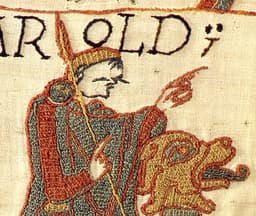
Harold Godwinson
Emperor · Medieval
45.8Total

Julius Caesar
General · Ancient
82.8Total
Basic Information
Born
1022
-100
Died
1066
-44
Era
Medieval
Ancient
Nationality
England
Roman Republic
Occupation
Emperor
General
Civilization
Western
Western
Score Comparison
Military (10%)
47.5
88.0
Political (20%)
35.1
78.0
Influence (20%)
54.1
85.0
Legacy (20%)
49.2
82.0
Leadership (15%)
31.2
80.0
Strategy (15%)
52.5
85.0
TOTAL
45.8
82.8
Harold Godwinson — Complete Timeline
1066 AD
Battle of Stamford BridgeWar◆ Major
Harold defeated an invading Norwegian army under King Harald Hardrada at Stamford Bridge in Yorkshire. The victory was decisive, but Harold's army was weakened and exhausted.
BattleVictoryViking Invasion
Impact: national
Battle of HastingsWar
Harold's army was defeated by William of Normandy at Hastings on October 14. Harold was killed in the battle, traditionally by an arrow in the eye, ending Anglo-Saxon rule in England.
BattleDefeatNorman Conquest
Impact: globaltragic
Coronation of Harold GodwinsonPolitical Action◆ Major
Harold was crowned king of England on January 6, 1066, the day after Edward the Confessor's death. His claim was contested by William of Normandy and Harald Hardrada of Norway.
CoronationSuccessionContested Claim
Impact: national
Julius Caesar — Complete Timeline
58 BC
Gallic WarsWar◆ Major
Caesar, as proconsul of Gaul, launched a series of campaigns that conquered all of Gaul (modern France, Belgium, and parts of Switzerland). He fought numerous battles, including against the Helvetii, the Belgae, and the Gallic chieftain Vercingetorix. The wars brought immense wealth and a loyal army to Caesar.
Gallic WarsConquestRoman Expansion
Impact: regional
49 BC
Crossing the RubiconPolitical Action◆ Major
Caesar led Legio XIII across the Rubicon River into Italy, defying the Roman Senate's order to disband his army. This act triggered a civil war against Pompey and the Optimates, ultimately leading to Caesar's dictatorship and the end of the Roman Republic.
Roman Civil WarEnd of RepublicPower Struggle
Impact: global
48 BC
Battle of PharsalusWar◆ Major
Caesar's outnumbered army defeated the larger forces of Pompey the Great at Pharsalus in Greece. Caesar's tactical use of a reserve line to counter Pompey's cavalry charge proved decisive. Pompey fled to Egypt, where he was assassinated, leaving Caesar as the undisputed master of the Roman world.
Roman Civil WarBattleDecisive Victory
Impact: regional
44 BC
Appointment as Dictator for LifePolitical Action◆ Major
The Roman Senate appointed Caesar dictator perpetuo (dictator for life), granting him unprecedented personal power. This move concentrated military, legislative, and judicial authority in one person, effectively ending the Roman Republic's traditional system of checks and balances and alarming many senators.
DictatorshipEnd of RepublicPower Consolidation
Impact: regionaldestructive
Assassination on the Ides of MarchPolitical Action◆ Major
A group of Roman senators, led by Marcus Junius Brutus and Gaius Cassius Longinus, stabbed Caesar to death at a meeting of the Senate in the Theatre of Pompey. The assassination was intended to restore the Republic, but instead triggered another civil war that led to the rise of the Roman Empire.
AssassinationRoman PoliticsEnd of Republic
Impact: globaldestructive
Expert Analysis
harold-godwinson-vs-julius-caesar
# The Edge of the Sword
On a winter morning in January 1066, Harold Godwinson stood in Westminster Abbey as the crown of England was placed upon his head. The day before, he had been a powerful earl; now he was king, inheriting a realm shadowed by promises made to a Norman duke across the Channel. Across the centuries and the continent, another man had once stood in a moment of similar precarious triumph: Gaius Julius Caesar, crossing the Rubicon in 49 BCE, knowing that the step he took would either make him master of Rome or destroy him. Both men lived by the sword, but only one understood that the sword alone could never hold a throne.
Origins
Caesar was born into the chaos of the late Roman Republic, a world of senatorial intrigue, civil wars, and a political system buckling under the weight of empire. His family, the Julii, claimed descent from the goddess Venus, but their fortunes were modest. Caesar grew up watching his uncle Gaius Marius and his rival Sulla tear the Republic apart with armies loyal to commanders, not the state. This was his classroom: a place where ambition was the only law, and survival demanded both brilliance and ruthlessness.
Harold Godwinson came from a very different world. England in the 11th century was a kingdom built on oaths, bloodlines, and the shifting loyalties of earls. His father, Godwin, had been the most powerful man in England under King Edward the Confessor. Harold inherited not just his father’s lands but his web of alliances, his enemies, and a crown that was never truly secure. Unlike Caesar, who rose from relative obscurity, Harold was born into the center of power, but that power was brittle, resting on personal loyalty rather than institutional strength.
Rise to Power
Caesar’s path was long and calculated. He climbed the Roman political ladder—quaestor, aedile, praetor—borrowing fortunes to fund games and bribes, forging the First Triumvirate with Pompey and Crassus, and then securing a command in Gaul. Between 58 and 50 BCE, he conquered a territory larger than Italy itself, writing his own legend in *The Gallic Wars*. His men adored him because he shared their hardships and their spoils. When the Senate ordered him to disband his army, he refused. The Rubicon was not a gamble; it was the logical end of a career built on breaking every rule.
Harold’s rise was swifter and more constrained. He had been the effective ruler of England for years under the ailing Edward the Confessor, leading campaigns in Wales and negotiating with rivals. But his coronation on January 6, 1066, was immediately contested. William of Normandy claimed that Edward had promised him the throne, and that Harold himself had sworn an oath to support William. Whether that oath was coerced or voluntary, Harold’s kingship rested on a foundation of disputed legitimacy. He had no time to build a new order; he had to defend what he had seized.
Leadership & Governance
Caesar governed as he fought: with audacity and a vision that transcended the old order. As dictator, he reformed the calendar, granted citizenship to provincials, launched public works, and centralized power in his own hands. He understood that the Republic was dead and that only a monarch could hold the empire together. His military genius lay in speed and deception—the siege of Alesia, the lightning campaign in Egypt—but his political wisdom was even more profound. He pardoned his enemies, elevated his supporters, and built a cult of personality that would outlive him.
Harold, by contrast, governed as a traditional Anglo-Saxon king. He relied on the *fyrd*—a militia of free men—and the loyalty of his housecarls, his personal bodyguard. His military strategy was competent but conventional. At Stamford Bridge on September 25, 1066, he caught Harald Hardrada’s Viking army by surprise and annihilated it, a stunning victory that demonstrated his tactical skill. But that victory came at a terrible cost: his army was exhausted, and he had to march 240 miles south in two weeks to meet William’s invasion. Harold chose to fight at Hastings immediately, refusing to wait for reinforcements. It was a decision born of urgency, but also of a king who had no strategic reserve, no fallback plan, no empire to draw upon.
Triumph & Tragedy
Caesar’s greatest moment was his triumph over Gaul and his victory over Pompey at Pharsalus in 48 BCE. He had conquered the known world and remade Rome in his image. But his tragedy was the Ides of March, 44 BCE, when his own senators, men he had pardoned and promoted, stabbed him to death. He had centralized power but failed to secure its succession. His murder plunged Rome into another generation of civil war.
Harold’s triumph was Stamford Bridge, a victory so complete that the Norwegian invasion was shattered. But his tragedy came three weeks later on October 14, 1066, at Hastings. The battle was close—William’s cavalry repeatedly broke against the shield wall—but Harold fell, according to legend, with an arrow in his eye. With him died the Anglo-Saxon England of Alfred the Great, of Beowulf, of a thousand years of tradition.
Character & Destiny
Caesar was a gambler who calculated the odds. He understood that in a world without rules, the only sin was failure. His personality was magnetic, his ambition boundless, but he also possessed a cold pragmatism. He forgave his enemies not out of mercy but because he knew that dead men cannot be useful.
Harold was a man of his time: brave, loyal to his kin, bound by oaths he could not break. He did not have Caesar’s vision because he did not need one. He was defending a kingdom, not building an empire. His destiny was to be the hinge of history, the last king of a dying world, crushed between the hammer of Norman feudalism and the anvil of Viking aggression.
Legacy
Caesar’s legacy is the Roman Empire itself. His name became a title—Kaiser, Tsar—and his reforms shaped Western law, language, and governance for two millennia. He was a tyrant, but a founding one.
Harold’s legacy is more tragic. He is remembered as the loser, the king who fell. The Bayeux Tapestry tells his story in thread, but it was woven by the victors. English history after 1066 was Norman history, and Harold Godwinson became a footnote, a symbol of a lost world.
Conclusion
Standing at Stamford Bridge in the autumn of 1066, Harold Godwinson watched his enemies drown in the river. He had won. Standing on the Capitoline Hill in 44 BCE, Julius Caesar looked out over a city he had conquered without a war. Both men believed they had mastered fate. But the sword is a fickle instrument, and history, like a river, flows in directions no one can predict. Caesar’s body fell bleeding on the Senate floor; Harold’s fell in the mud of a Sussex hillside. The difference is not in their courage, but in the worlds they built around themselves. Caesar created an empire that could survive his death. Harold inherited a kingdom that could not survive his.
Rankings
🥇
Julius CaesarLeader
Mil: 88.0Pol: 78.0Inf: 85.0
82.8
🥈
Harold Godwinson
Mil: 47.5Pol: 35.1Inf: 54.1
45.8
+37.0 behind
How This Comparison Works
Algorithm
Each figure is scored on 6 dimensions (0—100 scale) based on structured historical data: Military (10%), Political (20%), Influence (20%), Legacy (20%), Leadership (15%), Strategy (15%). The weighted total produces the final ranking.
Data Sources
Scores are computed from structured sub-indicators in the database. Scale factors adjust for era (Ancient ×0.85, Modern ×1.0) and civilization size (Eastern ×1.05, Other ×0.80) to account for differences in population and military scale.
Maximum 3 Figures
Comparisons are limited to 2—3 figures to ensure readability and statistical meaningfulness.
Error Margins
±5 points per dimension — Sub-scores are derived from historical records with inherent uncertainty. Two figures within 5 points on a dimension should be considered roughly equivalent in that area.
Total Score Accuracy
±3 points overall — The weighted combination of 6 dimensions produces a total score with approximately ±3 points of uncertainty. Differences of less than 3 points are not statistically significant— the figures are effectively tied.
Known Limitations
- Historical records are incomplete and uneven across civilizations
- Figures from oral-tradition societies may be underrepresented
- Occupation labels can misclassify multi-role figures
- Scores measure capability and impact, not moral character
- Quantitative scoring is a comparison tool, not absolute truth
Capability Radar
Military (10%) — Battles & Warfare
Battles
60
95
Win Rate
55
92
Expansion
40
97
Political (20%) — Governance & Reform
Reform
20
90
Diplomacy
40
85
Economy
30
82
Influence (20%) — Cultural & Global Reach
Cultural
35
88
Global
30
94
Legacy (20%) — Historical Impact
Historical
55
95
Longevity
40
96
Leadership (15%) — Power & Stability
Tenure
15
75
Stability
20
60
Strategy (15%) — Tactics & Innovation
Strategy
60
94
Tactics
65
96
Reform
30
88
Similar Comparisons
Comments & Discussion
RubiconRider6/17/2026
Caesar crossing the Rubicon was a calculated gamble by a military genius who wrote his own rulebook. Harold? He was a competent earl who got lucky with the crown and unlucky with the weather. Caesar beat Gaul with strategy; Harold beat Harald Hardrada with a forced march. But facing William’s feigned retreats exposed Harold’s tactical shallowness. Caesar would’ve spotted that trap from a mile away and turned it into a pincer movement.
铁血史官6/17/2026
拿恺撒和哈罗德比?一个玩的是帝国级战略游戏,一个混的是岛国级巷战副本。恺撒在高卢杀了上百万人还写书炫耀,哈罗德连自己弟弟都摆不平。1066年黑斯廷斯那场仗,哈罗德要是生在共和国时期,最多当个百夫长——还是那种会累死在山地步兵里的。
LongbowLuddite6/17/2026
You’ve got to be kidding me. Harold wasn’t some peasant king; he ran Wessex like a modern CEO. Caesar had legions of professionals, sure, but Harold held together a war-band of housecarles that could chew up Viking berserkers. The real difference? Caesar invented propaganda (hello, Gallic Wars fan-fiction), while Harold just let the Bayeux Tapestry tell his story—badly. Give me a shield-wall over a Senatorial backstab any day.
罗马迷途6/17/2026
你们都在说打仗,但问题是两个人玩的根本不是同一套游戏。恺撒是政治动物,靠债务和联姻爬上权力顶峰;哈罗德是军事管家,靠给爱德华国王擦屁股站稳脚跟。前者能用一纸书信让元老院发抖,后者连自家兄弟托斯蒂格都控制不住——最后战场上兄弟相残,恺撒看了都摇头。高维政治打击和低维部落内斗,不是一个物种。
NumismaticNinja6/17/2026
Let’s talk about coins, people. Caesar’s denarii plastered his face everywhere—he minted his own legend. Harold’s only known coinage? The “PAX” penny with a hand of God. No portrait, no ego, just a promise of peace. That tells you everything: Caesar built a personal brand; Harold inherited a job. One created a cult of personality that outlasted his empire; the other vanished into the fog of 1066. Gold speaks louder than cloaks, people.
叙事破坏者6/17/2026
总结一下:恺撒把历史当剧本写,哈罗德把人生当悲剧演。文献里恺撒是“独裁者”,哈罗德是“篡位者”——但问题来了,这些标签谁贴的?恺撒的死对头西塞罗骂他暴君,诺曼人修史把哈罗德写成背誓小人。实际上两人都是