Loading...
This comparison has not been analyzed yet.
One-time AI generation (~1 minute). Scores and timeline are already available below.
Harold Macmillan vs Tuilaepa Sailele
Harold Macmillan leads by 5.8 pts · 2 figures compared
…
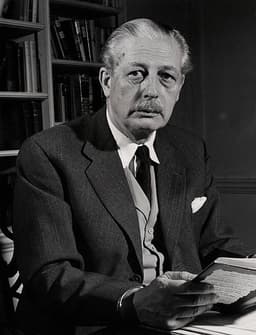
Harold Macmillan
Politician · Modern
58.4Total

Tuilaepa Sailele
Politician · Modern
52.6Total
Basic Information
Born
1894
1945
Died
1986
—
Era
Modern
Modern
Nationality
United Kingdom
Samoa
Occupation
Politician
Politician
Civilization
Western
Other
Score Comparison
Military (10%)
50.0
33.1
Political (20%)
72.0
45.0
Influence (20%)
60.0
55.7
Legacy (20%)
50.0
49.2
Leadership (15%)
72.0
80.0
Strategy (15%)
43.1
42.8
TOTAL
58.4
52.6
Harold Macmillan — Complete Timeline
1957 AD
Elected Prime MinisterPolitical Action
Macmillan succeeded Anthony Eden as Prime Minister after the Suez Crisis. He led the Conservative Party to a landslide victory in the 1959 general election, consolidating his power.
Prime MinisterConservative Party
Impact: national
Delivered 'You've Never Had It So Good' SpeechCultural◆ Major
Macmillan gave a speech in Bedford stating that Britons had 'never had it so good,' referring to post-war prosperity. The phrase became emblematic of his premiership and the era of rising living standards.
SpeechEconomic Prosperity
Impact: nationalconstructive
Signed the Treaty of RomePolitical Action◆ Major
Macmillan's government signed the Treaty of Rome, establishing the European Economic Community (EEC). However, the UK did not join at this time, as Macmillan prioritized the European Free Trade Association (EFTA).
European IntegrationEEC
Impact: global
1960 AD
Wind of Change SpeechCultural◆ Major
Macmillan delivered the 'Wind of Change' speech to the South African Parliament, acknowledging the rise of African nationalism and the inevitability of decolonization. This signaled Britain's shift away from empire.
DecolonizationAfrica
Impact: global
1963 AD
Profumo AffairPolitical Action◆ Major
The Profumo affair, a sex scandal involving War Minister John Profumo, damaged Macmillan's government. Macmillan's handling of the crisis was criticized, contributing to his resignation later that year.
ScandalGovernment
Impact: nationaldestructive
Resigned as Prime MinisterPolitical Action◆ Major
Macmillan resigned as Prime Minister in October 1963, citing ill health. He was succeeded by Alec Douglas-Home. His resignation marked the end of a premiership defined by prosperity and decolonization.
ResignationConservative Party
Impact: national
Tuilaepa Sailele — Complete Timeline
1998 AD
Elected Prime Minister of SamoaPolitical Action◆ Major
Tuilaepa Sailele was elected as Prime Minister of Samoa, beginning his tenure as the longest-serving head of government in the country's history. He succeeded Tofilau Eti Alesana and led the Human Rights Protection Party.
ElectionLeadershipSamoa
Impact: nationalconstructive
2009 AD
Switched Samoa to driving on the left side of the roadReform◆ Major
Tuilaepa's government implemented a change from driving on the right to driving on the left, aligning with neighboring Australia and New Zealand. The switch aimed to reduce import costs for vehicles and improve road safety, though it caused initial disruption.
Transport ReformInfrastructurePolicy Change
Impact: nationalconstructive
2016 AD
Re-elected for fifth consecutive termPolitical Action◆ Major
Tuilaepa won a fifth consecutive term as Prime Minister, extending his record as the longest-serving leader in Samoa. His party, HRPP, secured a majority in the general election, continuing his dominance in Samoan politics.
ElectionRe-electionSamoa
Impact: national
2019 AD
Declared state of emergency during measles outbreakPolitical Action◆ Major
Tuilaepa declared a state of emergency in response to a severe measles epidemic that killed over 80 people, mostly children. The government mandated vaccinations and closed schools, but the outbreak highlighted gaps in healthcare infrastructure.
Public HealthCrisis ManagementMeasles
Impact: nationaltragic
2021 AD
Lost general election after 22 years in powerPolitical Action
Tuilaepa's HRPP lost the general election to the FAST party led by Fiame Naomi Mataafa. The result led to a constitutional crisis and legal battles, but Tuilaepa eventually conceded, ending his 22-year tenure as Prime Minister.
ElectionTransition of PowerSamoa
Impact: national
This comparison has not been analyzed yet.
One-time AI generation (~1 minute). Scores and timeline are already available below.
Rankings
🥇
Harold MacmillanLeader
Mil: 50.0Pol: 72.0Inf: 60.0
58.4
🥈
Tuilaepa Sailele
Mil: 33.1Pol: 45.0Inf: 55.7
52.6
+5.8 behind
How This Comparison Works
Algorithm
Each figure is scored on 6 dimensions (0—100 scale) based on structured historical data: Military (10%), Political (20%), Influence (20%), Legacy (20%), Leadership (15%), Strategy (15%). The weighted total produces the final ranking.
Data Sources
Scores are computed from structured sub-indicators in the database. Scale factors adjust for era (Ancient ×0.85, Modern ×1.0) and civilization size (Eastern ×1.05, Other ×0.80) to account for differences in population and military scale.
Maximum 3 Figures
Comparisons are limited to 2—3 figures to ensure readability and statistical meaningfulness.
Error Margins
±5 points per dimension — Sub-scores are derived from historical records with inherent uncertainty. Two figures within 5 points on a dimension should be considered roughly equivalent in that area.
Total Score Accuracy
±3 points overall — The weighted combination of 6 dimensions produces a total score with approximately ±3 points of uncertainty. Differences of less than 3 points are not statistically significant— the figures are effectively tied.
Known Limitations
- Historical records are incomplete and uneven across civilizations
- Figures from oral-tradition societies may be underrepresented
- Occupation labels can misclassify multi-role figures
- Scores measure capability and impact, not moral character
- Quantitative scoring is a comparison tool, not absolute truth
Capability Radar
Military (10%) — Battles & Warfare
Battles
28
21
Win Rate
31
25
Expansion
36
26
Political (20%) — Governance & Reform
Reform
55
60
Diplomacy
70
65
Economy
65
55
Influence (20%) — Cultural & Global Reach
Cultural
40
40
Global
50
35
Legacy (20%) — Historical Impact
Historical
50
50
Longevity
40
45
Leadership (15%) — Power & Stability
Tenure
60
85
Stability
60
70
Strategy (15%) — Tactics & Innovation
Strategy
40
32
Tactics
40
32
Reform
45
37
Similar Comparisons
Comments & Discussion
No comments yet. Be the first to share your thoughts!